

to be maintained in international collections (cf. Sect. 6.2).
When the temperature increases again, cellular functions
are reactivated.
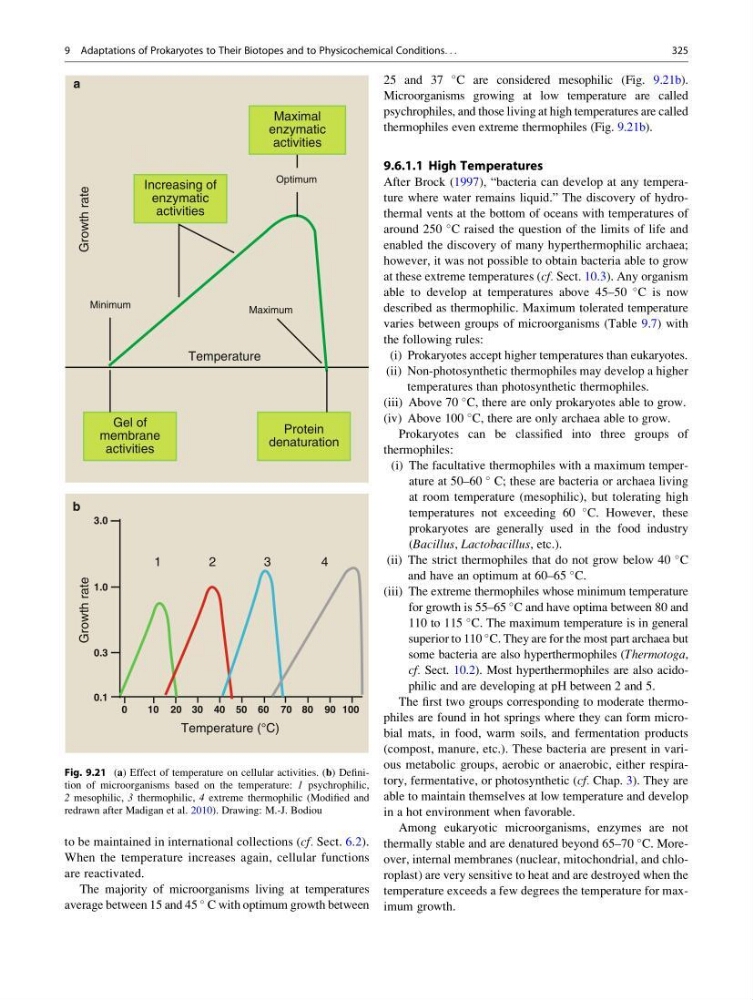
The majority of microorganisms living at temperatures
average between 15 and 45
C with optimum growth between
25 and 37
C are considered mesophilic (Fig. 9.21b).
Microorganisms growing at low temperature are called
psychrophiles, and those living at high temperatures are called
thermophiles even extreme thermophiles (Fig. 9.21b).
9.6.1.1 High Temperatures
After Brock (1997), “bacteria can develop at any temperature where water remains liquid.” The discovery of hydrothermal vents at the bottom of oceans with temperatures of
around 250
C raised the question of the limits of life and
enabled the discovery of many hyperthermophilic archaea;
however, it was not possible to obtain bacteria able to grow
at these extreme temperatures (cf. Sect. 10.3). Any organism
able to develop at temperatures above 45–50
C is now
described as thermophilic. Maximum tolerated temperature
varies between groups of microorganisms (Table 9.7) with
the following rules:
(i) Prokaryotes accept higher temperatures than eukaryotes.
(ii) Non-photosynthetic thermophiles may develop a higher
temperatures than photosynthetic thermophiles.
(iii) Above 70
C, there are only prokaryotes able to grow.
(iv) Above 100
C, there are only archaea able to grow.
Prokaryotes can be classified into three groups of
thermophiles:
(i) The facultative thermophiles with a maximum temperature at 50–60
C; these are bacteria or archaea living
at room temperature (mesophilic), but tolerating high
temperatures not exceeding 60
C. However, these
prokaryotes are generally used in the food industry
(Bacillus, Lactobacillus, etc.).
(ii) The strict thermophiles that do not grow below 40
C
and have an optimum at 60–65
C.
(iii) The extreme thermophiles whose minimum temperature
for growth is 55–65
C and have optima between 80 and
110 to 115
C. The maximum temperature is in general
superior to 110
C. They are for the most part archaea but
some bacteria are also hyperthermophiles (Thermotoga,
cf. Sect. 10.2). Most hyperthermophiles are also acidophilic and are developing at pH between 2 and 5.
The first two groups corresponding to moderate thermophiles are found in hot springs where they can form microbial mats, in food, warm soils, and fermentation products
(compost, manure, etc.). These bacteria are present in various metabolic groups, aerobic or anaerobic, either respiratory, fermentative, or photosynthetic (cf. Chap. 3). They are
able to maintain themselves at low temperature and develop
in a hot environment when favorable.
Among eukaryotic microorganisms, enzymes are not
thermally stable and are denatured beyond 65–70
C. Moreover, internal membranes (nuclear, mitochondrial, and chloroplast) are very sensitive to heat and are destroyed when the
temperature exceeds a few degrees the temperature for maximum growth.
Maximal
enzymatic
activities
Increasing of
enzymatic
activities
Minimum
Optimum
Maximum
Temperature
Growth rate
Gel of
membrane
activities
Protein
denaturation
Growth rate
a
Temperature (°C)
b
0
10 20 30 40 50 60 70 80 90 100
1.0
0.1
3.0
0.3
1
2
3
4
Fig. 9.21 (a) Effect of temperature on cellular activities. (b) Definition of microorganisms based on the temperature: 1 psychrophilic,
2 mesophilic, 3 thermophilic, 4 extreme thermophilic (Modified and
redrawn after Madigan et al. 2010). Drawing: M.-J. Bodiou
9 Adaptations of Prokaryotes to Their Biotopes and to Physicochemical Conditions. . .
325
When the temperature increases again, cellular functions
are reactivated.
The majority of microorganisms living at temperatures
average between 15 and 45
C with optimum growth between
25 and 37
C are considered mesophilic (Fig. 9.21b).
Microorganisms growing at low temperature are called
psychrophiles, and those living at high temperatures are called
thermophiles even extreme thermophiles (Fig. 9.21b).
9.6.1.1 High Temperatures
After Brock (1997), “bacteria can develop at any temperature where water remains liquid.” The discovery of hydrothermal vents at the bottom of oceans with temperatures of
around 250
C raised the question of the limits of life and
enabled the discovery of many hyperthermophilic archaea;
however, it was not possible to obtain bacteria able to grow
at these extreme temperatures (cf. Sect. 10.3). Any organism
able to develop at temperatures above 45–50
C is now
described as thermophilic. Maximum tolerated temperature
varies between groups of microorganisms (Table 9.7) with
the following rules:
(i) Prokaryotes accept higher temperatures than eukaryotes.
(ii) Non-photosynthetic thermophiles may develop a higher
temperatures than photosynthetic thermophiles.
(iii) Above 70
C, there are only prokaryotes able to grow.
(iv) Above 100
C, there are only archaea able to grow.
Prokaryotes can be classified into three groups of
thermophiles:
(i) The facultative thermophiles with a maximum temperature at 50–60
C; these are bacteria or archaea living
at room temperature (mesophilic), but tolerating high
temperatures not exceeding 60
C. However, these
prokaryotes are generally used in the food industry
(Bacillus, Lactobacillus, etc.).
(ii) The strict thermophiles that do not grow below 40
C
and have an optimum at 60–65
C.
(iii) The extreme thermophiles whose minimum temperature
for growth is 55–65
C and have optima between 80 and
110 to 115
C. The maximum temperature is in general
superior to 110
C. They are for the most part archaea but
some bacteria are also hyperthermophiles (Thermotoga,
cf. Sect. 10.2). Most hyperthermophiles are also acidophilic and are developing at pH between 2 and 5.
The first two groups corresponding to moderate thermophiles are found in hot springs where they can form microbial mats, in food, warm soils, and fermentation products
(compost, manure, etc.). These bacteria are present in various metabolic groups, aerobic or anaerobic, either respiratory, fermentative, or photosynthetic (cf. Chap. 3). They are
able to maintain themselves at low temperature and develop
in a hot environment when favorable.
Among eukaryotic microorganisms, enzymes are not
thermally stable and are denatured beyond 65–70
C. Moreover, internal membranes (nuclear, mitochondrial, and chloroplast) are very sensitive to heat and are destroyed when the
temperature exceeds a few degrees the temperature for maximum growth.
Maximal
enzymatic
activities
Increasing of
enzymatic
activities
Minimum
Optimum
Maximum
Temperature
Growth rate
Gel of
membrane
activities
Protein
denaturation
Growth rate
a
Temperature (°C)
b
0
10 20 30 40 50 60 70 80 90 100
1.0
0.1
3.0
0.3
1
2
3
4
Fig. 9.21 (a) Effect of temperature on cellular activities. (b) Definition of microorganisms based on the temperature: 1 psychrophilic,
2 mesophilic, 3 thermophilic, 4 extreme thermophilic (Modified and
redrawn after Madigan et al. 2010). Drawing: M.-J. Bodiou
9 Adaptations of Prokaryotes to Their Biotopes and to Physicochemical Conditions. . .
325