

AT domain
AT ACP
KS
SH
TE
AT
ACP
KS
KR
DH
ER
TE
KS domain
AT ACP
KS
SH
TE
KR domain
DH domain
AT
ACP
KS
KR
DH
ER
TE
ER domain
AT
ACP
KS
KR
DH
ER
TE
TE domain
AT
ACP
KS
KR
DH
ER
TE
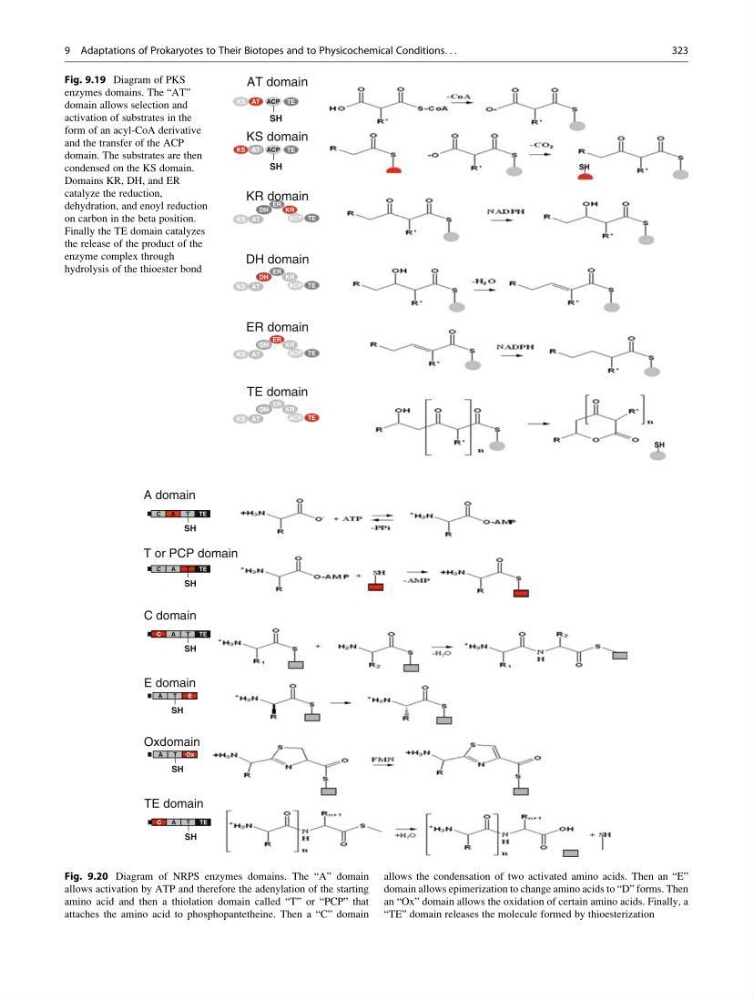
Fig. 9.19 Diagram of PKS
enzymes domains. The “AT”
domain allows selection and
activation of substrates in the
form of an acyl-CoA derivative
and the transfer of the ACP
domain. The substrates are then
condensed on the KS domain.
Domains KR, DH, and ER
catalyze the reduction,
dehydration, and enoyl reduction
on carbon in the beta position.
Finally the TE domain catalyzes
the release of the product of the
enzyme complex through
hydrolysis of the thioester bond
SH
A
C
T
TE
A domain
T or PCP domain
SH
A
C
T
TE
SH
A
C
T
TE
C domain
E domain
SH
A
T
E
Oxdomain
SH
A
T Ox
SH
A
C
T
TE
TE domain
Fig. 9.20 Diagram of NRPS enzymes domains. The “A” domain
allows activation by ATP and therefore the adenylation of the starting
amino acid and then a thiolation domain called “T” or “PCP” that
attaches the amino acid to phosphopantetheine. Then a “C” domain
allows the condensation of two activated amino acids. Then an “E”
domain allows epimerization to change amino acids to “D” forms. Then
an “Ox” domain allows the oxidation of certain amino acids. Finally, a
“TE” domain releases the molecule formed by thioesterization
9 Adaptations of Prokaryotes to Their Biotopes and to Physicochemical Conditions. . .
323
AT ACP
KS
SH
TE
AT
ACP
KS
KR
DH
ER
TE
KS domain
AT ACP
KS
SH
TE
KR domain
DH domain
AT
ACP
KS
KR
DH
ER
TE
ER domain
AT
ACP
KS
KR
DH
ER
TE
TE domain
AT
ACP
KS
KR
DH
ER
TE
Fig. 9.19 Diagram of PKS
enzymes domains. The “AT”
domain allows selection and
activation of substrates in the
form of an acyl-CoA derivative
and the transfer of the ACP
domain. The substrates are then
condensed on the KS domain.
Domains KR, DH, and ER
catalyze the reduction,
dehydration, and enoyl reduction
on carbon in the beta position.
Finally the TE domain catalyzes
the release of the product of the
enzyme complex through
hydrolysis of the thioester bond
SH
A
C
T
TE
A domain
T or PCP domain
SH
A
C
T
TE
SH
A
C
T
TE
C domain
E domain
SH
A
T
E
Oxdomain
SH
A
T Ox
SH
A
C
T
TE
TE domain
Fig. 9.20 Diagram of NRPS enzymes domains. The “A” domain
allows activation by ATP and therefore the adenylation of the starting
amino acid and then a thiolation domain called “T” or “PCP” that
attaches the amino acid to phosphopantetheine. Then a “C” domain
allows the condensation of two activated amino acids. Then an “E”
domain allows epimerization to change amino acids to “D” forms. Then
an “Ox” domain allows the oxidation of certain amino acids. Finally, a
“TE” domain releases the molecule formed by thioesterization
9 Adaptations of Prokaryotes to Their Biotopes and to Physicochemical Conditions. . .
323