

many students including Nobel laureates who continued his
work on the physiology of bacteria, their role, and their
interactions with their biotic and abiotic environments.
Another microbiologist who continued the tradition of
Beijerinck and Kluyver was Hans Gunter Schlegel (1924–)
in Germany. After studying under the direction of Buder in
Halle, he accepted the chair of microbiology at the University of Go ¨ttingen in 1958. He contributed to knowledge on
the development of purple bacteria in light gradients of
lakes, as well as hydrogen-oxidizing bacteria. He was editor
of the journal Archives of Microbiology, which has long
been a journal of reference in the fields of microbiology
and microbial ecology.
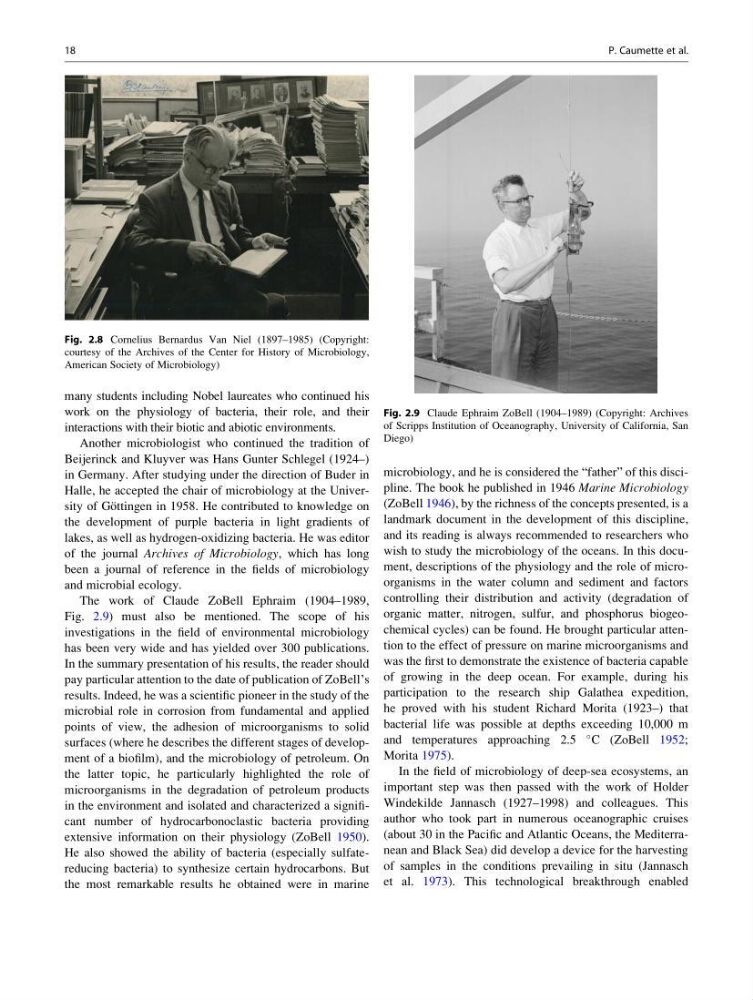
The work of Claude ZoBell Ephraim (1904–1989,
Fig. 2.9) must also be mentioned. The scope of his
investigations in the field of environmental microbiology
has been very wide and has yielded over 300 publications.
In the summary presentation of his results, the reader should
pay particular attention to the date of publication of ZoBell’s
results. Indeed, he was a scientific pioneer in the study of the
microbial role in corrosion from fundamental and applied
points of view, the adhesion of microorganisms to solid
surfaces (where he describes the different stages of development of a biofilm), and the microbiology of petroleum. On
the latter topic, he particularly highlighted the role of
microorganisms in the degradation of petroleum products
in the environment and isolated and characterized a significant number of hydrocarbonoclastic bacteria providing
extensive information on their physiology (ZoBell 1950).
He also showed the ability of bacteria (especially sulfatereducing bacteria) to synthesize certain hydrocarbons. But
the most remarkable results he obtained were in marine
microbiology, and he is considered the “father” of this discipline. The book he published in 1946 Marine Microbiology
(ZoBell 1946), by the richness of the concepts presented, is a
landmark document in the development of this discipline,
and its reading is always recommended to researchers who
wish to study the microbiology of the oceans. In this document, descriptions of the physiology and the role of microorganisms in the water column and sediment and factors
controlling their distribution and activity (degradation of
organic matter, nitrogen, sulfur, and phosphorus biogeochemical cycles) can be found. He brought particular attention to the effect of pressure on marine microorganisms and
was the first to demonstrate the existence of bacteria capable
of growing in the deep ocean. For example, during his
participation to the research ship Galathea expedition,
he proved with his student Richard Morita (1923–) that
bacterial life was possible at depths exceeding 10,000 m
and temperatures approaching 2.5
C (ZoBell 1952;
Morita 1975).
In the field of microbiology of deep-sea ecosystems, an
important step was then passed with the work of Holder
Windekilde Jannasch (1927–1998) and colleagues. This
author who took part in numerous oceanographic cruises
(about 30 in the Pacific and Atlantic Oceans, the Mediterranean and Black Sea) did develop a device for the harvesting
of samples in the conditions prevailing in situ (Jannasch
et al. 1973). This technological breakthrough enabled
Fig. 2.8 Cornelius Bernardus Van Niel (1897–1985) (Copyright:
courtesy of the Archives of the Center for History of Microbiology,
American Society of Microbiology)
Fig. 2.9 Claude Ephraim ZoBell (1904–1989) (Copyright: Archives
of Scripps Institution of Oceanography, University of California, San
Diego)
18
P. Caumette et al.
work on the physiology of bacteria, their role, and their
interactions with their biotic and abiotic environments.
Another microbiologist who continued the tradition of
Beijerinck and Kluyver was Hans Gunter Schlegel (1924–)
in Germany. After studying under the direction of Buder in
Halle, he accepted the chair of microbiology at the University of Go ¨ttingen in 1958. He contributed to knowledge on
the development of purple bacteria in light gradients of
lakes, as well as hydrogen-oxidizing bacteria. He was editor
of the journal Archives of Microbiology, which has long
been a journal of reference in the fields of microbiology
and microbial ecology.
The work of Claude ZoBell Ephraim (1904–1989,
Fig. 2.9) must also be mentioned. The scope of his
investigations in the field of environmental microbiology
has been very wide and has yielded over 300 publications.
In the summary presentation of his results, the reader should
pay particular attention to the date of publication of ZoBell’s
results. Indeed, he was a scientific pioneer in the study of the
microbial role in corrosion from fundamental and applied
points of view, the adhesion of microorganisms to solid
surfaces (where he describes the different stages of development of a biofilm), and the microbiology of petroleum. On
the latter topic, he particularly highlighted the role of
microorganisms in the degradation of petroleum products
in the environment and isolated and characterized a significant number of hydrocarbonoclastic bacteria providing
extensive information on their physiology (ZoBell 1950).
He also showed the ability of bacteria (especially sulfatereducing bacteria) to synthesize certain hydrocarbons. But
the most remarkable results he obtained were in marine
microbiology, and he is considered the “father” of this discipline. The book he published in 1946 Marine Microbiology
(ZoBell 1946), by the richness of the concepts presented, is a
landmark document in the development of this discipline,
and its reading is always recommended to researchers who
wish to study the microbiology of the oceans. In this document, descriptions of the physiology and the role of microorganisms in the water column and sediment and factors
controlling their distribution and activity (degradation of
organic matter, nitrogen, sulfur, and phosphorus biogeochemical cycles) can be found. He brought particular attention to the effect of pressure on marine microorganisms and
was the first to demonstrate the existence of bacteria capable
of growing in the deep ocean. For example, during his
participation to the research ship Galathea expedition,
he proved with his student Richard Morita (1923–) that
bacterial life was possible at depths exceeding 10,000 m
and temperatures approaching 2.5
C (ZoBell 1952;
Morita 1975).
In the field of microbiology of deep-sea ecosystems, an
important step was then passed with the work of Holder
Windekilde Jannasch (1927–1998) and colleagues. This
author who took part in numerous oceanographic cruises
(about 30 in the Pacific and Atlantic Oceans, the Mediterranean and Black Sea) did develop a device for the harvesting
of samples in the conditions prevailing in situ (Jannasch
et al. 1973). This technological breakthrough enabled
Fig. 2.8 Cornelius Bernardus Van Niel (1897–1985) (Copyright:
courtesy of the Archives of the Center for History of Microbiology,
American Society of Microbiology)
Fig. 2.9 Claude Ephraim ZoBell (1904–1989) (Copyright: Archives
of Scripps Institution of Oceanography, University of California, San
Diego)
18
P. Caumette et al.