

quality and the maintenance of life on Earth. As a result of
numerous studies, he was able to show the ubiquity of
microorganisms in soils and the emergence of a community
based on the selective influence of the environment. On the
basis of the famous often-cited sentence “all microorganisms are everywhere, the environment selects,”
expressed by the Dutch microbiologist Lourens Baas
Becking (see below), he developed methods to obtain and
select by enrichment and isolate targeted microorganisms
even if they were in low numbers in the original samples.
At the same time, other studies completed the work of
Beijerinck and Winogradsky on the role of bacteria in biogeochemical cycles and confirmed the importance of
emerging microbial ecology, particularly with regard to the
reduction of nitrates (Deherain 1897), methanogenesis and
methanotrophy (So ¨hngen 1906), and the isolation of
hydrogenotrophic bacteria (Kaserer 1906).
2.5
Microbial Ecology During the Twentieth
Century
Fundamental discoveries about the role of microorganisms
in the recycling of elements in ecosystems, initiated in the
early twentieth century, were pursued by a few microbiologists who continued the pioneering work of
Winogradsky and Beijerinck. At the University of Delft,
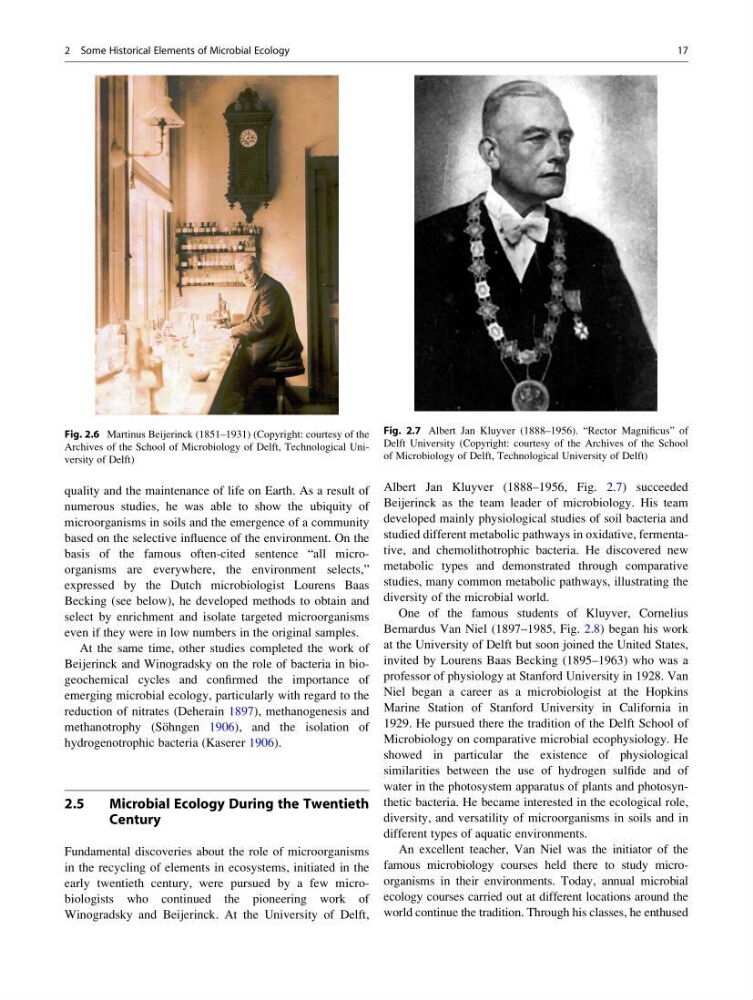
Albert Jan Kluyver (1888–1956, Fig. 2.7) succeeded
Beijerinck as the team leader of microbiology. His team
developed mainly physiological studies of soil bacteria and
studied different metabolic pathways in oxidative, fermentative, and chemolithotrophic bacteria. He discovered new
metabolic types and demonstrated through comparative
studies, many common metabolic pathways, illustrating the
diversity of the microbial world.
One of the famous students of Kluyver, Cornelius
Bernardus Van Niel (1897–1985, Fig. 2.8) began his work
at the University of Delft but soon joined the United States,
invited by Lourens Baas Becking (1895–1963) who was a
professor of physiology at Stanford University in 1928. Van
Niel began a career as a microbiologist at the Hopkins
Marine Station of Stanford University in California in
1929. He pursued there the tradition of the Delft School of
Microbiology on comparative microbial ecophysiology. He
showed in particular the existence of physiological
similarities between the use of hydrogen sulfide and of
water in the photosystem apparatus of plants and photosynthetic bacteria. He became interested in the ecological role,
diversity, and versatility of microorganisms in soils and in
different types of aquatic environments.
An excellent teacher, Van Niel was the initiator of the
famous microbiology courses held there to study microorganisms in their environments. Today, annual microbial
ecology courses carried out at different locations around the
world continue the tradition. Through his classes, he enthused
Fig. 2.6 Martinus Beijerinck (1851–1931) (Copyright: courtesy of the
Archives of the School of Microbiology of Delft, Technological University of Delft)
Fig. 2.7 Albert Jan Kluyver (1888–1956). “Rector Magnificus” of
Delft University (Copyright: courtesy of the Archives of the School
of Microbiology of Delft, Technological University of Delft)
2 Some Historical Elements of Microbial Ecology
17
numerous studies, he was able to show the ubiquity of
microorganisms in soils and the emergence of a community
based on the selective influence of the environment. On the
basis of the famous often-cited sentence “all microorganisms are everywhere, the environment selects,”
expressed by the Dutch microbiologist Lourens Baas
Becking (see below), he developed methods to obtain and
select by enrichment and isolate targeted microorganisms
even if they were in low numbers in the original samples.
At the same time, other studies completed the work of
Beijerinck and Winogradsky on the role of bacteria in biogeochemical cycles and confirmed the importance of
emerging microbial ecology, particularly with regard to the
reduction of nitrates (Deherain 1897), methanogenesis and
methanotrophy (So ¨hngen 1906), and the isolation of
hydrogenotrophic bacteria (Kaserer 1906).
2.5
Microbial Ecology During the Twentieth
Century
Fundamental discoveries about the role of microorganisms
in the recycling of elements in ecosystems, initiated in the
early twentieth century, were pursued by a few microbiologists who continued the pioneering work of
Winogradsky and Beijerinck. At the University of Delft,
Albert Jan Kluyver (1888–1956, Fig. 2.7) succeeded
Beijerinck as the team leader of microbiology. His team
developed mainly physiological studies of soil bacteria and
studied different metabolic pathways in oxidative, fermentative, and chemolithotrophic bacteria. He discovered new
metabolic types and demonstrated through comparative
studies, many common metabolic pathways, illustrating the
diversity of the microbial world.
One of the famous students of Kluyver, Cornelius
Bernardus Van Niel (1897–1985, Fig. 2.8) began his work
at the University of Delft but soon joined the United States,
invited by Lourens Baas Becking (1895–1963) who was a
professor of physiology at Stanford University in 1928. Van
Niel began a career as a microbiologist at the Hopkins
Marine Station of Stanford University in California in
1929. He pursued there the tradition of the Delft School of
Microbiology on comparative microbial ecophysiology. He
showed in particular the existence of physiological
similarities between the use of hydrogen sulfide and of
water in the photosystem apparatus of plants and photosynthetic bacteria. He became interested in the ecological role,
diversity, and versatility of microorganisms in soils and in
different types of aquatic environments.
An excellent teacher, Van Niel was the initiator of the
famous microbiology courses held there to study microorganisms in their environments. Today, annual microbial
ecology courses carried out at different locations around the
world continue the tradition. Through his classes, he enthused
Fig. 2.6 Martinus Beijerinck (1851–1931) (Copyright: courtesy of the
Archives of the School of Microbiology of Delft, Technological University of Delft)
Fig. 2.7 Albert Jan Kluyver (1888–1956). “Rector Magnificus” of
Delft University (Copyright: courtesy of the Archives of the School
of Microbiology of Delft, Technological University of Delft)
2 Some Historical Elements of Microbial Ecology
17