

The perception of the signal by the sensor leads to
changes in the intramolecular conformation of HK, which
leads in turn to activation of the kinase activity and results in
ATP-dependent autophosphorylation of the highly conserved His residue dimerization domain. The autophosphorylation of the dimer is a bimolecular reaction in
which one monomer catalyzes the phosphorylation of the
conserved His residue of the other monomer. Most
periplasmic domain HKs have a HAMP domain (histidine
kinase, adenylyl cyclase, methyl-binding proteins, and phosphatase domain) essential for signal transduction between
the sensor and the catalytic domain (Inouye 2006).
The response regulator RR has a conserved domain with
phosphotransferase activity (REC) that uses phosphorylated
histidine of the HK as donor group to autophosphorylate a
highly conserved Asp residue and thus regulates the activity
GGDEF
GGDEF
EnvZ (E. coli)
BvgS (B. pertussis)
FixL (S. meliloti)
KinA (B. subtilis)
Tar (E. coli)
CyaA (Nostoc sp.)
WspR (P.aeruginosa)
HmsT (Y. pestis)
STK1 (Nostoc sp.)
Aer (E. coli)
CHASE 3
CHASE 2
CYCc
STYKc
PAC
PAC
PAC
HAMP
HAMP
HisKA
HisKA
HisKA
HisKA
PAS
MA
TarH
PAS
PAS
PAS
REC
REC
HPT
PAS
PBPb
PBPb
HATPase
HATPase
HATPase
HATPase
PAC
HAMP
MA
PAS
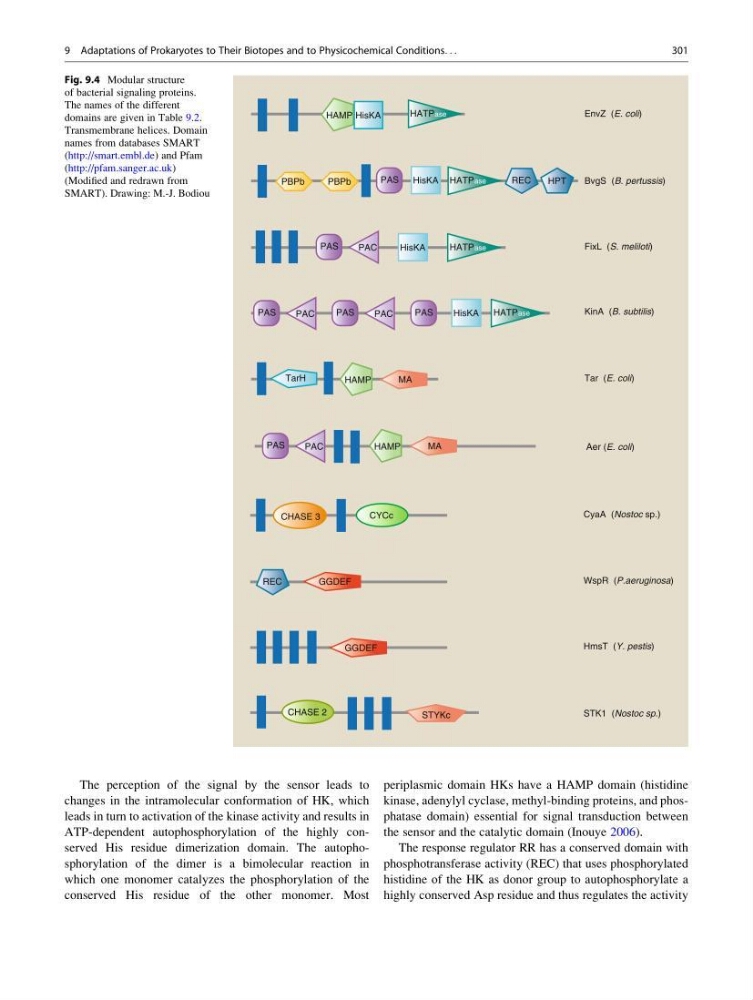
Fig. 9.4 Modular structure
of bacterial signaling proteins.
The names of the different
domains are given in Table 9.2.
Transmembrane helices. Domain
names from databases SMART
(http://smart.embl.de) and Pfam
(http://pfam.sanger.ac.uk)
(Modified and redrawn from
SMART). Drawing: M.-J. Bodiou
9 Adaptations of Prokaryotes to Their Biotopes and to Physicochemical Conditions. . .
301
changes in the intramolecular conformation of HK, which
leads in turn to activation of the kinase activity and results in
ATP-dependent autophosphorylation of the highly conserved His residue dimerization domain. The autophosphorylation of the dimer is a bimolecular reaction in
which one monomer catalyzes the phosphorylation of the
conserved His residue of the other monomer. Most
periplasmic domain HKs have a HAMP domain (histidine
kinase, adenylyl cyclase, methyl-binding proteins, and phosphatase domain) essential for signal transduction between
the sensor and the catalytic domain (Inouye 2006).
The response regulator RR has a conserved domain with
phosphotransferase activity (REC) that uses phosphorylated
histidine of the HK as donor group to autophosphorylate a
highly conserved Asp residue and thus regulates the activity
GGDEF
GGDEF
EnvZ (E. coli)
BvgS (B. pertussis)
FixL (S. meliloti)
KinA (B. subtilis)
Tar (E. coli)
CyaA (Nostoc sp.)
WspR (P.aeruginosa)
HmsT (Y. pestis)
STK1 (Nostoc sp.)
Aer (E. coli)
CHASE 3
CHASE 2
CYCc
STYKc
PAC
PAC
PAC
HAMP
HAMP
HisKA
HisKA
HisKA
HisKA
PAS
MA
TarH
PAS
PAS
PAS
REC
REC
HPT
PAS
PBPb
PBPb
HATPase
HATPase
HATPase
HATPase
PAC
HAMP
MA
PAS
Fig. 9.4 Modular structure
of bacterial signaling proteins.
The names of the different
domains are given in Table 9.2.
Transmembrane helices. Domain
names from databases SMART
(http://smart.embl.de) and Pfam
(http://pfam.sanger.ac.uk)
(Modified and redrawn from
SMART). Drawing: M.-J. Bodiou
9 Adaptations of Prokaryotes to Their Biotopes and to Physicochemical Conditions. . .
301