

Box 9.1 (continued)
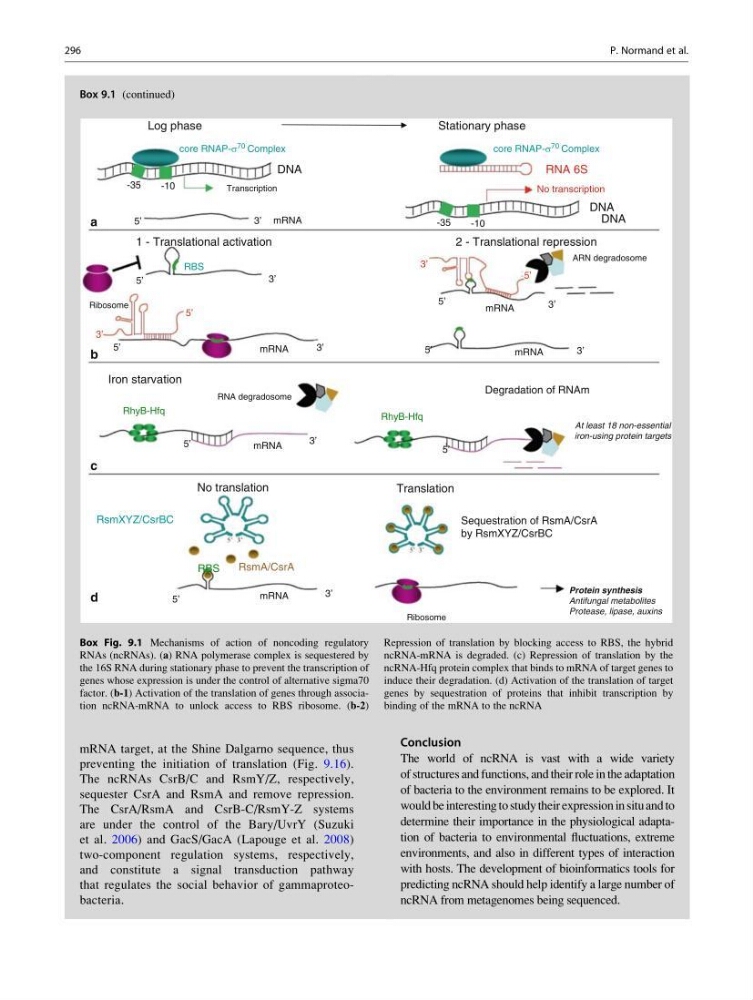
mRNA target, at the Shine Dalgarno sequence, thus
preventing the initiation of translation (Fig. 9.16).
The ncRNAs CsrB/C and RsmY/Z, respectively,
sequester CsrA and RsmA and remove repression.
The CsrA/RsmA and CsrB-C/RsmY-Z systems
are under the control of the Bary/UvrY (Suzuki
et al. 2006) and GacS/GacA (Lapouge et al. 2008)
two-component regulation systems, respectively,
and constitute a signal transduction pathway
that regulates the social behavior of gammaproteobacteria.
(continued)
Box 9.1 (continued)
Conclusion
The world of ncRNA is vast with a wide variety
of structures and functions, and their role in the adaptation
of bacteria to the environment remains to be explored. It
would be interesting to study their expression in situ and to
determine their importance in the physiological adaptation of bacteria to environmental fluctuations, extreme
environments, and also in different types of interaction
with hosts. The development of bioinformatics tools for
predicting ncRNA should help identify a large number of
ncRNA from metagenomes being sequenced.
Log phase
Stationary phase
core RNAP-s 70 Complex
1 - Translational activation
2 - Translational repression
Iron starvation
No translation
Translation
DNA
a
b
c
d
RNA 6S
No transcription
DNA
mRNA
RBS
Ribosome
Ribosome
Transcription
mRNA
RNA degradosome
Degradation of RNAm
Sequestration of RsmA/CsrA
by RsmXYZ/CsrBC
RsmXYZ/CsrBC
ARN degradosome
RhyB-Hfq
RhyB-Hfq
At least 18 non-essential
iron-using protein targets
Protein synthesis
Antifungal metabolites
Protease, lipase, auxins
RsmA/CsrA
RBS
-35
-10
-35
-10
5’
3’
5’
3’
5’
3’
5’
5’
3’
5’
3’
5’
3’
5’
3’
5’
3’
5’
3’
DNA
core RNAP-s 70 Complex
mRNA
mRNA
mRNA
mRNA
Box Fig. 9.1 Mechanisms of action of noncoding regulatory
RNAs (ncRNAs). (a) RNA polymerase complex is sequestered by
the 16S RNA during stationary phase to prevent the transcription of
genes whose expression is under the control of alternative sigma70
factor. (b-1) Activation of the translation of genes through association ncRNA-mRNA to unlock access to RBS ribosome. (b-2)
Repression of translation by blocking access to RBS, the hybrid
ncRNA-mRNA is degraded. (c) Repression of translation by the
ncRNA-Hfq protein complex that binds to mRNA of target genes to
induce their degradation. (d) Activation of the translation of target
genes by sequestration of proteins that inhibit transcription by
binding of the mRNA to the ncRNA
296
P. Normand et al.
mRNA target, at the Shine Dalgarno sequence, thus
preventing the initiation of translation (Fig. 9.16).
The ncRNAs CsrB/C and RsmY/Z, respectively,
sequester CsrA and RsmA and remove repression.
The CsrA/RsmA and CsrB-C/RsmY-Z systems
are under the control of the Bary/UvrY (Suzuki
et al. 2006) and GacS/GacA (Lapouge et al. 2008)
two-component regulation systems, respectively,
and constitute a signal transduction pathway
that regulates the social behavior of gammaproteobacteria.
(continued)
Box 9.1 (continued)
Conclusion
The world of ncRNA is vast with a wide variety
of structures and functions, and their role in the adaptation
of bacteria to the environment remains to be explored. It
would be interesting to study their expression in situ and to
determine their importance in the physiological adaptation of bacteria to environmental fluctuations, extreme
environments, and also in different types of interaction
with hosts. The development of bioinformatics tools for
predicting ncRNA should help identify a large number of
ncRNA from metagenomes being sequenced.
Log phase
Stationary phase
core RNAP-s 70 Complex
1 - Translational activation
2 - Translational repression
Iron starvation
No translation
Translation
DNA
a
b
c
d
RNA 6S
No transcription
DNA
mRNA
RBS
Ribosome
Ribosome
Transcription
mRNA
RNA degradosome
Degradation of RNAm
Sequestration of RsmA/CsrA
by RsmXYZ/CsrBC
RsmXYZ/CsrBC
ARN degradosome
RhyB-Hfq
RhyB-Hfq
At least 18 non-essential
iron-using protein targets
Protein synthesis
Antifungal metabolites
Protease, lipase, auxins
RsmA/CsrA
RBS
-35
-10
-35
-10
5’
3’
5’
3’
5’
3’
5’
5’
3’
5’
3’
5’
3’
5’
3’
5’
3’
5’
3’
DNA
core RNAP-s 70 Complex
mRNA
mRNA
mRNA
mRNA
Box Fig. 9.1 Mechanisms of action of noncoding regulatory
RNAs (ncRNAs). (a) RNA polymerase complex is sequestered by
the 16S RNA during stationary phase to prevent the transcription of
genes whose expression is under the control of alternative sigma70
factor. (b-1) Activation of the translation of genes through association ncRNA-mRNA to unlock access to RBS ribosome. (b-2)
Repression of translation by blocking access to RBS, the hybrid
ncRNA-mRNA is degraded. (c) Repression of translation by the
ncRNA-Hfq protein complex that binds to mRNA of target genes to
induce their degradation. (d) Activation of the translation of target
genes by sequestration of proteins that inhibit transcription by
binding of the mRNA to the ncRNA
296
P. Normand et al.