

7.12.2 Euglenoidea
The Euglenoidea (¼Euglenophyta, Euglenophyceae,
euglenids) are unicellular, more rarely colonial (Colacium),
organisms. They comprise about 1,500 species. Some
Euglenoidea acquired the photosynthesis by means of a secondary endosymbiosis with a Chlorobionta (Bhattacharya
et al. 2003). Photosynthesis has been preserved in many
species (e.g., Euglena spp.), while secondarily lost in others
(e.g., Astasia and Hyalophacus). Some other Euglenoidea
(e.g., Rhabdomonas and Distigma) may never have acquired
photosynthesis (de Reviers 2003).
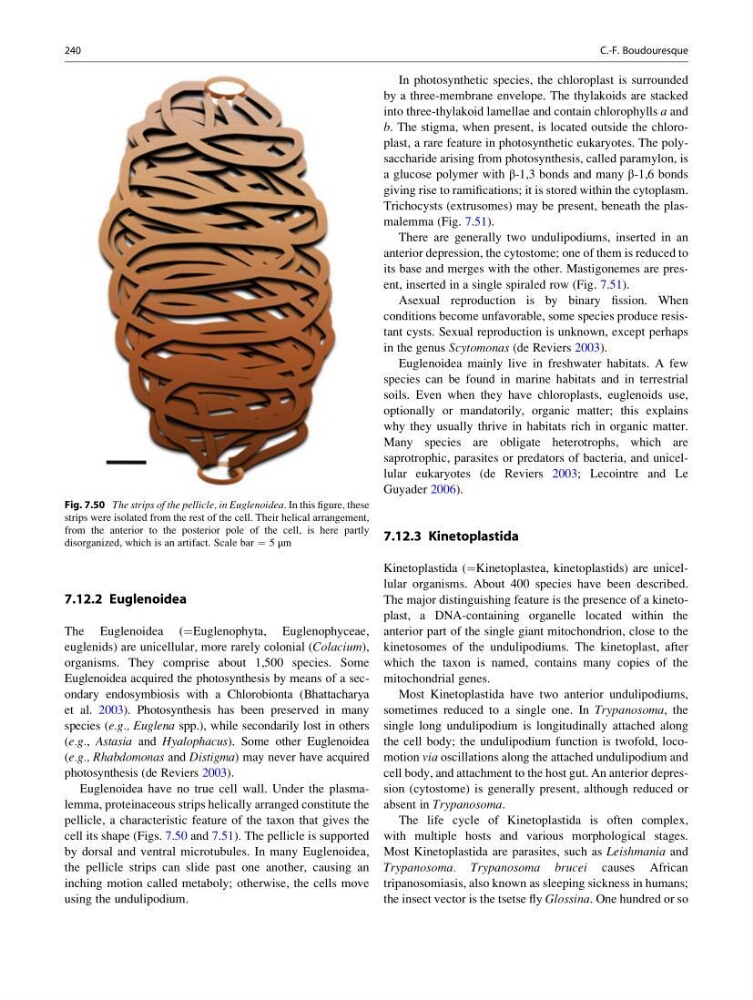
Euglenoidea have no true cell wall. Under the plasmalemma, proteinaceous strips helically arranged constitute the
pellicle, a characteristic feature of the taxon that gives the
cell its shape (Figs. 7.50 and 7.51). The pellicle is supported
by dorsal and ventral microtubules. In many Euglenoidea,
the pellicle strips can slide past one another, causing an
inching motion called metaboly; otherwise, the cells move
using the undulipodium.
In photosynthetic species, the chloroplast is surrounded
by a three-membrane envelope. The thylakoids are stacked
into three-thylakoid lamellae and contain chlorophylls a and
b. The stigma, when present, is located outside the chloroplast, a rare feature in photosynthetic eukaryotes. The polysaccharide arising from photosynthesis, called paramylon, is
a glucose polymer with β-1,3 bonds and many β-1,6 bonds
giving rise to ramifications; it is stored within the cytoplasm.
Trichocysts (extrusomes) may be present, beneath the plasmalemma (Fig. 7.51).
There are generally two undulipodiums, inserted in an
anterior depression, the cytostome; one of them is reduced to
its base and merges with the other. Mastigonemes are present, inserted in a single spiraled row (Fig. 7.51).
Asexual reproduction is by binary fission. When
conditions become unfavorable, some species produce resistant cysts. Sexual reproduction is unknown, except perhaps
in the genus Scytomonas (de Reviers 2003).
Euglenoidea mainly live in freshwater habitats. A few
species can be found in marine habitats and in terrestrial
soils. Even when they have chloroplasts, euglenoids use,
optionally or mandatorily, organic matter; this explains
why they usually thrive in habitats rich in organic matter.
Many species are obligate heterotrophs, which are
saprotrophic, parasites or predators of bacteria, and unicellular eukaryotes (de Reviers 2003; Lecointre and Le
Guyader 2006).
7.12.3 Kinetoplastida
Kinetoplastida (¼Kinetoplastea, kinetoplastids) are unicellular organisms. About 400 species have been described.
The major distinguishing feature is the presence of a kinetoplast, a DNA-containing organelle located within the
anterior part of the single giant mitochondrion, close to the
kinetosomes of the undulipodiums. The kinetoplast, after
which the taxon is named, contains many copies of the
mitochondrial genes.
Most Kinetoplastida have two anterior undulipodiums,
sometimes reduced to a single one. In Trypanosoma, the
single long undulipodium is longitudinally attached along
the cell body; the undulipodium function is twofold, locomotion via oscillations along the attached undulipodium and
cell body, and attachment to the host gut. An anterior depression (cytostome) is generally present, although reduced or
absent in Trypanosoma.
The life cycle of Kinetoplastida is often complex,
with multiple hosts and various morphological stages.
Most Kinetoplastida are parasites, such as Leishmania and
Trypanosoma. Trypanosoma brucei causes African
tripanosomiasis, also known as sleeping sickness in humans;
the insect vector is the tsetse fly Glossina. One hundred or so
Fig. 7.50 The strips of the pellicle, in Euglenoidea. In this figure, these
strips were isolated from the rest of the cell. Their helical arrangement,
from the anterior to the posterior pole of the cell, is here partly
disorganized, which is an artifact. Scale bar ¼ 5 μm
240
C.-F. Boudouresque
The Euglenoidea (¼Euglenophyta, Euglenophyceae,
euglenids) are unicellular, more rarely colonial (Colacium),
organisms. They comprise about 1,500 species. Some
Euglenoidea acquired the photosynthesis by means of a secondary endosymbiosis with a Chlorobionta (Bhattacharya
et al. 2003). Photosynthesis has been preserved in many
species (e.g., Euglena spp.), while secondarily lost in others
(e.g., Astasia and Hyalophacus). Some other Euglenoidea
(e.g., Rhabdomonas and Distigma) may never have acquired
photosynthesis (de Reviers 2003).
Euglenoidea have no true cell wall. Under the plasmalemma, proteinaceous strips helically arranged constitute the
pellicle, a characteristic feature of the taxon that gives the
cell its shape (Figs. 7.50 and 7.51). The pellicle is supported
by dorsal and ventral microtubules. In many Euglenoidea,
the pellicle strips can slide past one another, causing an
inching motion called metaboly; otherwise, the cells move
using the undulipodium.
In photosynthetic species, the chloroplast is surrounded
by a three-membrane envelope. The thylakoids are stacked
into three-thylakoid lamellae and contain chlorophylls a and
b. The stigma, when present, is located outside the chloroplast, a rare feature in photosynthetic eukaryotes. The polysaccharide arising from photosynthesis, called paramylon, is
a glucose polymer with β-1,3 bonds and many β-1,6 bonds
giving rise to ramifications; it is stored within the cytoplasm.
Trichocysts (extrusomes) may be present, beneath the plasmalemma (Fig. 7.51).
There are generally two undulipodiums, inserted in an
anterior depression, the cytostome; one of them is reduced to
its base and merges with the other. Mastigonemes are present, inserted in a single spiraled row (Fig. 7.51).
Asexual reproduction is by binary fission. When
conditions become unfavorable, some species produce resistant cysts. Sexual reproduction is unknown, except perhaps
in the genus Scytomonas (de Reviers 2003).
Euglenoidea mainly live in freshwater habitats. A few
species can be found in marine habitats and in terrestrial
soils. Even when they have chloroplasts, euglenoids use,
optionally or mandatorily, organic matter; this explains
why they usually thrive in habitats rich in organic matter.
Many species are obligate heterotrophs, which are
saprotrophic, parasites or predators of bacteria, and unicellular eukaryotes (de Reviers 2003; Lecointre and Le
Guyader 2006).
7.12.3 Kinetoplastida
Kinetoplastida (¼Kinetoplastea, kinetoplastids) are unicellular organisms. About 400 species have been described.
The major distinguishing feature is the presence of a kinetoplast, a DNA-containing organelle located within the
anterior part of the single giant mitochondrion, close to the
kinetosomes of the undulipodiums. The kinetoplast, after
which the taxon is named, contains many copies of the
mitochondrial genes.
Most Kinetoplastida have two anterior undulipodiums,
sometimes reduced to a single one. In Trypanosoma, the
single long undulipodium is longitudinally attached along
the cell body; the undulipodium function is twofold, locomotion via oscillations along the attached undulipodium and
cell body, and attachment to the host gut. An anterior depression (cytostome) is generally present, although reduced or
absent in Trypanosoma.
The life cycle of Kinetoplastida is often complex,
with multiple hosts and various morphological stages.
Most Kinetoplastida are parasites, such as Leishmania and
Trypanosoma. Trypanosoma brucei causes African
tripanosomiasis, also known as sleeping sickness in humans;
the insect vector is the tsetse fly Glossina. One hundred or so
Fig. 7.50 The strips of the pellicle, in Euglenoidea. In this figure, these
strips were isolated from the rest of the cell. Their helical arrangement,
from the anterior to the posterior pole of the cell, is here partly
disorganized, which is an artifact. Scale bar ¼ 5 μm
240
C.-F. Boudouresque