

7.3.3 What Is a Cyst?
A cyst* is a non-motile resistant cell formed under adverse
conditions (e.g., low nutrient, predation), which may survive
for months or years and is able to again become an active
cell when conditions improve. A cyst is surrounded by a
thick wall that can be almost indestructible, as is the case of
cysts of Dinobionta (cf. Sect. 7.8.3). Cysts can originate in a
variety of life stages (spores, conidia, zygotes).
7.3.4 Different Types of Fertilization
Fertilization is the fusion of two gametes, possibly of two
vegetative cells which play the role of gametes. It gives rise
to a zygote that initiates the development of a new individual
organism. Fertilization can be decomposed into two steps,
the fusion of cytoplasms (plasmogamy) and the fusion of
nuclei (karyogamy). Generally, plasmogamy and karyogamy occur simultaneously or with only a slight delay. However, in some eukaryotes, such as Fungi, karyogamy is
delayed and occurs a variable amount of time after
plasmogamy. As a result, in addition to the classical
haploid (n) and diploid (2n) phases, these organisms can
present, at least during part of their life cycle, phases
where nuclei of both sexes (male and female, or + and À),
inherited from the two parents, coexist within the cytoplasm
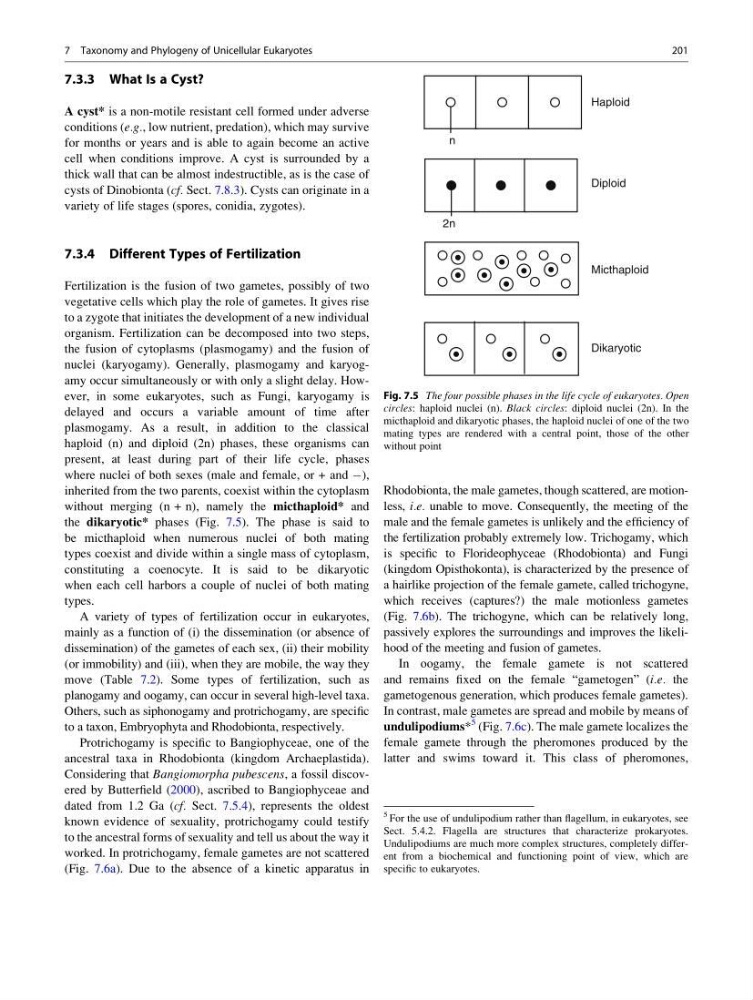
without merging (n + n), namely the micthaploid* and
the dikaryotic* phases (Fig. 7.5). The phase is said to
be micthaploid when numerous nuclei of both mating
types coexist and divide within a single mass of cytoplasm,
constituting a coenocyte. It is said to be dikaryotic
when each cell harbors a couple of nuclei of both mating
types.
A variety of types of fertilization occur in eukaryotes,
mainly as a function of (i) the dissemination (or absence of
dissemination) of the gametes of each sex, (ii) their mobility
(or immobility) and (iii), when they are mobile, the way they
move (Table 7.2). Some types of fertilization, such as
planogamy and oogamy, can occur in several high-level taxa.
Others, such as siphonogamy and protrichogamy, are specific
to a taxon, Embryophyta and Rhodobionta, respectively.
Protrichogamy is specific to Bangiophyceae, one of the
ancestral taxa in Rhodobionta (kingdom Archaeplastida).
Considering that Bangiomorpha pubescens, a fossil discovered by Butterfield (2000), ascribed to Bangiophyceae and
dated from 1.2 Ga (cf. Sect. 7.5.4), represents the oldest
known evidence of sexuality, protrichogamy could testify
to the ancestral forms of sexuality and tell us about the way it
worked. In protrichogamy, female gametes are not scattered
(Fig. 7.6a). Due to the absence of a kinetic apparatus in
Rhodobionta, the male gametes, though scattered, are motionless, i.e. unable to move. Consequently, the meeting of the
male and the female gametes is unlikely and the efficiency of
the fertilization probably extremely low. Trichogamy, which
is specific to Florideophyceae (Rhodobionta) and Fungi
(kingdom Opisthokonta), is characterized by the presence of
a hairlike projection of the female gamete, called trichogyne,
which receives (captures?) the male motionless gametes
(Fig. 7.6b). The trichogyne, which can be relatively long,
passively explores the surroundings and improves the likelihood of the meeting and fusion of gametes.
In oogamy, the female gamete is not scattered
and remains fixed on the female “gametogen” (i.e. the
gametogenous generation, which produces female gametes).
In contrast, male gametes are spread and mobile by means of
undulipodiums*
5 (Fig. 7.6c). The male gamete localizes the
female gamete through the pheromones produced by the
latter and swims toward it. This class of pheromones,
Dikaryotic
n
Haploid
2n
Diploid
Micthaploid
Fig. 7.5 The four possible phases in the life cycle of eukaryotes. Open
circles: haploid nuclei (n). Black circles: diploid nuclei (2n). In the
micthaploid and dikaryotic phases, the haploid nuclei of one of the two
mating types are rendered with a central point, those of the other
without point
5 For the use of undulipodium rather than flagellum, in eukaryotes, see
Sect. 5.4.2. Flagella are structures that characterize prokaryotes.
Undulipodiums are much more complex structures, completely different from a biochemical and functioning point of view, which are
specific to eukaryotes.
7 Taxonomy and Phylogeny of Unicellular Eukaryotes
201
A cyst* is a non-motile resistant cell formed under adverse
conditions (e.g., low nutrient, predation), which may survive
for months or years and is able to again become an active
cell when conditions improve. A cyst is surrounded by a
thick wall that can be almost indestructible, as is the case of
cysts of Dinobionta (cf. Sect. 7.8.3). Cysts can originate in a
variety of life stages (spores, conidia, zygotes).
7.3.4 Different Types of Fertilization
Fertilization is the fusion of two gametes, possibly of two
vegetative cells which play the role of gametes. It gives rise
to a zygote that initiates the development of a new individual
organism. Fertilization can be decomposed into two steps,
the fusion of cytoplasms (plasmogamy) and the fusion of
nuclei (karyogamy). Generally, plasmogamy and karyogamy occur simultaneously or with only a slight delay. However, in some eukaryotes, such as Fungi, karyogamy is
delayed and occurs a variable amount of time after
plasmogamy. As a result, in addition to the classical
haploid (n) and diploid (2n) phases, these organisms can
present, at least during part of their life cycle, phases
where nuclei of both sexes (male and female, or + and À),
inherited from the two parents, coexist within the cytoplasm
without merging (n + n), namely the micthaploid* and
the dikaryotic* phases (Fig. 7.5). The phase is said to
be micthaploid when numerous nuclei of both mating
types coexist and divide within a single mass of cytoplasm,
constituting a coenocyte. It is said to be dikaryotic
when each cell harbors a couple of nuclei of both mating
types.
A variety of types of fertilization occur in eukaryotes,
mainly as a function of (i) the dissemination (or absence of
dissemination) of the gametes of each sex, (ii) their mobility
(or immobility) and (iii), when they are mobile, the way they
move (Table 7.2). Some types of fertilization, such as
planogamy and oogamy, can occur in several high-level taxa.
Others, such as siphonogamy and protrichogamy, are specific
to a taxon, Embryophyta and Rhodobionta, respectively.
Protrichogamy is specific to Bangiophyceae, one of the
ancestral taxa in Rhodobionta (kingdom Archaeplastida).
Considering that Bangiomorpha pubescens, a fossil discovered by Butterfield (2000), ascribed to Bangiophyceae and
dated from 1.2 Ga (cf. Sect. 7.5.4), represents the oldest
known evidence of sexuality, protrichogamy could testify
to the ancestral forms of sexuality and tell us about the way it
worked. In protrichogamy, female gametes are not scattered
(Fig. 7.6a). Due to the absence of a kinetic apparatus in
Rhodobionta, the male gametes, though scattered, are motionless, i.e. unable to move. Consequently, the meeting of the
male and the female gametes is unlikely and the efficiency of
the fertilization probably extremely low. Trichogamy, which
is specific to Florideophyceae (Rhodobionta) and Fungi
(kingdom Opisthokonta), is characterized by the presence of
a hairlike projection of the female gamete, called trichogyne,
which receives (captures?) the male motionless gametes
(Fig. 7.6b). The trichogyne, which can be relatively long,
passively explores the surroundings and improves the likelihood of the meeting and fusion of gametes.
In oogamy, the female gamete is not scattered
and remains fixed on the female “gametogen” (i.e. the
gametogenous generation, which produces female gametes).
In contrast, male gametes are spread and mobile by means of
undulipodiums*
5 (Fig. 7.6c). The male gamete localizes the
female gamete through the pheromones produced by the
latter and swims toward it. This class of pheromones,
Dikaryotic
n
Haploid
2n
Diploid
Micthaploid
Fig. 7.5 The four possible phases in the life cycle of eukaryotes. Open
circles: haploid nuclei (n). Black circles: diploid nuclei (2n). In the
micthaploid and dikaryotic phases, the haploid nuclei of one of the two
mating types are rendered with a central point, those of the other
without point
5 For the use of undulipodium rather than flagellum, in eukaryotes, see
Sect. 5.4.2. Flagella are structures that characterize prokaryotes.
Undulipodiums are much more complex structures, completely different from a biochemical and functioning point of view, which are
specific to eukaryotes.
7 Taxonomy and Phylogeny of Unicellular Eukaryotes
201