

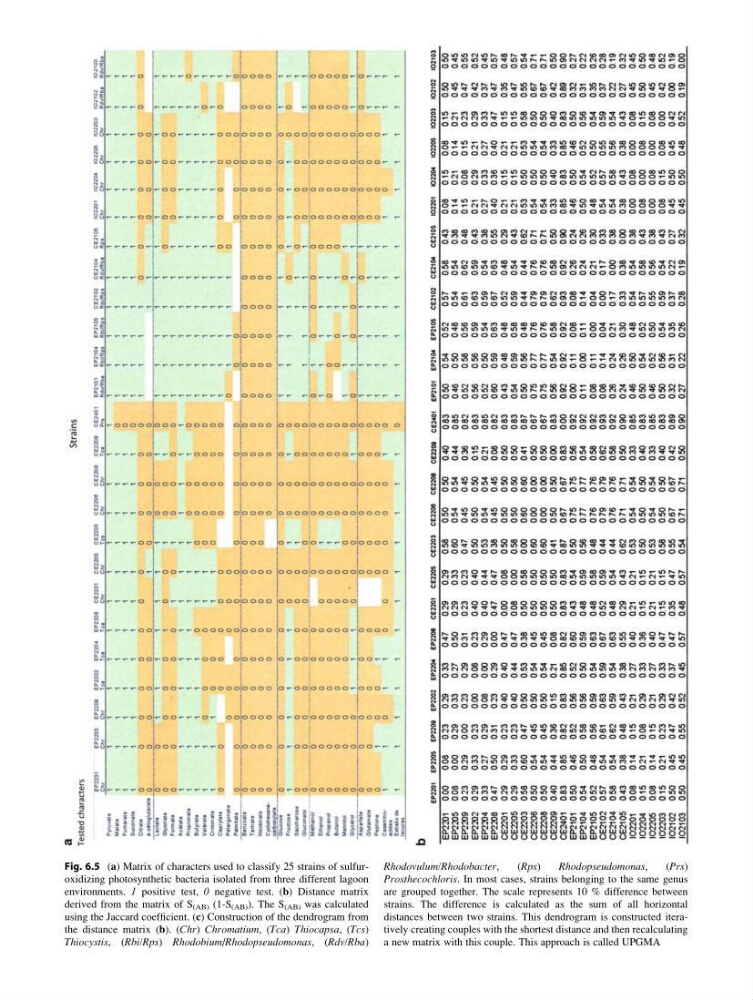
Fig. 6.5 (a) Matrix of characters used to classify 25 strains of sulfuroxidizing photosynthetic bacteria isolated from three different lagoon
environments. 1 positive test, 0 negative test. (b) Distance matrix
derived from the matrix of S (AB) (1-S (AB) ). The S (AB) was calculated
using the Jaccard coefficient. (c) Construction of the dendrogram from
the distance matrix (b). (Chr) Chromatium, (Tca) Thiocapsa, (Tcs)
Thiocystis, (Rbi/Rps) Rhodobium/Rhodopseudomonas, (Rdv/Rba)
Rhodovulum/Rhodobacter,
(Rps)
Rhodopseudomonas,
(Prs)
Prosthecochloris. In most cases, strains belonging to the same genus
are grouped together. The scale represents 10 % difference between
strains. The difference is calculated as the sum of all horizontal
distances between two strains. This dendrogram is constructed iteratively creating couples with the shortest distance and then recalculating
a new matrix with this couple. This approach is called UPGMA
environments. 1 positive test, 0 negative test. (b) Distance matrix
derived from the matrix of S (AB) (1-S (AB) ). The S (AB) was calculated
using the Jaccard coefficient. (c) Construction of the dendrogram from
the distance matrix (b). (Chr) Chromatium, (Tca) Thiocapsa, (Tcs)
Thiocystis, (Rbi/Rps) Rhodobium/Rhodopseudomonas, (Rdv/Rba)
Rhodovulum/Rhodobacter,
(Rps)
Rhodopseudomonas,
(Prs)
Prosthecochloris. In most cases, strains belonging to the same genus
are grouped together. The scale represents 10 % difference between
strains. The difference is calculated as the sum of all horizontal
distances between two strains. This dendrogram is constructed iteratively creating couples with the shortest distance and then recalculating
a new matrix with this couple. This approach is called UPGMA