

many artifactual mutations, so that fossils can hardly
be studied by techniques such as PCR that involve polymerization. However, it is conceivable that the chemistry of
ancient DNA progresses or else that it will become possible
to determine the sequence of fossils other than through
polymerization, making it possible to study the earliest
fossils.
The extraterrestrial exploration of the moons of Saturn
and Jupiter, as well as that of the subsurface of Mars, may
also surprise us and may confirm the panspermia hypothesis
developed by many researchers such as Anaxagoras, Benoit
de Maillet, Hermann von Helmholtz, and closer to us Fred
Hoyle and Chandra Wickramasinghe. Any microorganism
found in these extraterrestrial environments will immediately be analyzed in every manner imaginable (and
sequenced if of course it contains DNA) and positioned in
the universal phylogeny. In addition, on our planet itself, it is
likely that new lineages will be identified, particularly in
extreme habitats that have been little explored (cf. Chap. 10)
such as the deep earth. These lineage will complete the tree
of living.
References
Andersson GE (2006) The bacterial world gets smaller. Science
314:259–260
Ane ´ C, Burleigh JG, Mcmahon MM, Sanderson MJ (2005) Covarion
structure in plastid genome evolution: a new statistical test. Mol
Biol Evol 22(4):914–924
Arslan D et al (2011) Distant Mimivirus relative with a larger genome
highlights the fundamental features of Megaviridae. Proc Natl Acad
Sci U S A 108:17486–17491
Baldauf SL (2003) The deep roots of eucaryotes. Science
300:1703–1706
Baldauf SL (2008) An overview of the phylogeny and diversity of
eukaryotes. J Syst Evol 46(3):263–273
Ball P (2007) Bacteria may be wiring up the soil. Nature 449:388
Berry AM, Harriott OT, Moreau RA, Osman SF, Benson DR, Jones AD
(2003) Hopanoid lipids compose the Frankia vesicle envelope,
presumptive barrier of oxygen diffusion to nitrogenase. Proc Natl
Acad Sci U S A 90:6091–6094
Bertrand J (1991) Mouvement des diatome ´es. I – L’e ´quilibre
dynamique chez Rhoicosphaenia abbreviata. Cryptogamie Algol
12(1):11–29
Bertrand J (1992) Mouvement des diatome ´es. II – Synthe `se des
mouvements. Cryptogamie Algol 13(1):49–71
Retaria
Embryophyta
phyceae
Chlorophyceae
Prasinophyceae
Rhodobionta
Glauco
-cystobionta
Lobosa
Mycetobionta
Chytridiomycota
Fungi
Choanoflagellata
Metazoa
(=animals)
basalia
monadida
Euglenoidea
Kinetoplastida
Acrasiobionta
(= Heterolobosa)
Percolobionta
Chromobionta
Oobionta
Labyrinthulobionta
Ciliophora
Dinobionta
Apicomplexa
Radiolaria
Foraminifera
Chlorarachniobionta
EXCAVATES
DISCICRISTATES
STRAMENOPILES
(= HETEROKONTA)
ALVEOLATA
RHIZARIA
AMOEBOBIONTA (=
AMOEBOZOA)
OPISTHOKONTA
helida ?
Actinophryda
HAPTOBIONTA
Chromalveolata Chromalveolata
Chlorobionta
Viridiplantae
Euglenobionta
Archamaeba
Phytomyxea
Haplosporidia
Unikonts
monadida
Oxymonadida
Streptobionta
Euglyphids
Cercobionta
ARCHAEPLASTIDA
(= PLANTAE)
Ellobiopsidae
Bicosoecida
Eumetazoa
Placozoa
Porifera
Microsporidia
Basidiomycota
Ascomycota
Mesomycetozoa
Picobiliphyta ?
Katablepharida
Cryptophyta
CRYPTOBIONTA
Trentepohliophyceae
Ulvophyceae
tophyceae
LECA
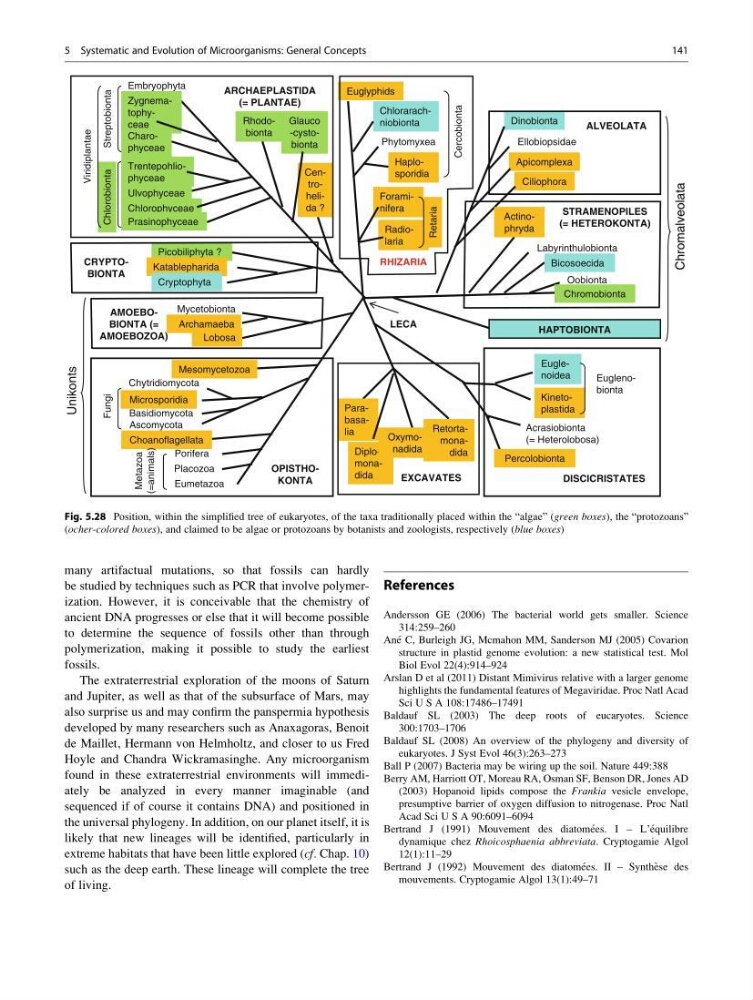
CharoFig. 5.28 Position, within the simplified tree of eukaryotes, of the taxa traditionally placed within the “algae” (green boxes), the “protozoans”
(ocher-colored boxes), and claimed to be algae or protozoans by botanists and zoologists, respectively (blue boxes)
5 Systematic and Evolution of Microorganisms: General Concepts
141
be studied by techniques such as PCR that involve polymerization. However, it is conceivable that the chemistry of
ancient DNA progresses or else that it will become possible
to determine the sequence of fossils other than through
polymerization, making it possible to study the earliest
fossils.
The extraterrestrial exploration of the moons of Saturn
and Jupiter, as well as that of the subsurface of Mars, may
also surprise us and may confirm the panspermia hypothesis
developed by many researchers such as Anaxagoras, Benoit
de Maillet, Hermann von Helmholtz, and closer to us Fred
Hoyle and Chandra Wickramasinghe. Any microorganism
found in these extraterrestrial environments will immediately be analyzed in every manner imaginable (and
sequenced if of course it contains DNA) and positioned in
the universal phylogeny. In addition, on our planet itself, it is
likely that new lineages will be identified, particularly in
extreme habitats that have been little explored (cf. Chap. 10)
such as the deep earth. These lineage will complete the tree
of living.
References
Andersson GE (2006) The bacterial world gets smaller. Science
314:259–260
Ane ´ C, Burleigh JG, Mcmahon MM, Sanderson MJ (2005) Covarion
structure in plastid genome evolution: a new statistical test. Mol
Biol Evol 22(4):914–924
Arslan D et al (2011) Distant Mimivirus relative with a larger genome
highlights the fundamental features of Megaviridae. Proc Natl Acad
Sci U S A 108:17486–17491
Baldauf SL (2003) The deep roots of eucaryotes. Science
300:1703–1706
Baldauf SL (2008) An overview of the phylogeny and diversity of
eukaryotes. J Syst Evol 46(3):263–273
Ball P (2007) Bacteria may be wiring up the soil. Nature 449:388
Berry AM, Harriott OT, Moreau RA, Osman SF, Benson DR, Jones AD
(2003) Hopanoid lipids compose the Frankia vesicle envelope,
presumptive barrier of oxygen diffusion to nitrogenase. Proc Natl
Acad Sci U S A 90:6091–6094
Bertrand J (1991) Mouvement des diatome ´es. I – L’e ´quilibre
dynamique chez Rhoicosphaenia abbreviata. Cryptogamie Algol
12(1):11–29
Bertrand J (1992) Mouvement des diatome ´es. II – Synthe `se des
mouvements. Cryptogamie Algol 13(1):49–71
Retaria
Embryophyta
phyceae
Chlorophyceae
Prasinophyceae
Rhodobionta
Glauco
-cystobionta
Lobosa
Mycetobionta
Chytridiomycota
Fungi
Choanoflagellata
Metazoa
(=animals)
basalia
monadida
Euglenoidea
Kinetoplastida
Acrasiobionta
(= Heterolobosa)
Percolobionta
Chromobionta
Oobionta
Labyrinthulobionta
Ciliophora
Dinobionta
Apicomplexa
Radiolaria
Foraminifera
Chlorarachniobionta
EXCAVATES
DISCICRISTATES
STRAMENOPILES
(= HETEROKONTA)
ALVEOLATA
RHIZARIA
AMOEBOBIONTA (=
AMOEBOZOA)
OPISTHOKONTA
helida ?
Actinophryda
HAPTOBIONTA
Chromalveolata Chromalveolata
Chlorobionta
Viridiplantae
Euglenobionta
Archamaeba
Phytomyxea
Haplosporidia
Unikonts
monadida
Oxymonadida
Streptobionta
Euglyphids
Cercobionta
ARCHAEPLASTIDA
(= PLANTAE)
Ellobiopsidae
Bicosoecida
Eumetazoa
Placozoa
Porifera
Microsporidia
Basidiomycota
Ascomycota
Mesomycetozoa
Picobiliphyta ?
Katablepharida
Cryptophyta
CRYPTOBIONTA
Trentepohliophyceae
Ulvophyceae
tophyceae
LECA
CharoFig. 5.28 Position, within the simplified tree of eukaryotes, of the taxa traditionally placed within the “algae” (green boxes), the “protozoans”
(ocher-colored boxes), and claimed to be algae or protozoans by botanists and zoologists, respectively (blue boxes)
5 Systematic and Evolution of Microorganisms: General Concepts
141