

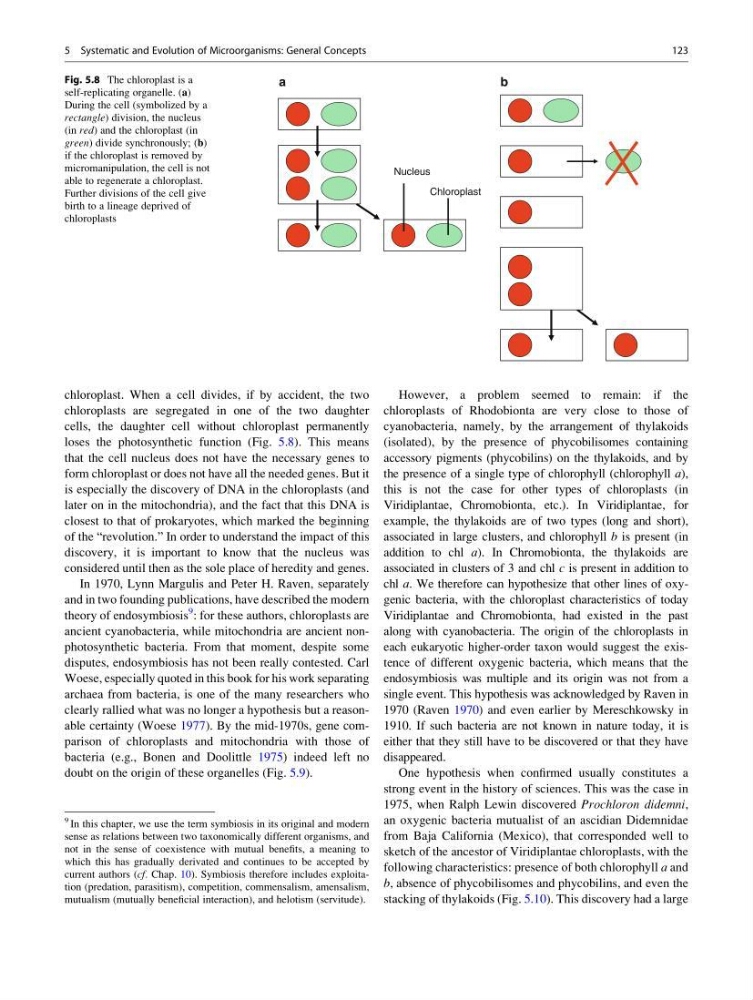
chloroplast. When a cell divides, if by accident, the two
chloroplasts are segregated in one of the two daughter
cells, the daughter cell without chloroplast permanently
loses the photosynthetic function (Fig. 5.8). This means
that the cell nucleus does not have the necessary genes to
form chloroplast or does not have all the needed genes. But it
is especially the discovery of DNA in the chloroplasts (and
later on in the mitochondria), and the fact that this DNA is
closest to that of prokaryotes, which marked the beginning
of the “revolution.” In order to understand the impact of this
discovery, it is important to know that the nucleus was
considered until then as the sole place of heredity and genes.
In 1970, Lynn Margulis and Peter H. Raven, separately
and in two founding publications, have described the modern
theory of endosymbiosis
9 : for these authors, chloroplasts are
ancient cyanobacteria, while mitochondria are ancient nonphotosynthetic bacteria. From that moment, despite some
disputes, endosymbiosis has not been really contested. Carl
Woese, especially quoted in this book for his work separating
archaea from bacteria, is one of the many researchers who
clearly rallied what was no longer a hypothesis but a reasonable certainty (Woese 1977). By the mid-1970s, gene comparison of chloroplasts and mitochondria with those of
bacteria (e.g., Bonen and Doolittle 1975) indeed left no
doubt on the origin of these organelles (Fig. 5.9).
However, a problem seemed to remain: if the
chloroplasts of Rhodobionta are very close to those of
cyanobacteria, namely, by the arrangement of thylakoids
(isolated), by the presence of phycobilisomes containing
accessory pigments (phycobilins) on the thylakoids, and by
the presence of a single type of chlorophyll (chlorophyll a),
this is not the case for other types of chloroplasts (in
Viridiplantae, Chromobionta, etc.). In Viridiplantae, for
example, the thylakoids are of two types (long and short),
associated in large clusters, and chlorophyll b is present (in
addition to chl a). In Chromobionta, the thylakoids are
associated in clusters of 3 and chl c is present in addition to
chl a. We therefore can hypothesize that other lines of oxygenic bacteria, with the chloroplast characteristics of today
Viridiplantae and Chromobionta, had existed in the past
along with cyanobacteria. The origin of the chloroplasts in
each eukaryotic higher-order taxon would suggest the existence of different oxygenic bacteria, which means that the
endosymbiosis was multiple and its origin was not from a
single event. This hypothesis was acknowledged by Raven in
1970 (Raven 1970) and even earlier by Mereschkowsky in
1910. If such bacteria are not known in nature today, it is
either that they still have to be discovered or that they have
disappeared.
One hypothesis when confirmed usually constitutes a
strong event in the history of sciences. This was the case in
1975, when Ralph Lewin discovered Prochloron didemni,
an oxygenic bacteria mutualist of an ascidian Didemnidae
from Baja California (Mexico), that corresponded well to
sketch of the ancestor of Viridiplantae chloroplasts, with the
following characteristics: presence of both chlorophyll a and
b, absence of phycobilisomes and phycobilins, and even the
stacking of thylakoids (Fig. 5.10). This discovery had a large
a
b
Nucleus
Chloroplast
Fig. 5.8 The chloroplast is a
self-replicating organelle. (a)
During the cell (symbolized by a
rectangle) division, the nucleus
(in red) and the chloroplast (in
green) divide synchronously; (b)
if the chloroplast is removed by
micromanipulation, the cell is not
able to regenerate a chloroplast.
Further divisions of the cell give
birth to a lineage deprived of
chloroplasts
9 In this chapter, we use the term symbiosis in its original and modern
sense as relations between two taxonomically different organisms, and
not in the sense of coexistence with mutual benefits, a meaning to
which this has gradually derivated and continues to be accepted by
current authors (cf. Chap. 10). Symbiosis therefore includes exploitation (predation, parasitism), competition, commensalism, amensalism,
mutualism (mutually beneficial interaction), and helotism (servitude).
5 Systematic and Evolution of Microorganisms: General Concepts
123
chloroplasts are segregated in one of the two daughter
cells, the daughter cell without chloroplast permanently
loses the photosynthetic function (Fig. 5.8). This means
that the cell nucleus does not have the necessary genes to
form chloroplast or does not have all the needed genes. But it
is especially the discovery of DNA in the chloroplasts (and
later on in the mitochondria), and the fact that this DNA is
closest to that of prokaryotes, which marked the beginning
of the “revolution.” In order to understand the impact of this
discovery, it is important to know that the nucleus was
considered until then as the sole place of heredity and genes.
In 1970, Lynn Margulis and Peter H. Raven, separately
and in two founding publications, have described the modern
theory of endosymbiosis
9 : for these authors, chloroplasts are
ancient cyanobacteria, while mitochondria are ancient nonphotosynthetic bacteria. From that moment, despite some
disputes, endosymbiosis has not been really contested. Carl
Woese, especially quoted in this book for his work separating
archaea from bacteria, is one of the many researchers who
clearly rallied what was no longer a hypothesis but a reasonable certainty (Woese 1977). By the mid-1970s, gene comparison of chloroplasts and mitochondria with those of
bacteria (e.g., Bonen and Doolittle 1975) indeed left no
doubt on the origin of these organelles (Fig. 5.9).
However, a problem seemed to remain: if the
chloroplasts of Rhodobionta are very close to those of
cyanobacteria, namely, by the arrangement of thylakoids
(isolated), by the presence of phycobilisomes containing
accessory pigments (phycobilins) on the thylakoids, and by
the presence of a single type of chlorophyll (chlorophyll a),
this is not the case for other types of chloroplasts (in
Viridiplantae, Chromobionta, etc.). In Viridiplantae, for
example, the thylakoids are of two types (long and short),
associated in large clusters, and chlorophyll b is present (in
addition to chl a). In Chromobionta, the thylakoids are
associated in clusters of 3 and chl c is present in addition to
chl a. We therefore can hypothesize that other lines of oxygenic bacteria, with the chloroplast characteristics of today
Viridiplantae and Chromobionta, had existed in the past
along with cyanobacteria. The origin of the chloroplasts in
each eukaryotic higher-order taxon would suggest the existence of different oxygenic bacteria, which means that the
endosymbiosis was multiple and its origin was not from a
single event. This hypothesis was acknowledged by Raven in
1970 (Raven 1970) and even earlier by Mereschkowsky in
1910. If such bacteria are not known in nature today, it is
either that they still have to be discovered or that they have
disappeared.
One hypothesis when confirmed usually constitutes a
strong event in the history of sciences. This was the case in
1975, when Ralph Lewin discovered Prochloron didemni,
an oxygenic bacteria mutualist of an ascidian Didemnidae
from Baja California (Mexico), that corresponded well to
sketch of the ancestor of Viridiplantae chloroplasts, with the
following characteristics: presence of both chlorophyll a and
b, absence of phycobilisomes and phycobilins, and even the
stacking of thylakoids (Fig. 5.10). This discovery had a large
a
b
Nucleus
Chloroplast
Fig. 5.8 The chloroplast is a
self-replicating organelle. (a)
During the cell (symbolized by a
rectangle) division, the nucleus
(in red) and the chloroplast (in
green) divide synchronously; (b)
if the chloroplast is removed by
micromanipulation, the cell is not
able to regenerate a chloroplast.
Further divisions of the cell give
birth to a lineage deprived of
chloroplasts
9 In this chapter, we use the term symbiosis in its original and modern
sense as relations between two taxonomically different organisms, and
not in the sense of coexistence with mutual benefits, a meaning to
which this has gradually derivated and continues to be accepted by
current authors (cf. Chap. 10). Symbiosis therefore includes exploitation (predation, parasitism), competition, commensalism, amensalism,
mutualism (mutually beneficial interaction), and helotism (servitude).
5 Systematic and Evolution of Microorganisms: General Concepts
123