

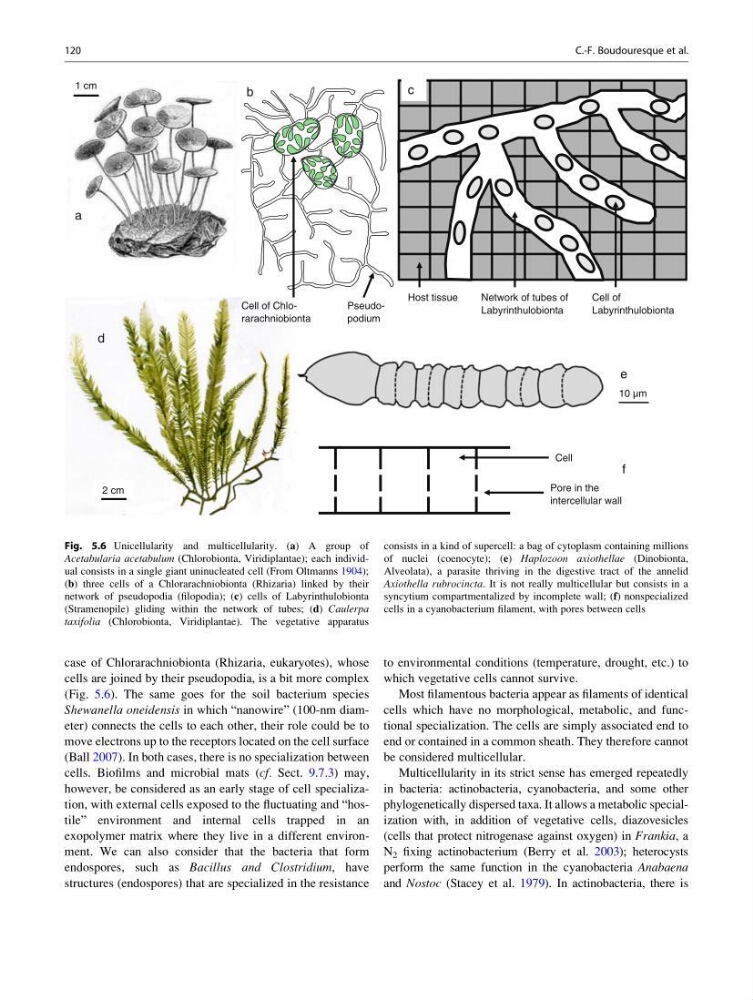
case of Chlorarachniobionta (Rhizaria, eukaryotes), whose
cells are joined by their pseudopodia, is a bit more complex
(Fig. 5.6). The same goes for the soil bacterium species
Shewanella oneidensis in which “nanowire” (100-nm diameter) connects the cells to each other, their role could be to
move electrons up to the receptors located on the cell surface
(Ball 2007). In both cases, there is no specialization between
cells. Biofilms and microbial mats (cf. Sect. 9.7.3) may,
however, be considered as an early stage of cell specialization, with external cells exposed to the fluctuating and “hostile” environment and internal cells trapped in an
exopolymer matrix where they live in a different environment. We can also consider that the bacteria that form
endospores, such as Bacillus and Clostridium, have
structures (endospores) that are specialized in the resistance
to environmental conditions (temperature, drought, etc.) to
which vegetative cells cannot survive.
Most filamentous bacteria appear as filaments of identical
cells which have no morphological, metabolic, and functional specialization. The cells are simply associated end to
end or contained in a common sheath. They therefore cannot
be considered multicellular.
Multicellularity in its strict sense has emerged repeatedly
in bacteria: actinobacteria, cyanobacteria, and some other
phylogenetically dispersed taxa. It allows a metabolic specialization with, in addition of vegetative cells, diazovesicles
(cells that protect nitrogenase against oxygen) in Frankia, a
N 2 fixing actinobacterium (Berry et al. 2003); heterocysts
perform the same function in the cyanobacteria Anabaena
and Nostoc (Stacey et al. 1979). In actinobacteria, there is
1 cm
a
Host tissue
Network of tubes of
Labyrinthulobionta
Cell of
Labyrinthulobionta
Cell of Chlorarachniobionta
Pseudopodium
b
d
c
2 cm
10 μm
f
Cell
Pore in the
intercellular wall
e
10 μm
Fig. 5.6 Unicellularity and multicellularity. (a) A group of
Acetabularia acetabulum (Chlorobionta, Viridiplantae); each individual consists in a single giant uninucleated cell (From Oltmanns 1904);
(b) three cells of a Chlorarachniobionta (Rhizaria) linked by their
network of pseudopodia (filopodia); (c) cells of Labyrinthulobionta
(Stramenopile) gliding within the network of tubes; (d) Caulerpa
taxifolia (Chlorobionta, Viridiplantae). The vegetative apparatus
consists in a kind of supercell: a bag of cytoplasm containing millions
of nuclei (coenocyte); (e) Haplozoon axiothellae (Dinobionta,
Alveolata), a parasite thriving in the digestive tract of the annelid
Axiothella rubrocincta. It is not really multicellular but consists in a
syncytium compartmentalized by incomplete wall; (f) nonspecialized
cells in a cyanobacterium filament, with pores between cells
120
C.-F. Boudouresque et al.
cells are joined by their pseudopodia, is a bit more complex
(Fig. 5.6). The same goes for the soil bacterium species
Shewanella oneidensis in which “nanowire” (100-nm diameter) connects the cells to each other, their role could be to
move electrons up to the receptors located on the cell surface
(Ball 2007). In both cases, there is no specialization between
cells. Biofilms and microbial mats (cf. Sect. 9.7.3) may,
however, be considered as an early stage of cell specialization, with external cells exposed to the fluctuating and “hostile” environment and internal cells trapped in an
exopolymer matrix where they live in a different environment. We can also consider that the bacteria that form
endospores, such as Bacillus and Clostridium, have
structures (endospores) that are specialized in the resistance
to environmental conditions (temperature, drought, etc.) to
which vegetative cells cannot survive.
Most filamentous bacteria appear as filaments of identical
cells which have no morphological, metabolic, and functional specialization. The cells are simply associated end to
end or contained in a common sheath. They therefore cannot
be considered multicellular.
Multicellularity in its strict sense has emerged repeatedly
in bacteria: actinobacteria, cyanobacteria, and some other
phylogenetically dispersed taxa. It allows a metabolic specialization with, in addition of vegetative cells, diazovesicles
(cells that protect nitrogenase against oxygen) in Frankia, a
N 2 fixing actinobacterium (Berry et al. 2003); heterocysts
perform the same function in the cyanobacteria Anabaena
and Nostoc (Stacey et al. 1979). In actinobacteria, there is
1 cm
a
Host tissue
Network of tubes of
Labyrinthulobionta
Cell of
Labyrinthulobionta
Cell of Chlorarachniobionta
Pseudopodium
b
d
c
2 cm
10 μm
f
Cell
Pore in the
intercellular wall
e
10 μm
Fig. 5.6 Unicellularity and multicellularity. (a) A group of
Acetabularia acetabulum (Chlorobionta, Viridiplantae); each individual consists in a single giant uninucleated cell (From Oltmanns 1904);
(b) three cells of a Chlorarachniobionta (Rhizaria) linked by their
network of pseudopodia (filopodia); (c) cells of Labyrinthulobionta
(Stramenopile) gliding within the network of tubes; (d) Caulerpa
taxifolia (Chlorobionta, Viridiplantae). The vegetative apparatus
consists in a kind of supercell: a bag of cytoplasm containing millions
of nuclei (coenocyte); (e) Haplozoon axiothellae (Dinobionta,
Alveolata), a parasite thriving in the digestive tract of the annelid
Axiothella rubrocincta. It is not really multicellular but consists in a
syncytium compartmentalized by incomplete wall; (f) nonspecialized
cells in a cyanobacterium filament, with pores between cells
120
C.-F. Boudouresque et al.