

morphological or an evolutionary perspective (Fig. 5.3). The
generality of this observation has profoundly changed the
approach to microbial phylogeny.
This search for evolutionary relationships and a molecular clock (Box 5.3) has resulted in the use of the SSU (16S/
18S) ribosomal RNA as a universal marker in
microorganisms where morphological characters are not
diversified and where paleontological data are rare (cf.
Sect. 4.2). It is the work of Woese in the 1980s, which
brought an end to the concept of a single taxon containing
all prokaryotes (“kingdom of prokaryotes” Stanier 1974), by
proposing a division of the living world in three domains,
two of which are prokaryotic (Bacteria and Archaea)
(Fig. 5.4, Table 5.1). The use of 16S ribosomal RNA has
also clarified the concept of species showing that close
bacterial strains have 16S ribosomal RNA gene sequences
that are also close. It was thus found that strains with
similarity between their sequences of the genes coding for
16S ribosomal RNA below 97 % did not belong to the same
species.
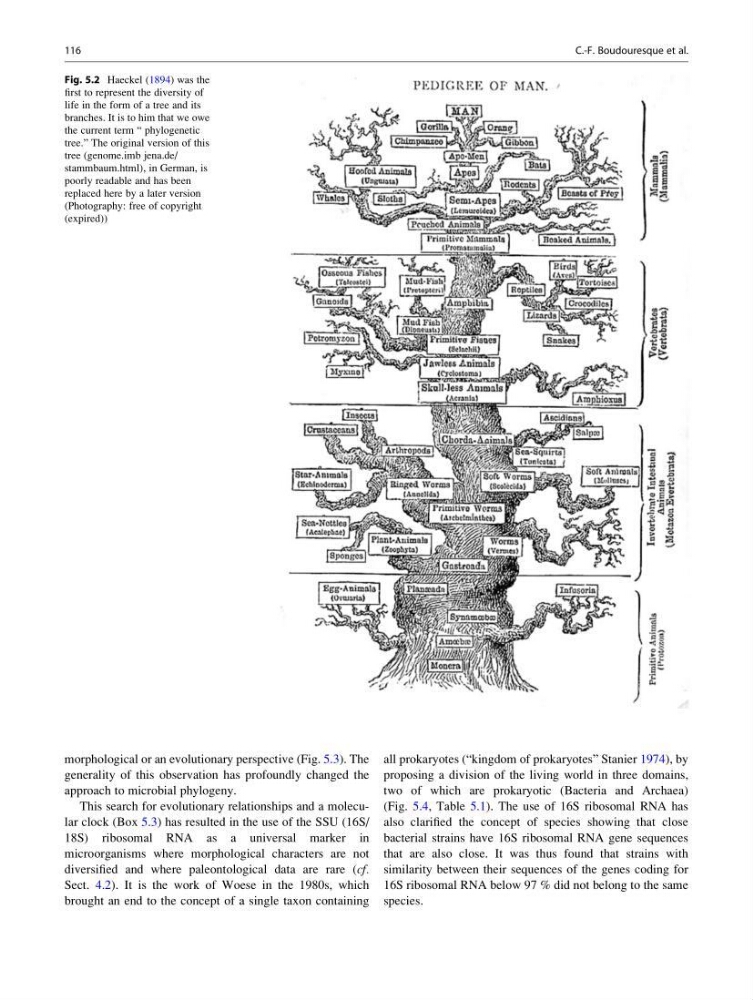
Fig. 5.2 Haeckel (1894) was the
first to represent the diversity of
life in the form of a tree and its
branches. It is to him that we owe
the current term “ phylogenetic
tree.” The original version of this
tree (genome.imb jena.de/
stammbaum.html), in German, is
poorly readable and has been
replaced here by a later version
(Photography: free of copyright
(expired))
116
C.-F. Boudouresque et al.
generality of this observation has profoundly changed the
approach to microbial phylogeny.
This search for evolutionary relationships and a molecular clock (Box 5.3) has resulted in the use of the SSU (16S/
18S) ribosomal RNA as a universal marker in
microorganisms where morphological characters are not
diversified and where paleontological data are rare (cf.
Sect. 4.2). It is the work of Woese in the 1980s, which
brought an end to the concept of a single taxon containing
all prokaryotes (“kingdom of prokaryotes” Stanier 1974), by
proposing a division of the living world in three domains,
two of which are prokaryotic (Bacteria and Archaea)
(Fig. 5.4, Table 5.1). The use of 16S ribosomal RNA has
also clarified the concept of species showing that close
bacterial strains have 16S ribosomal RNA gene sequences
that are also close. It was thus found that strains with
similarity between their sequences of the genes coding for
16S ribosomal RNA below 97 % did not belong to the same
species.
Fig. 5.2 Haeckel (1894) was the
first to represent the diversity of
life in the form of a tree and its
branches. It is to him that we owe
the current term “ phylogenetic
tree.” The original version of this
tree (genome.imb jena.de/
stammbaum.html), in German, is
poorly readable and has been
replaced here by a later version
(Photography: free of copyright
(expired))
116
C.-F. Boudouresque et al.