

process in hierarchical organization with multiple revisions
over the years based on the observation of morphological
and physiological parameters of microorganisms, but historical and evolutionary perspectives have been provided with
the explosion of tools and concepts of molecular biology,
placing the microorganisms in a comprehensive evolutionary scheme.
Starting with Haeckel (1894) (Fig. 5.2), the microbial
world was organized with two major kingdoms: the animal
kingdom including protozoa and the plant kingdom including microalgae and microscopic fungi, which are all eukaryotic microorganisms. Starting with Pasteur in 1860 and its
successors, the bacteria (prokaryotic microorganisms) were
included in the classification of life, but with great difficulty.
They were long included in the plant kingdom, in separate
branches, with microscopic fungi and microalgae (including
cyanobacteria, long known as blue-green algae or
Cyanophyceae). Gradually, this pattern changed when
cytology and biochemistry brought to understand that the
prokaryotes were fundamentally different from eukaryotes.
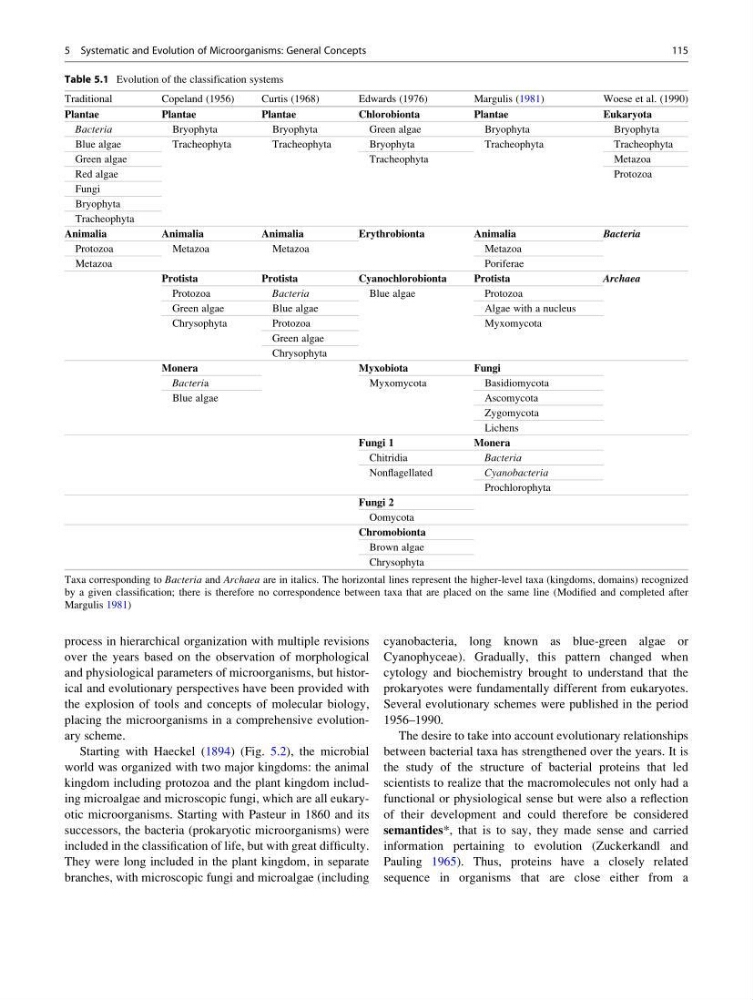
Several evolutionary schemes were published in the period
1956–1990.
The desire to take into account evolutionary relationships
between bacterial taxa has strengthened over the years. It is
the study of the structure of bacterial proteins that led
scientists to realize that the macromolecules not only had a
functional or physiological sense but were also a reflection
of their development and could therefore be considered
semantides*, that is to say, they made sense and carried
information pertaining to evolution (Zuckerkandl and
Pauling 1965). Thus, proteins have a closely related
sequence in organisms that are close either from a
Table 5.1 Evolution of the classification systems
Traditional
Copeland (1956)
Curtis (1968)
Edwards (1976)
Margulis (1981)
Woese et al. (1990)
Plantae
Plantae
Plantae
Chlorobionta
Plantae
Eukaryota
Bacteria
Bryophyta
Bryophyta
Green algae
Bryophyta
Bryophyta
Blue algae
Tracheophyta
Tracheophyta
Bryophyta
Tracheophyta
Tracheophyta
Green algae
Tracheophyta
Metazoa
Red algae
Protozoa
Fungi
Bryophyta
Tracheophyta
Animalia
Animalia
Animalia
Erythrobionta
Animalia
Bacteria
Protozoa
Metazoa
Metazoa
Metazoa
Metazoa
Poriferae
Protista
Protista
Cyanochlorobionta
Protista
Archaea
Protozoa
Bacteria
Blue algae
Protozoa
Green algae
Blue algae
Algae with a nucleus
Chrysophyta
Protozoa
Myxomycota
Green algae
Chrysophyta
Monera
Myxobiota
Fungi
Bacteria
Myxomycota
Basidiomycota
Blue algae
Ascomycota
Zygomycota
Lichens
Fungi 1
Monera
Chitridia
Bacteria
Nonflagellated
Cyanobacteria
Prochlorophyta
Fungi 2
Oomycota
Chromobionta
Brown algae
Chrysophyta
Taxa corresponding to Bacteria and Archaea are in italics. The horizontal lines represent the higher-level taxa (kingdoms, domains) recognized
by a given classification; there is therefore no correspondence between taxa that are placed on the same line (Modified and completed after
Margulis 1981)
5 Systematic and Evolution of Microorganisms: General Concepts
115
over the years based on the observation of morphological
and physiological parameters of microorganisms, but historical and evolutionary perspectives have been provided with
the explosion of tools and concepts of molecular biology,
placing the microorganisms in a comprehensive evolutionary scheme.
Starting with Haeckel (1894) (Fig. 5.2), the microbial
world was organized with two major kingdoms: the animal
kingdom including protozoa and the plant kingdom including microalgae and microscopic fungi, which are all eukaryotic microorganisms. Starting with Pasteur in 1860 and its
successors, the bacteria (prokaryotic microorganisms) were
included in the classification of life, but with great difficulty.
They were long included in the plant kingdom, in separate
branches, with microscopic fungi and microalgae (including
cyanobacteria, long known as blue-green algae or
Cyanophyceae). Gradually, this pattern changed when
cytology and biochemistry brought to understand that the
prokaryotes were fundamentally different from eukaryotes.
Several evolutionary schemes were published in the period
1956–1990.
The desire to take into account evolutionary relationships
between bacterial taxa has strengthened over the years. It is
the study of the structure of bacterial proteins that led
scientists to realize that the macromolecules not only had a
functional or physiological sense but were also a reflection
of their development and could therefore be considered
semantides*, that is to say, they made sense and carried
information pertaining to evolution (Zuckerkandl and
Pauling 1965). Thus, proteins have a closely related
sequence in organisms that are close either from a
Table 5.1 Evolution of the classification systems
Traditional
Copeland (1956)
Curtis (1968)
Edwards (1976)
Margulis (1981)
Woese et al. (1990)
Plantae
Plantae
Plantae
Chlorobionta
Plantae
Eukaryota
Bacteria
Bryophyta
Bryophyta
Green algae
Bryophyta
Bryophyta
Blue algae
Tracheophyta
Tracheophyta
Bryophyta
Tracheophyta
Tracheophyta
Green algae
Tracheophyta
Metazoa
Red algae
Protozoa
Fungi
Bryophyta
Tracheophyta
Animalia
Animalia
Animalia
Erythrobionta
Animalia
Bacteria
Protozoa
Metazoa
Metazoa
Metazoa
Metazoa
Poriferae
Protista
Protista
Cyanochlorobionta
Protista
Archaea
Protozoa
Bacteria
Blue algae
Protozoa
Green algae
Blue algae
Algae with a nucleus
Chrysophyta
Protozoa
Myxomycota
Green algae
Chrysophyta
Monera
Myxobiota
Fungi
Bacteria
Myxomycota
Basidiomycota
Blue algae
Ascomycota
Zygomycota
Lichens
Fungi 1
Monera
Chitridia
Bacteria
Nonflagellated
Cyanobacteria
Prochlorophyta
Fungi 2
Oomycota
Chromobionta
Brown algae
Chrysophyta
Taxa corresponding to Bacteria and Archaea are in italics. The horizontal lines represent the higher-level taxa (kingdoms, domains) recognized
by a given classification; there is therefore no correspondence between taxa that are placed on the same line (Modified and completed after
Margulis 1981)
5 Systematic and Evolution of Microorganisms: General Concepts
115