

702
cated food appears to be quite stable (McCracken and Fidgeon 1977 ). Moreover,
this method is advantageous insofar as the quantities of compound fed to the fi sh are
carefully controlled, and if sensible feeding regimes are adopted, only minimal
quantities would reach the waterways. Three provisos exist, namely that:
• the fi sh are capable of feeding,
• the drug is palatable,
• the drug is capable of absorption intact through the gut.
An interesting approach has involved bioencapsulation, principally of quinolones (Duis et al. 1995 ). This theme was expanded with some excellent work which
examined the potential for Artemia nauplii to serve as carriers to sulphamethoxazole
and trimethoprim for the chemotherapy of diseased marine fi sh fry (Touraki et al.
1996 ). Both these compounds accumulated in the nauplii, with maximal levels
recorded after 8 h. In a trial with sea bass larvae challenged with V. anguillarum , an
improvement in survival followed use of the medicated nauplii (Touraki et al. 1996 ).
Whether or not the fi sh will feed is largely a function of the nature and severity of
the disease. Often in advanced cases of disease the fi sh will not feed. Therefore, it
is vitally important that treatment begins as soon as possible after diagnosis has
been established. The aquaculturist will need to seek specialist advice as soon as
any abnormal behaviour or unhealthy condition is noted. This means that good management practices need to be routinely adopted.
Palatability of fi sheries antimicrobial compounds receives only scant attention.
Whereas it is accepted that little can be done to improve the palatability of the active
ingredient, effort could be directed towards improving binders and bulking agents,
which are commonly contained in proprietary mixes. Perhaps, consideration could
be given to using chemical attractants.
Application by the water-borne route becomes necessary if the fi sh refuse to eat,
and, therefore, would be unlikely to consume any medicated food. With these methods, the fi sh are exposed to solutions/suspensions of the drug for a pre-determined
period. This may be only briefl y, i.e. a few seconds duration (‘dip’), or for many
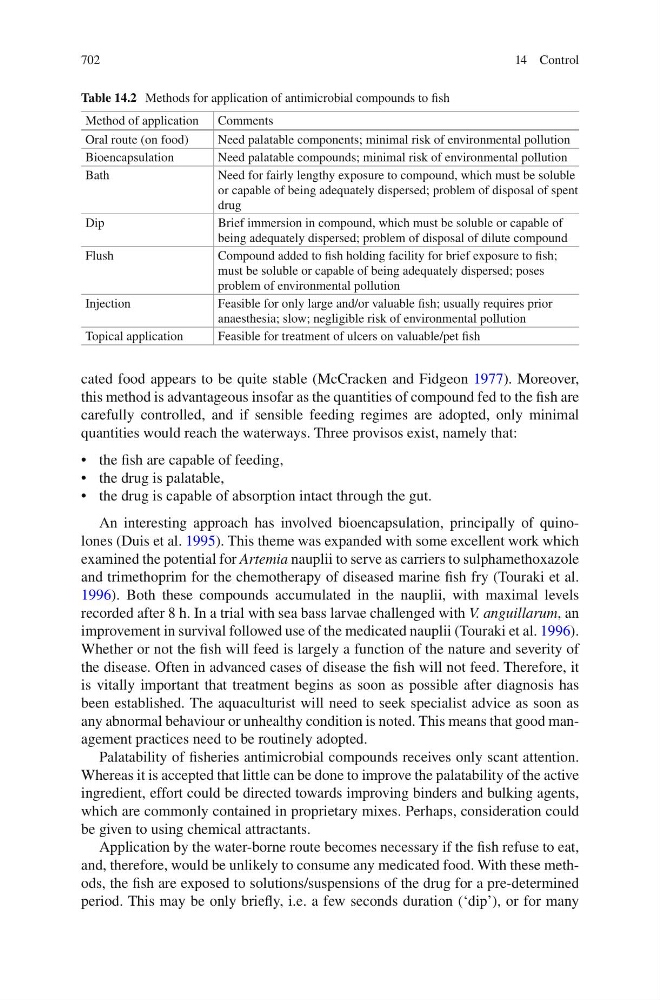
Table 14.2 Methods for application of antimicrobial compounds to fi sh
Method of application
Comments
Oral route (on food)
Need palatable components; minimal risk of environmental pollution
Bioencapsulation
Need palatable compounds; minimal risk of environmental pollution
Bath
Need for fairly lengthy exposure to compound, which must be soluble
or capable of being adequately dispersed; problem of disposal of spent
drug
Dip
Brief immersion in compound, which must be soluble or capable of
being adequately dispersed; problem of disposal of dilute compound
Flush
Compound added to fi sh holding facility for brief exposure to fi sh;
must be soluble or capable of being adequately dispersed; poses
problem of environmental pollution
Injection
Feasible for only large and/or valuable fi sh; usually requires prior
anaesthesia; slow; negligible risk of environmental pollution
Topical application
Feasible for treatment of ulcers on valuable/pet fi sh
14 Control