

26
anaerobic pathogen of fi sh (Henley and Lewis 1976 ), may well be synonymous with
Eu. tarantellae (Udey et al. 1977 ).
Unfortunately, the G + C ratio of the DNA was not determined. From these phenotypic characteristics, Udey et al. ( 1977 ) proposed that the organism should be
classifi ed in a new species, as Eubacterium tarantellus . Clearly, the fi sh isolates
possess the general characteristics of Eubacterium , i.e. Gram-positive anaerobic,
asporogenous, chemo-organotrophic, non-motile, catalase-negative rods, which
grow well at 37 °C (Moore and Holeman-Moore 1986 ). A comparison between the
descriptions of Eu. limosum and Eu. tarantellae reveals that, among comparative
tests, there are similarities. In fact, the only major differences concern hydrolysis of
aesculin and acid production from lactose and mannitol.
Epizootiology
So far, the organism has only been recovered from the brain of mullet and ten other
unnamed species of estuarine fi sh caught in Biscayne Bay and Florida Bay. It has
not been found outside this area. Moreover, the inability to grow in 2 % (w/v)
sodium chloride implies that the organism is likely to be restricted to estuarine environments (Udey et al. 1977 ). These authors considered that isolates recovered from
moribund fi sh, caught off the Texas coast and tentatively identifi ed as
Catenabacterium (Henley and Lewis 1976 ), also belong in Eubacterium , as Eu.
tarantellae . Therefore, the range would appear to be restricted to the warmer waters
of the southern part of the USA. It is uncertain whether or not the organism occurs
in water, or indeed as part of the resident microfl ora of fi sh, although Trust et al.
( 1979 ) isolated eubacteria from the intestinal tract of three fi sh species. Therefore,
it is conceivable that Eu. tarantellae could comprise part of the anaerobic microfl ora
of the digestive tract, although it will be necessary for further study to clarify this
point.
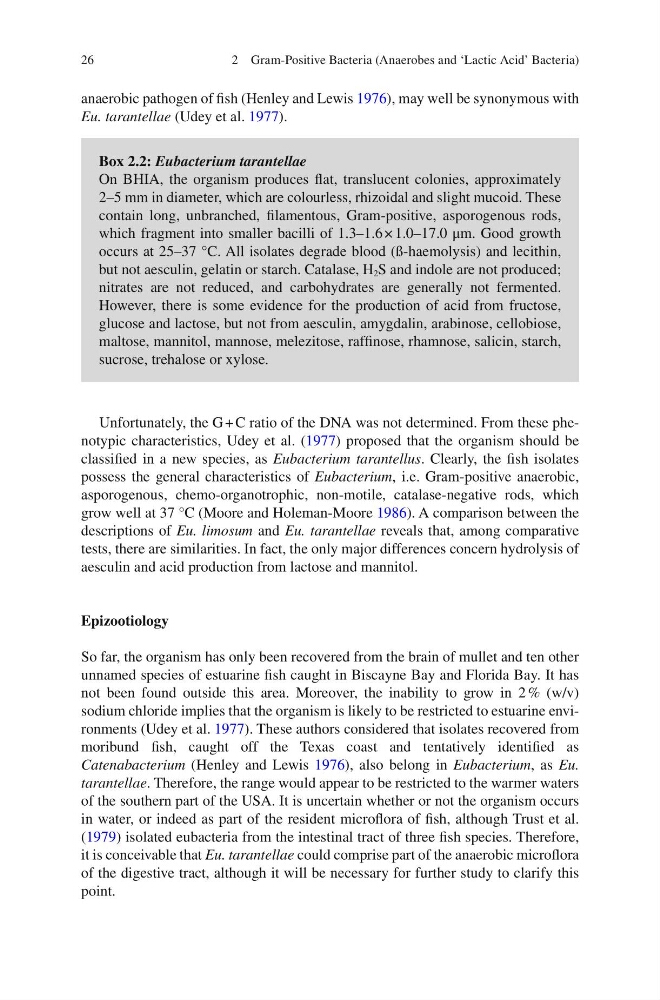
Box 2.2: Eubacterium tarantellae
On BHIA, the organism produces fl at, translucent colonies, approximately
2–5 mm in diameter, which are colourless, rhizoidal and slight mucoid. These
contain long, unbranched, fi lamentous, Gram-positive, asporogenous rods,
which fragment into smaller bacilli of 1.3–1.6 × 1.0–17.0 μm. Good growth
occurs at 25–37 °C. All isolates degrade blood (ß-haemolysis) and lecithin,
but not aesculin, gelatin or starch. Catalase, H 2 S and indole are not produced;
nitrates are not reduced, and carbohydrates are generally not fermented.
However, there is some evidence for the production of acid from fructose,
glucose and lactose, but not from aesculin, amygdalin, arabinose, cellobiose,
maltose, mannitol, mannose, melezitose, raffi nose, rhamnose, salicin, starch,
sucrose, trehalose or xylose.
2 Gram-Positive Bacteria (Anaerobes and ‘Lactic Acid’ Bacteria)
anaerobic pathogen of fi sh (Henley and Lewis 1976 ), may well be synonymous with
Eu. tarantellae (Udey et al. 1977 ).
Unfortunately, the G + C ratio of the DNA was not determined. From these phenotypic characteristics, Udey et al. ( 1977 ) proposed that the organism should be
classifi ed in a new species, as Eubacterium tarantellus . Clearly, the fi sh isolates
possess the general characteristics of Eubacterium , i.e. Gram-positive anaerobic,
asporogenous, chemo-organotrophic, non-motile, catalase-negative rods, which
grow well at 37 °C (Moore and Holeman-Moore 1986 ). A comparison between the
descriptions of Eu. limosum and Eu. tarantellae reveals that, among comparative
tests, there are similarities. In fact, the only major differences concern hydrolysis of
aesculin and acid production from lactose and mannitol.
Epizootiology
So far, the organism has only been recovered from the brain of mullet and ten other
unnamed species of estuarine fi sh caught in Biscayne Bay and Florida Bay. It has
not been found outside this area. Moreover, the inability to grow in 2 % (w/v)
sodium chloride implies that the organism is likely to be restricted to estuarine environments (Udey et al. 1977 ). These authors considered that isolates recovered from
moribund fi sh, caught off the Texas coast and tentatively identifi ed as
Catenabacterium (Henley and Lewis 1976 ), also belong in Eubacterium , as Eu.
tarantellae . Therefore, the range would appear to be restricted to the warmer waters
of the southern part of the USA. It is uncertain whether or not the organism occurs
in water, or indeed as part of the resident microfl ora of fi sh, although Trust et al.
( 1979 ) isolated eubacteria from the intestinal tract of three fi sh species. Therefore,
it is conceivable that Eu. tarantellae could comprise part of the anaerobic microfl ora
of the digestive tract, although it will be necessary for further study to clarify this
point.
Box 2.2: Eubacterium tarantellae
On BHIA, the organism produces fl at, translucent colonies, approximately
2–5 mm in diameter, which are colourless, rhizoidal and slight mucoid. These
contain long, unbranched, fi lamentous, Gram-positive, asporogenous rods,
which fragment into smaller bacilli of 1.3–1.6 × 1.0–17.0 μm. Good growth
occurs at 25–37 °C. All isolates degrade blood (ß-haemolysis) and lecithin,
but not aesculin, gelatin or starch. Catalase, H 2 S and indole are not produced;
nitrates are not reduced, and carbohydrates are generally not fermented.
However, there is some evidence for the production of acid from fructose,
glucose and lactose, but not from aesculin, amygdalin, arabinose, cellobiose,
maltose, mannitol, mannose, melezitose, raffi nose, rhamnose, salicin, starch,
sucrose, trehalose or xylose.
2 Gram-Positive Bacteria (Anaerobes and ‘Lactic Acid’ Bacteria)