

568
Characteristics of the Pathogen
A group of bacteria was recovered, which appeared to belong to the same taxon.
The closest neighbour was thought to be V. anguillarum type B (= V. anguillarum
forma anguillicida), according to the description of Nybelin ( 1935 ). However, this
group lacks taxonomic meaning, and consequently it was agreed to resurrect the
name of V. anguillicida (after Bruun and Heiberg 1935 ) to accommodate the organisms (Muroga et al. 1976a , b ; Nishibuchi et al. 1979 ). Some excellent detective
work by Tison et al. ( 1982 ) led to the realisation that the organisms, in fact, approximated V. vulnifi cus (= lactose-fermenting vibrios). A new biotype, i.e. biogroup 2,
was duly established. However, the biotype concept was considered no longer
appropriate (Arias et al. 1997a , b ), and it was subsequently deemed preferable to
refer to the organisms as a serovar rather than biotype (Biosca et al. 1997a ).
Nevertheless, V. vulnifi cus biotype 2 serovar A was subsequently described (Fouz
et al. 2006 ). A third biotype accommodates human isolates (Fouz et al. 2007 ).
Serotype A infects only fi sh whereas serotype E is virulent to both fi sh and humans
(Fouz et al. 2010 ). A complication is that analysis of 7 housekeeping and virulencerelated genes has revealed that the taxon comprises three phylogenetic lineages,
which do not match the current biotypes. Moreover, biotype 2 is polyphyletic,
which supports a notion that these pathogenic strains should be regarded as a pathovar (Sanjuán et al. 2011 ). From an examination of 80 cultures, eel isolates were
separated from others by ribotyping (Arias et al. 1997a , b ). Moreover, AFLP was
very discriminatory (Arias et al. 1997a , b ).
There are some differences between the species description of V. vulnifi cus and
the fi sh isolates. For example, the latter do not produce indole, ornithine
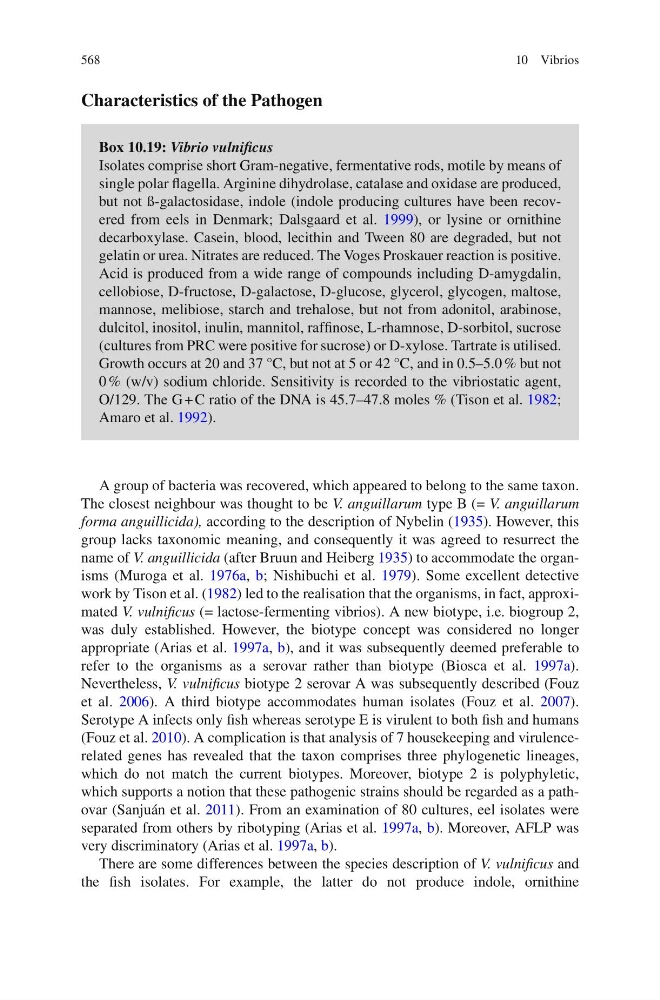
Box 10.19: Vibrio vulnifi cus
Isolates comprise short Gram-negative, fermentative rods, motile by means of
single polar fl agella. Arginine dihydrolase, catalase and oxidase are produced,
but not ß-galactosidase, indole (indole producing cultures have been recovered from eels in Denmark; Dalsgaard et al. 1999 ), or lysine or ornithine
decarboxylase. Casein, blood, lecithin and Tween 80 are degraded, but not
gelatin or urea. Nitrates are reduced. The Voges Proskauer reaction is positive.
Acid is produced from a wide range of compounds including D-amygdalin,
cellobiose, D-fructose, D-galactose, D-glucose, glycerol, glycogen, maltose,
mannose, melibiose, starch and trehalose, but not from adonitol, arabinose,
dulcitol, inositol, inulin, mannitol, raffi nose, L-rhamnose, D-sorbitol, sucrose
(cultures from PRC were positive for sucrose) or D-xylose. Tartrate is utilised.
Growth occurs at 20 and 37 °C, but not at 5 or 42 °C, and in 0.5–5.0 % but not
0 % (w/v) sodium chloride. Sensitivity is recorded to the vibriostatic agent,
O/129. The G + C ratio of the DNA is 45.7–47.8 moles % (Tison et al. 1982 ;
Amaro et al. 1992 ).
10 Vibrios