

558
V. ordalii was homogeneous by plasmid profi ling, ribotyping and serogrouping,
accommodated two LPS groups, and were heterogeneous by BIOLOG-GN fi ngerprints and API 20E profi les (Austin et al. 1997 ).
Results of DNA:DNA hybridisation studies have confi rmed the homogeneity and
validity of V. ordalii, with intraspecifi c homologies of approximately 80 %. There is
only a 58–59 % association with V. anguillarum (Schiewe et al. 1981 ). V. ordalii
contains plasmids (Tiainen et al. 1995 ), but the profi le is inevitably different to V.
anguillarum. In one study, Schiewe and Crosa ( 1981 ) determined that 11 isolates of
V. ordalii contained a common plasmid type (pMJ101) with a molecular weight of
20 mDa. Indeed, this plasmid (= ~32 kb) is common to all V. ordalii isolates
(Pedersen et al. 1996a ).
There is serological (antigenic) cross-reactivity between V. ordalii and V. anguillarum serogroup 02 (Chart and Trust 1984 ).
Diagnosis
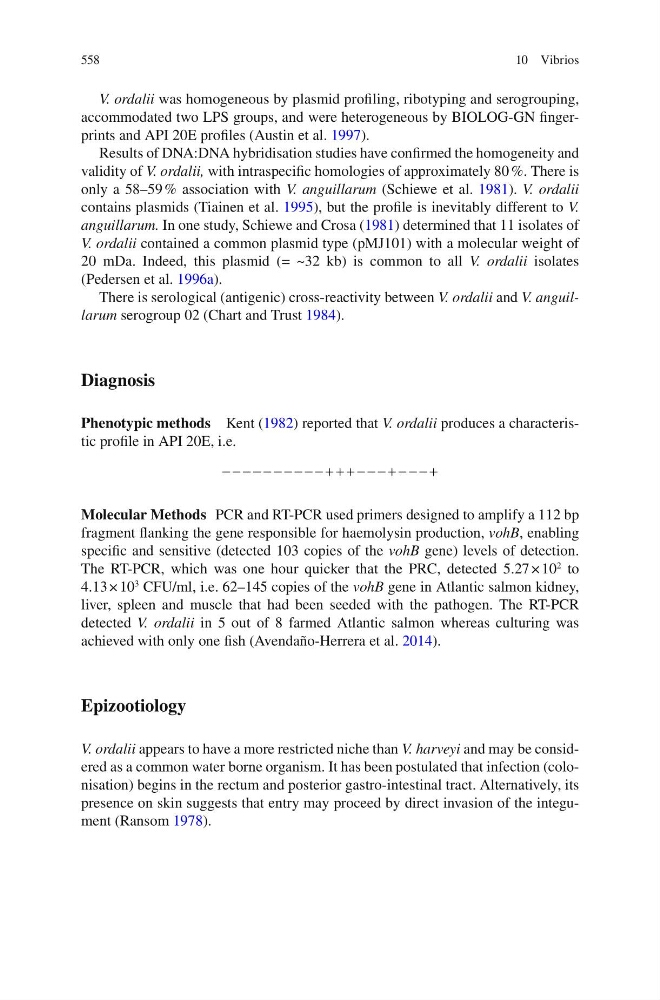
Phenotypic methods Kent ( 1982 ) reported that V. ordalii produces a characteristic profi le in API 20E, i.e.
Molecular Methods PCR and RT-PCR used primers designed to amplify a 112 bp
fragment fl anking the gene responsible for haemolysin production, vohB , enabling
specifi c and sensitive (detected 103 copies of the vohB gene) levels of detection.
The RT-PCR, which was one hour quicker that the PRC, detected 5.27 × 10
2 to
4.13 × 10
3 CFU/ml, i.e. 62–145 copies of the vohB gene in Atlantic salmon kidney,
liver, spleen and muscle that had been seeded with the pathogen. The RT-PCR
detected V. ordalii in 5 out of 8 farmed Atlantic salmon whereas culturing was
achieved with only one fi sh (Avendaño-Herrera et al. 2014 ).
Epizootiology
V. ordalii appears to have a more restricted niche than V. harveyi and may be considered as a common water borne organism. It has been postulated that infection (colonisation) begins in the rectum and posterior gastro-intestinal tract. Alternatively, its
presence on skin suggests that entry may proceed by direct invasion of the integument (Ransom 1978 ).
10 Vibrios