

422
Isolation
Cytophaga agar was used with gill, kidney, liver and samples from diseased rainbow
trout with incubation at 22 °C for 7 days. For these plates, 18 yellow-pigmented
isolates formed the basis of detailed taxonomic work leading to the proposal of a
new species, i.e. Fla. oncorhynchi (Zamora et al. 2012b ).
Characteristics of the Pathogen
The isolates were 99.2–100 % related by 16S rRNA sequence homology, with the
nearest neighbor as Fla. chungangense (98.6 % sequence homology), although the
corresponding DNA:DNA hybridization value was only 18.5 ± 7.8 % (Zamora et al.
2012b ).
Flavobacterium psychrophilum (=Cytophaga
psychrophila = Flexibacter psychrophilum)
Characteristics of the Diseases
Although this organism is mostly associated with infections in salmonids, it is
becoming increasingly associated with disease in other fi sh groups. For example, it
has become linked to tissue necrosis in the region of the mouth and with 40–60 %
mortalities in farmed perch ( Perca fl uviatilis ) in Finland (Lönnström et al. 2008 ).
Also, sea lamprey have become infected (Elsayed et al. 2006 ), and ayu has been
challenged successfully by immersion (Miwa and Nakayasu 2005 ). Mostly, this
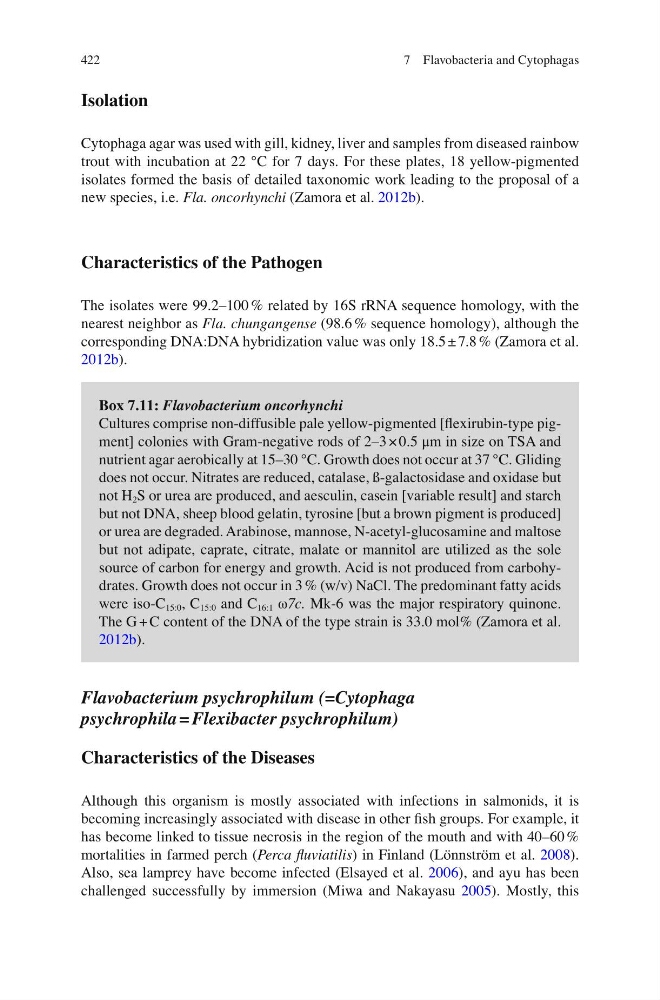
Box 7.11: Flavobacterium oncorhynchi
Cultures comprise non-diffusible pale yellow-pigmented [fl exirubin-type pigment] colonies with Gram-negative rods of 2–3 × 0.5 μm in size on TSA and
nutrient agar aerobically at 15–30 °C. Growth does not occur at 37 °C. Gliding
does not occur. Nitrates are reduced, catalase, ß-galactosidase and oxidase but
not H 2 S or urea are produced, and aesculin, casein [variable result] and starch
but not DNA, sheep blood gelatin, tyrosine [but a brown pigment is produced]
or urea are degraded. Arabinose, mannose, N-acetyl-glucosamine and maltose
but not adipate, caprate, citrate, malate or mannitol are utilized as the sole
source of carbon for energy and growth. Acid is not produced from carbohydrates. Growth does not occur in 3 % (w/v) NaCl. The predominant fatty acids
were iso-C 15:0 , C 15:0 and C 16:1 ω 7c. Mk-6 was the major respiratory quinone.
The G + C content of the DNA of the type strain is 33.0 mol% (Zamora et al.
2012b ).
7 Flavobacteria and Cytophagas
Isolation
Cytophaga agar was used with gill, kidney, liver and samples from diseased rainbow
trout with incubation at 22 °C for 7 days. For these plates, 18 yellow-pigmented
isolates formed the basis of detailed taxonomic work leading to the proposal of a
new species, i.e. Fla. oncorhynchi (Zamora et al. 2012b ).
Characteristics of the Pathogen
The isolates were 99.2–100 % related by 16S rRNA sequence homology, with the
nearest neighbor as Fla. chungangense (98.6 % sequence homology), although the
corresponding DNA:DNA hybridization value was only 18.5 ± 7.8 % (Zamora et al.
2012b ).
Flavobacterium psychrophilum (=Cytophaga
psychrophila = Flexibacter psychrophilum)
Characteristics of the Diseases
Although this organism is mostly associated with infections in salmonids, it is
becoming increasingly associated with disease in other fi sh groups. For example, it
has become linked to tissue necrosis in the region of the mouth and with 40–60 %
mortalities in farmed perch ( Perca fl uviatilis ) in Finland (Lönnström et al. 2008 ).
Also, sea lamprey have become infected (Elsayed et al. 2006 ), and ayu has been
challenged successfully by immersion (Miwa and Nakayasu 2005 ). Mostly, this
Box 7.11: Flavobacterium oncorhynchi
Cultures comprise non-diffusible pale yellow-pigmented [fl exirubin-type pigment] colonies with Gram-negative rods of 2–3 × 0.5 μm in size on TSA and
nutrient agar aerobically at 15–30 °C. Growth does not occur at 37 °C. Gliding
does not occur. Nitrates are reduced, catalase, ß-galactosidase and oxidase but
not H 2 S or urea are produced, and aesculin, casein [variable result] and starch
but not DNA, sheep blood gelatin, tyrosine [but a brown pigment is produced]
or urea are degraded. Arabinose, mannose, N-acetyl-glucosamine and maltose
but not adipate, caprate, citrate, malate or mannitol are utilized as the sole
source of carbon for energy and growth. Acid is not produced from carbohydrates. Growth does not occur in 3 % (w/v) NaCl. The predominant fatty acids
were iso-C 15:0 , C 15:0 and C 16:1 ω 7c. Mk-6 was the major respiratory quinone.
The G + C content of the DNA of the type strain is 33.0 mol% (Zamora et al.
2012b ).
7 Flavobacteria and Cytophagas