

421
Characteristics of the Pathogen
Fla. johnsoniae was identifi ed by an examination of phenotypic tests, and associated with mortalities in salmonids (Rintamäki-Kinnunen et al. 1997 ). Subsequently,
an organism with similarities to Flavobacterium johnsoniae has been recovered
from a variety of fi sh and disease conditions in South Africa (Flemming et al. 2007 ).
The characteristics for the fi sh isolates were as follows:
Disease Control
Vaccine An attenuated vaccine was developed by using a streptomycin-resistant
strategy leading to protection of grass carp ( Ctenopharyngodon idella ) to challenge (RPS = 34.8 % to 100 %) depending on where infected occurred at 28 or
240 days after vaccination, and whether the challenge was by i.p. injection or by
bath. The best results involved i.p. challenge at 28 days (RPS = 100 %) (Li et al.
2015b ).
Antimicrobial Compounds Acrifl avine and oxolinic acid were considered to be
effective treatments (Carson et al. 1993 ).
Flavobacterium oncorhynchi
Eighteen isolates were recovered from diseased rainbow trout in Spain, and named
as a new species, Fla. oncorhynchi (Zamora et al. 2012b ). Although pathogenicity
was not confi rmed in the initial publication, unpublished work has determined a
[systemic] pathogenic role in rainbow trout.
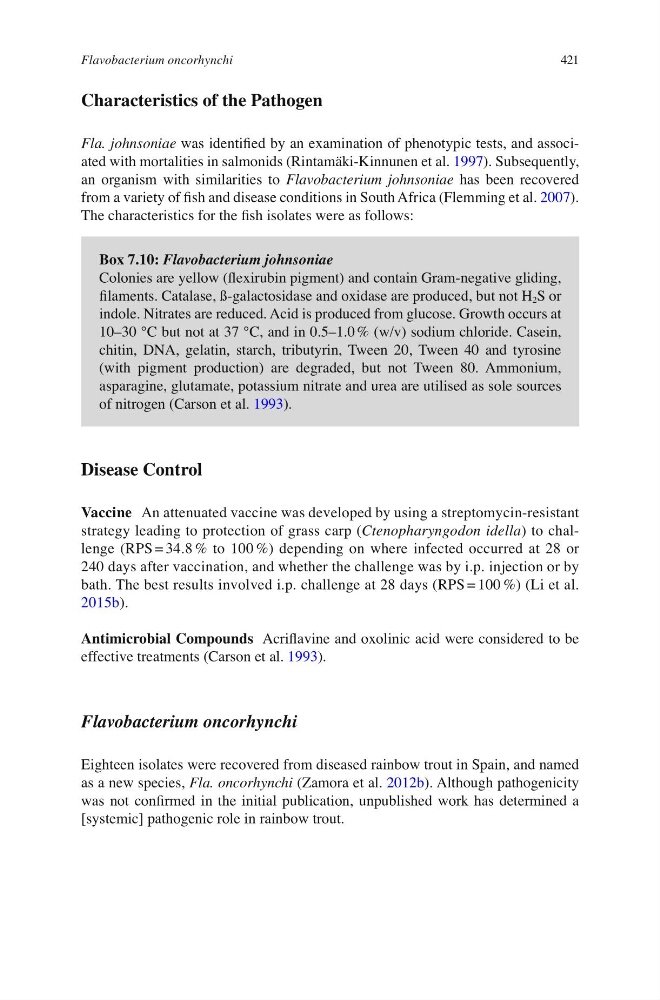
Box 7.10: Flavobacterium johnsoniae
Colonies are yellow (fl exirubin pigment) and contain Gram-negative gliding,
fi laments. Catalase, ß-galactosidase and oxidase are produced, but not H 2 S or
indole. Nitrates are reduced. Acid is produced from glucose. Growth occurs at
10–30 °C but not at 37 °C, and in 0.5–1.0 % (w/v) sodium chloride. Casein,
chitin, DNA, gelatin, starch, tributyrin, Tween 20, Tween 40 and tyrosine
(with pigment production) are degraded, but not Tween 80. Ammonium,
asparagine, glutamate, potassium nitrate and urea are utilised as sole sources
of nitrogen (Carson et al. 1993 ).
Flavobacterium oncorhynchi
Characteristics of the Pathogen
Fla. johnsoniae was identifi ed by an examination of phenotypic tests, and associated with mortalities in salmonids (Rintamäki-Kinnunen et al. 1997 ). Subsequently,
an organism with similarities to Flavobacterium johnsoniae has been recovered
from a variety of fi sh and disease conditions in South Africa (Flemming et al. 2007 ).
The characteristics for the fi sh isolates were as follows:
Disease Control
Vaccine An attenuated vaccine was developed by using a streptomycin-resistant
strategy leading to protection of grass carp ( Ctenopharyngodon idella ) to challenge (RPS = 34.8 % to 100 %) depending on where infected occurred at 28 or
240 days after vaccination, and whether the challenge was by i.p. injection or by
bath. The best results involved i.p. challenge at 28 days (RPS = 100 %) (Li et al.
2015b ).
Antimicrobial Compounds Acrifl avine and oxolinic acid were considered to be
effective treatments (Carson et al. 1993 ).
Flavobacterium oncorhynchi
Eighteen isolates were recovered from diseased rainbow trout in Spain, and named
as a new species, Fla. oncorhynchi (Zamora et al. 2012b ). Although pathogenicity
was not confi rmed in the initial publication, unpublished work has determined a
[systemic] pathogenic role in rainbow trout.
Box 7.10: Flavobacterium johnsoniae
Colonies are yellow (fl exirubin pigment) and contain Gram-negative gliding,
fi laments. Catalase, ß-galactosidase and oxidase are produced, but not H 2 S or
indole. Nitrates are reduced. Acid is produced from glucose. Growth occurs at
10–30 °C but not at 37 °C, and in 0.5–1.0 % (w/v) sodium chloride. Casein,
chitin, DNA, gelatin, starch, tributyrin, Tween 20, Tween 40 and tyrosine
(with pigment production) are degraded, but not Tween 80. Ammonium,
asparagine, glutamate, potassium nitrate and urea are utilised as sole sources
of nitrogen (Carson et al. 1993 ).
Flavobacterium oncorhynchi