

364
Characteristics of the Pathogen
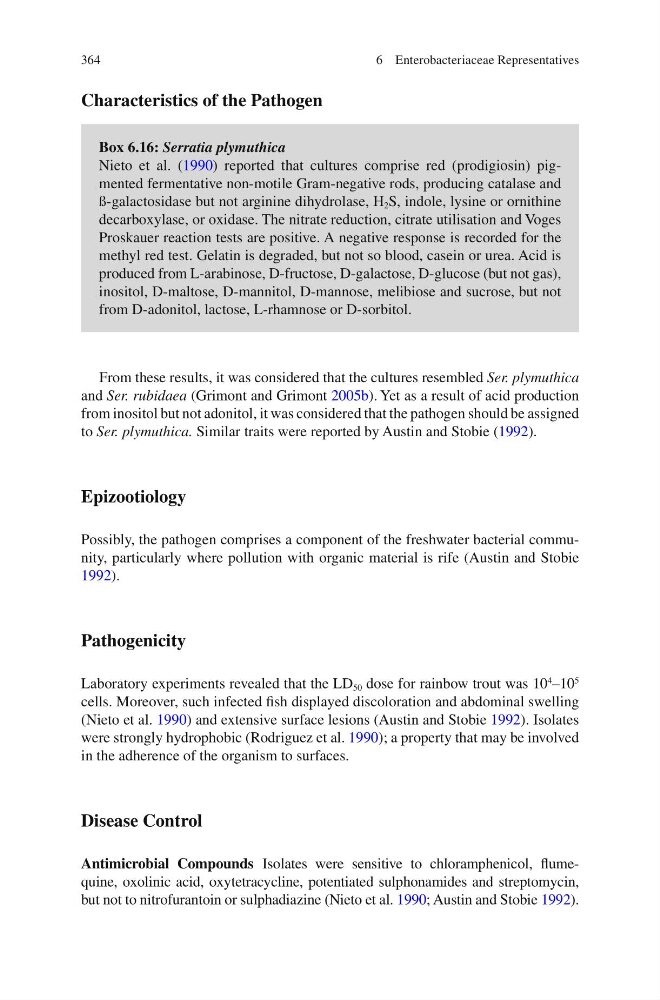
From these results, it was considered that the cultures resembled Ser. plymuthica
and Ser. rubidaea (Grimont and Grimont 2005b ). Yet as a result of acid production
from inositol but not adonitol, it was considered that the pathogen should be assigned
to Ser. plymuthica. Similar traits were reported by Austin and Stobie ( 1992 ).
Epizootiology
Possibly, the pathogen comprises a component of the freshwater bacterial community, particularly where pollution with organic material is rife (Austin and Stobie
1992 ).
Pathogenicity
Laboratory experiments revealed that the LD 50 dose for rainbow trout was 10
4 –10
5
cells. Moreover, such infected fi sh displayed discoloration and abdominal swelling
(Nieto et al. 1990 ) and extensive surface lesions (Austin and Stobie 1992 ). Isolates
were strongly hydrophobic (Rodriguez et al. 1990 ); a property that may be involved
in the adherence of the organism to surfaces.
Disease Control
Antimicrobial Compounds Isolates were sensitive to chloramphenicol, fl umequine, oxolinic acid, oxytetracycline, potentiated sulphonamides and streptomycin,
but not to nitrofurantoin or sulphadiazine (Nieto et al. 1990 ; Austin and Stobie 1992 ).
Box 6.16: Serratia plymuthica
Nieto et al. ( 1990 ) reported that cultures comprise red (prodigiosin) pigmented fermentative non-motile Gram-negative rods, producing catalase and
ß-galactosidase but not arginine dihydrolase, H 2 S, indole, lysine or ornithine
decarboxylase, or oxidase. The nitrate reduction, citrate utilisation and Voges
Proskauer reaction tests are positive. A negative response is recorded for the
methyl red test. Gelatin is degraded, but not so blood, casein or urea. Acid is
produced from L-arabinose, D-fructose, D-galactose, D-glucose (but not gas),
inositol, D-maltose, D-mannitol, D-mannose, melibiose and sucrose, but not
from D-adonitol, lactose, L-rhamnose or D-sorbitol.
6 Enterobacteriaceae Representatives
Characteristics of the Pathogen
From these results, it was considered that the cultures resembled Ser. plymuthica
and Ser. rubidaea (Grimont and Grimont 2005b ). Yet as a result of acid production
from inositol but not adonitol, it was considered that the pathogen should be assigned
to Ser. plymuthica. Similar traits were reported by Austin and Stobie ( 1992 ).
Epizootiology
Possibly, the pathogen comprises a component of the freshwater bacterial community, particularly where pollution with organic material is rife (Austin and Stobie
1992 ).
Pathogenicity
Laboratory experiments revealed that the LD 50 dose for rainbow trout was 10
4 –10
5
cells. Moreover, such infected fi sh displayed discoloration and abdominal swelling
(Nieto et al. 1990 ) and extensive surface lesions (Austin and Stobie 1992 ). Isolates
were strongly hydrophobic (Rodriguez et al. 1990 ); a property that may be involved
in the adherence of the organism to surfaces.
Disease Control
Antimicrobial Compounds Isolates were sensitive to chloramphenicol, fl umequine, oxolinic acid, oxytetracycline, potentiated sulphonamides and streptomycin,
but not to nitrofurantoin or sulphadiazine (Nieto et al. 1990 ; Austin and Stobie 1992 ).
Box 6.16: Serratia plymuthica
Nieto et al. ( 1990 ) reported that cultures comprise red (prodigiosin) pigmented fermentative non-motile Gram-negative rods, producing catalase and
ß-galactosidase but not arginine dihydrolase, H 2 S, indole, lysine or ornithine
decarboxylase, or oxidase. The nitrate reduction, citrate utilisation and Voges
Proskauer reaction tests are positive. A negative response is recorded for the
methyl red test. Gelatin is degraded, but not so blood, casein or urea. Acid is
produced from L-arabinose, D-fructose, D-galactose, D-glucose (but not gas),
inositol, D-maltose, D-mannitol, D-mannose, melibiose and sucrose, but not
from D-adonitol, lactose, L-rhamnose or D-sorbitol.
6 Enterobacteriaceae Representatives