

222
of rough-type colonies (this trait is associated with virulence) of Aer. salmonicida
were recovered on BHIA, than TSA.
In several instances, media supported with blood have been employed for the
isolation of the pathogen, especially atypical isolates from cyprinids. McCarthy
( 1977a ), however, stated that unsupplemented media, e.g. TSA, should be used in
preference to blood-containing media, but no explanation was given, other than that
the observations had resulted from extensive personal experiences.
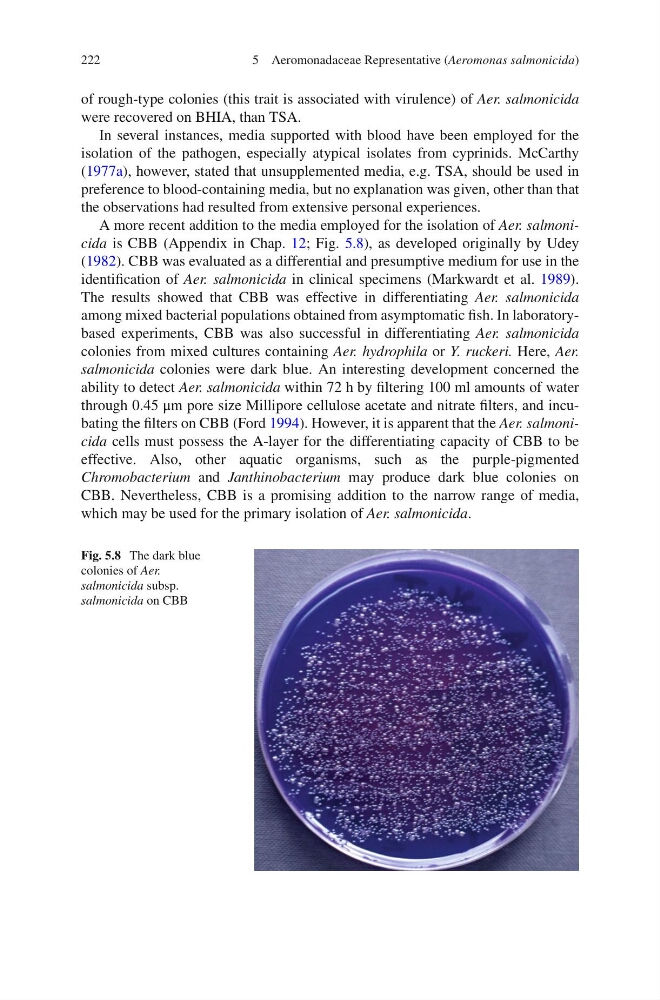
A more recent addition to the media employed for the isolation of Aer. salmonicida is CBB (Appendix in Chap. 12 ; Fig. 5.8 ), as developed originally by Udey
( 1982 ). CBB was evaluated as a differential and presumptive medium for use in the
identifi cation of Aer. salmonicida in clinical specimens (Markwardt et al. 1989 ).
The results showed that CBB was effective in differentiating Aer. salmonicida
among mixed bacterial populations obtained from asymptomatic fi sh. In laboratorybased experiments, CBB was also successful in differentiating Aer. salmonicida
colonies from mixed cultures containing Aer. hydrophila or Y. ruckeri. Here, Aer.
salmonicida colonies were dark blue. An interesting development concerned the
ability to detect Aer. salmonicida within 72 h by fi ltering 100 ml amounts of water
through 0.45 μm pore size Millipore cellulose acetate and nitrate fi lters, and incubating the fi lters on CBB (Ford 1994 ). However, it is apparent that the Aer. salmonicida cells must possess the A-layer for the differentiating capacity of CBB to be
effective. Also, other aquatic organisms, such as the purple-pigmented
Chromobacterium and Janthinobacterium may produce dark blue colonies on
CBB. Nevertheless, CBB is a promising addition to the narrow range of media,
which may be used for the primary isolation of Aer. salmonicida .
Fig. 5.8 The dark blue
colonies of Aer.
salmonicida subsp.
salmonicida on CBB
5 Aeromonadaceae Representative (Aeromonas salmonicida)
of rough-type colonies (this trait is associated with virulence) of Aer. salmonicida
were recovered on BHIA, than TSA.
In several instances, media supported with blood have been employed for the
isolation of the pathogen, especially atypical isolates from cyprinids. McCarthy
( 1977a ), however, stated that unsupplemented media, e.g. TSA, should be used in
preference to blood-containing media, but no explanation was given, other than that
the observations had resulted from extensive personal experiences.
A more recent addition to the media employed for the isolation of Aer. salmonicida is CBB (Appendix in Chap. 12 ; Fig. 5.8 ), as developed originally by Udey
( 1982 ). CBB was evaluated as a differential and presumptive medium for use in the
identifi cation of Aer. salmonicida in clinical specimens (Markwardt et al. 1989 ).
The results showed that CBB was effective in differentiating Aer. salmonicida
among mixed bacterial populations obtained from asymptomatic fi sh. In laboratorybased experiments, CBB was also successful in differentiating Aer. salmonicida
colonies from mixed cultures containing Aer. hydrophila or Y. ruckeri. Here, Aer.
salmonicida colonies were dark blue. An interesting development concerned the
ability to detect Aer. salmonicida within 72 h by fi ltering 100 ml amounts of water
through 0.45 μm pore size Millipore cellulose acetate and nitrate fi lters, and incubating the fi lters on CBB (Ford 1994 ). However, it is apparent that the Aer. salmonicida cells must possess the A-layer for the differentiating capacity of CBB to be
effective. Also, other aquatic organisms, such as the purple-pigmented
Chromobacterium and Janthinobacterium may produce dark blue colonies on
CBB. Nevertheless, CBB is a promising addition to the narrow range of media,
which may be used for the primary isolation of Aer. salmonicida .
Fig. 5.8 The dark blue
colonies of Aer.
salmonicida subsp.
salmonicida on CBB
5 Aeromonadaceae Representative (Aeromonas salmonicida)