

221
suppressed or pigment production inhibited. For these reasons, McCarthy and
Roberts ( 1980 ) recommended that a minimum of six fi sh should be sampled from
any disease outbreak where the presence of Aer. salmonicida is suspected. Also,
they suggested that samples destined for bacteriological examination should be
taken from skin lesions, in all stages of development. In a similar vein, Daly and
Stevenson ( 1985 ) concluded that it is advisable to sample other organs, i.e. heart,
liver and spleen, in addition to the kidney in order to increase the chances of detecting Aer. salmonicida . Indeed, these workers found that 45 % (14/31) of successful
isolations of the pathogen from brown trout, Salmo trutta, were from organs other
than kidney. Likewise, in a study to detect carrier rates of the pathogen, Rose et al.
( 1989 ) concluded that sampling of just the kidney might result in an underestimate
of the numbers of fi sh harbouring the pathogen. Thus, they recommended examining the intestine as well as the kidney for the presence of Aer. salmonicida . The
problem is with the asymptomatic carriers from which recovery of the pathogen is
notoriously diffi cult without stressing the fi sh (Cipriano et al. 1997 ).
In an attempt to improve the chances of recovering Aer. salmonicida from lake
trout in a hatchery experiencing an outbreak of furunculosis, an enrichment procedure using TSB was evaluated by Daly and Stevenson ( 1985 ). This entailed placing
swabbed material, derived from the organs of diseased animals, into TSB with incubation at 26 °C for 48 h. Then, the resulting broth cultures were streaked for single
colony isolation onto plates of TSA. The results indicated that the recovery of Aer.
salmonicida was twice that of using the conventional direct plating of swabbed
material onto TSA.
The use of BHIA for isolation and maintenance of Aer. salmonicida has been
recommended by some groups. In fact, we have observed that a greater proportion
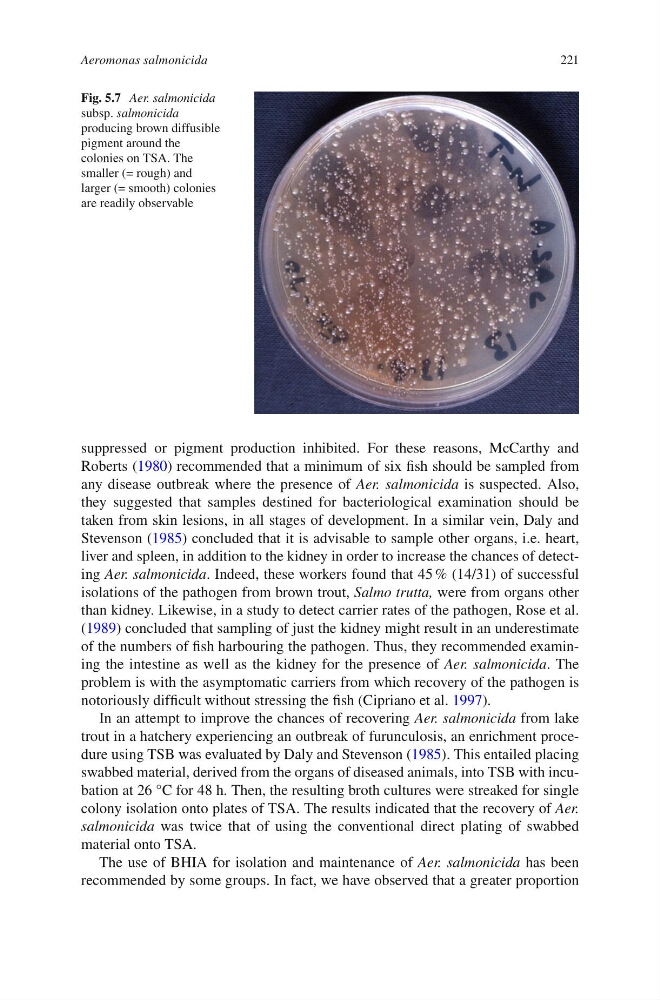
Fig. 5.7 Aer. salmonicida
subsp. salmonicida
producing brown diffusible
pigment around the
colonies on TSA. The
smaller (= rough) and
larger (= smooth) colonies
are readily observable
Aeromonas salmonicida
suppressed or pigment production inhibited. For these reasons, McCarthy and
Roberts ( 1980 ) recommended that a minimum of six fi sh should be sampled from
any disease outbreak where the presence of Aer. salmonicida is suspected. Also,
they suggested that samples destined for bacteriological examination should be
taken from skin lesions, in all stages of development. In a similar vein, Daly and
Stevenson ( 1985 ) concluded that it is advisable to sample other organs, i.e. heart,
liver and spleen, in addition to the kidney in order to increase the chances of detecting Aer. salmonicida . Indeed, these workers found that 45 % (14/31) of successful
isolations of the pathogen from brown trout, Salmo trutta, were from organs other
than kidney. Likewise, in a study to detect carrier rates of the pathogen, Rose et al.
( 1989 ) concluded that sampling of just the kidney might result in an underestimate
of the numbers of fi sh harbouring the pathogen. Thus, they recommended examining the intestine as well as the kidney for the presence of Aer. salmonicida . The
problem is with the asymptomatic carriers from which recovery of the pathogen is
notoriously diffi cult without stressing the fi sh (Cipriano et al. 1997 ).
In an attempt to improve the chances of recovering Aer. salmonicida from lake
trout in a hatchery experiencing an outbreak of furunculosis, an enrichment procedure using TSB was evaluated by Daly and Stevenson ( 1985 ). This entailed placing
swabbed material, derived from the organs of diseased animals, into TSB with incubation at 26 °C for 48 h. Then, the resulting broth cultures were streaked for single
colony isolation onto plates of TSA. The results indicated that the recovery of Aer.
salmonicida was twice that of using the conventional direct plating of swabbed
material onto TSA.
The use of BHIA for isolation and maintenance of Aer. salmonicida has been
recommended by some groups. In fact, we have observed that a greater proportion
Fig. 5.7 Aer. salmonicida
subsp. salmonicida
producing brown diffusible
pigment around the
colonies on TSA. The
smaller (= rough) and
larger (= smooth) colonies
are readily observable
Aeromonas salmonicida