

169
lead to the sloughing-off of scales), local haemorrhages particularly in the gills and
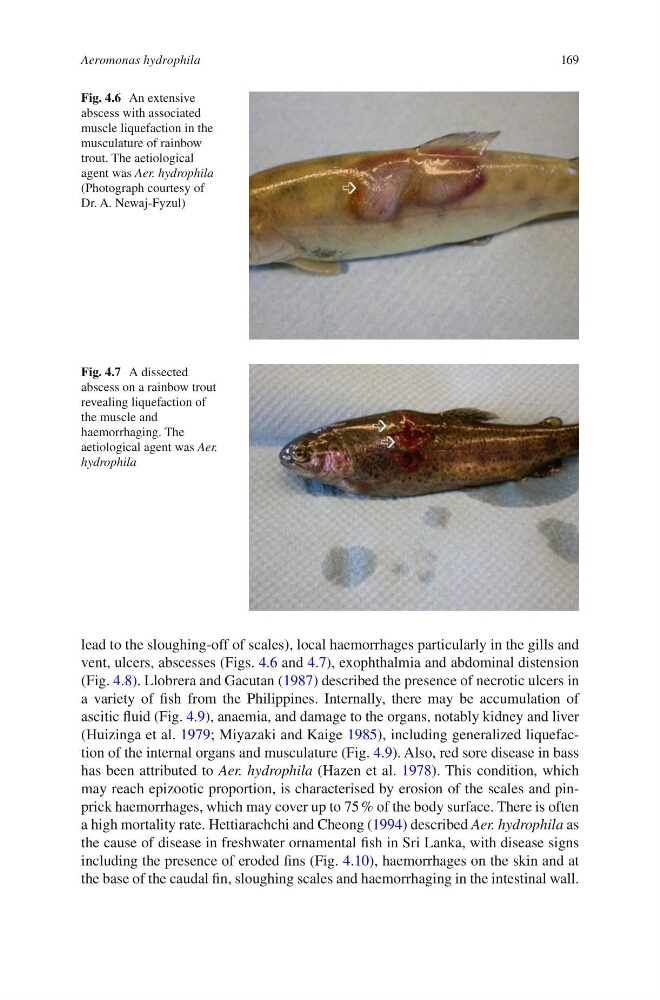
vent, ulcers, abscesses (Figs. 4.6 and 4.7 ), exophthalmia and abdominal distension
(Fig. 4.8 ). Llobrera and Gacutan ( 1987 ) described the presence of necrotic ulcers in
a variety of fi sh from the Philippines. Internally, there may be accumulation of
ascitic fl uid (Fig. 4.9 ), anaemia, and damage to the organs, notably kidney and liver
(Huizinga et al. 1979 ; Miyazaki and Kaige 1985 ), including generalized liquefaction of the internal organs and musculature (Fig. 4.9 ). Also, red sore disease in bass
has been attributed to Aer. hydrophila (Hazen et al. 1978 ). This condition, which
may reach epizootic proportion, is characterised by erosion of the scales and pinprick haemorrhages, which may cover up to 75 % of the body surface. There is often
a high mortality rate. Hettiarachchi and Cheong ( 1994 ) described Aer. hydrophila as
the cause of disease in freshwater ornamental fi sh in Sri Lanka, with disease signs
including the presence of eroded fi ns (Fig. 4.10 ), haemorrhages on the skin and at
the base of the caudal fi n, sloughing scales and haemorrhaging in the intestinal wall.
Fig. 4.6 An extensive
abscess with associated
muscle liquefaction in the
musculature of rainbow
trout. The aetiological
agent was Aer. hydrophila
(Photograph courtesy of
Dr. A. Newaj-Fyzul)
Fig. 4.7 A dissected
abscess on a rainbow trout
revealing liquefaction of
the muscle and
haemorrhaging. The
aetiological agent was Aer.
hydrophila
Aeromonas hydrophila
lead to the sloughing-off of scales), local haemorrhages particularly in the gills and
vent, ulcers, abscesses (Figs. 4.6 and 4.7 ), exophthalmia and abdominal distension
(Fig. 4.8 ). Llobrera and Gacutan ( 1987 ) described the presence of necrotic ulcers in
a variety of fi sh from the Philippines. Internally, there may be accumulation of
ascitic fl uid (Fig. 4.9 ), anaemia, and damage to the organs, notably kidney and liver
(Huizinga et al. 1979 ; Miyazaki and Kaige 1985 ), including generalized liquefaction of the internal organs and musculature (Fig. 4.9 ). Also, red sore disease in bass
has been attributed to Aer. hydrophila (Hazen et al. 1978 ). This condition, which
may reach epizootic proportion, is characterised by erosion of the scales and pinprick haemorrhages, which may cover up to 75 % of the body surface. There is often
a high mortality rate. Hettiarachchi and Cheong ( 1994 ) described Aer. hydrophila as
the cause of disease in freshwater ornamental fi sh in Sri Lanka, with disease signs
including the presence of eroded fi ns (Fig. 4.10 ), haemorrhages on the skin and at
the base of the caudal fi n, sloughing scales and haemorrhaging in the intestinal wall.
Fig. 4.6 An extensive
abscess with associated
muscle liquefaction in the
musculature of rainbow
trout. The aetiological
agent was Aer. hydrophila
(Photograph courtesy of
Dr. A. Newaj-Fyzul)
Fig. 4.7 A dissected
abscess on a rainbow trout
revealing liquefaction of
the muscle and
haemorrhaging. The
aetiological agent was Aer.
hydrophila
Aeromonas hydrophila