

168
between strains from these two countries with the suggestion that American strains
have an Asian origin/ancester (Hossain et al. 2014 ). However, some doubt has been
expressed over its precise role as a fi sh pathogen (Heuschmann-Brunner 1965 ;
Eurell et al. 1978 ; Michel 1981 ) with some workers contending that it may be
merely a secondary invader of already compromised hosts. Conversely, other groups
have insisted that Aer. hydrophila constitutes a primary pathogen. To some extent,
the signifi cance of Aer. hydrophila and its synonyms Aer. formicans and Aer. liquefaciens, as a fi sh pathogen has been overshadowed by Aer. salmonicida.
Aer. hydrophila has been credited with causing several distinct pathological conditions, including tail/fi n rot and haemorrhagic septicaemias (e.g. Hettiarachchi and
Cheong 1994 ). The organism may be found commonly in association with other
pathogens, such as Aer. salmonicida. There is evidence that prior infestation with
parasites, namely Ichthyophthirius multifi liis (= Ich) in channel catfi sh, may lead to
the development of heightened bacterial populations ( Aer. hydrophila) in the gills,
kidney, liver, skin and spleen and mortalities by Aer. hydrophila (Xu et al. 2012 ).
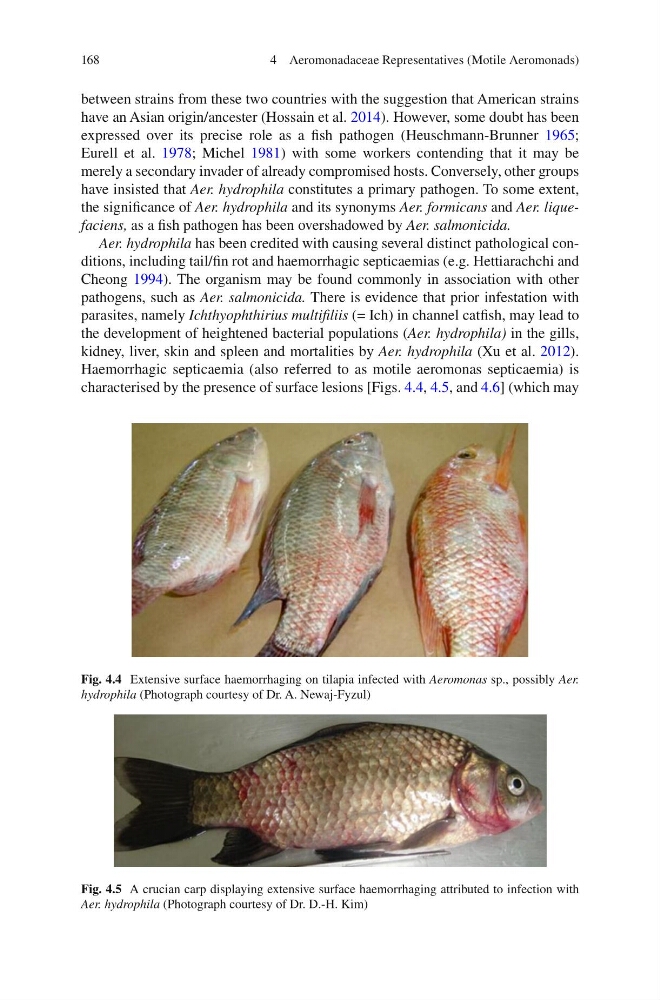
Haemorrhagic septicaemia (also referred to as motile aeromonas septicaemia) is
characterised by the presence of surface lesions [Figs. 4.4 , 4.5 , and 4.6 ] (which may
Fig. 4.4 Extensive surface haemorrhaging on tilapia infected with Aeromonas sp., possibly Aer.
hydrophila (Photograph courtesy of Dr. A. Newaj-Fyzul)
Fig. 4.5 A crucian carp displaying extensive surface haemorrhaging attributed to infection with
Aer. hydrophila (Photograph courtesy of Dr. D.-H. Kim)
4 Aeromonadaceae Representatives (Motile Aeromonads)
between strains from these two countries with the suggestion that American strains
have an Asian origin/ancester (Hossain et al. 2014 ). However, some doubt has been
expressed over its precise role as a fi sh pathogen (Heuschmann-Brunner 1965 ;
Eurell et al. 1978 ; Michel 1981 ) with some workers contending that it may be
merely a secondary invader of already compromised hosts. Conversely, other groups
have insisted that Aer. hydrophila constitutes a primary pathogen. To some extent,
the signifi cance of Aer. hydrophila and its synonyms Aer. formicans and Aer. liquefaciens, as a fi sh pathogen has been overshadowed by Aer. salmonicida.
Aer. hydrophila has been credited with causing several distinct pathological conditions, including tail/fi n rot and haemorrhagic septicaemias (e.g. Hettiarachchi and
Cheong 1994 ). The organism may be found commonly in association with other
pathogens, such as Aer. salmonicida. There is evidence that prior infestation with
parasites, namely Ichthyophthirius multifi liis (= Ich) in channel catfi sh, may lead to
the development of heightened bacterial populations ( Aer. hydrophila) in the gills,
kidney, liver, skin and spleen and mortalities by Aer. hydrophila (Xu et al. 2012 ).
Haemorrhagic septicaemia (also referred to as motile aeromonas septicaemia) is
characterised by the presence of surface lesions [Figs. 4.4 , 4.5 , and 4.6 ] (which may
Fig. 4.4 Extensive surface haemorrhaging on tilapia infected with Aeromonas sp., possibly Aer.
hydrophila (Photograph courtesy of Dr. A. Newaj-Fyzul)
Fig. 4.5 A crucian carp displaying extensive surface haemorrhaging attributed to infection with
Aer. hydrophila (Photograph courtesy of Dr. D.-H. Kim)
4 Aeromonadaceae Representatives (Motile Aeromonads)