

139
Staphylococcus epidermidis
Characteristics of the Disease
The fi rst reports of fi sh pathogenic strains of Staphylococcus epidermidis have emanated from Japan where, from July 1976 to September 1977, severe epizootics
occurred in farmed yellowtail ( Seriola quinqueradiata) and red sea bream ( Chrysophrus
major) (Kusuda and Sugiyama 1981 ; Sugiyama and Kusuda 1981a , b ). The initial
description of the disease was not exhaustive, but typical signs included exophthalmia,
congestion, and ulceration on the tail (Kusuda and Sugiyama 1981 ). Later, Sta. epidermidis was recovered from moribund cultured grass carp in Taiwan (Wang et al. 1996 ).
Here, the fi sh displayed haemorrhages on the opercula and pelvic fi ns. Internally, petechial haemorrhages and bloody ascites were observed. Although tapeworms were
present in the lumen of the intestine, smears revealed the presence of oval bacteria,
which were isolated, and considered to represent Sta. epidermidis (Wang et al. 1996 ).
The organism was associated with mortalities of up to 12 % in 1 day coinciding with a
sudden increase in water temperature in juvenile gilthead sea bream in Turkey during
2003. The diseased fi sh displayed haemorrhaging on the fi ns and gills, a slightly distended abdomen with ascites, and anaemic liver (Kubilay and Uloköy 2004 ).
Isolation
The pathogen was successfully cultured on BHIA following incubation at 37 °C for
24 h (Kusuda and Sugiyama 1981 ). However, the use of such a high temperature is
puzzling, and it is conceivable that mesophiles, preferring lower growth temperatures, may have been overlooked.
Characteristics of the Pathogen
From the outbreaks in Japan, six isolates, identifi ed as Sta. epidermidis , were
recovered:
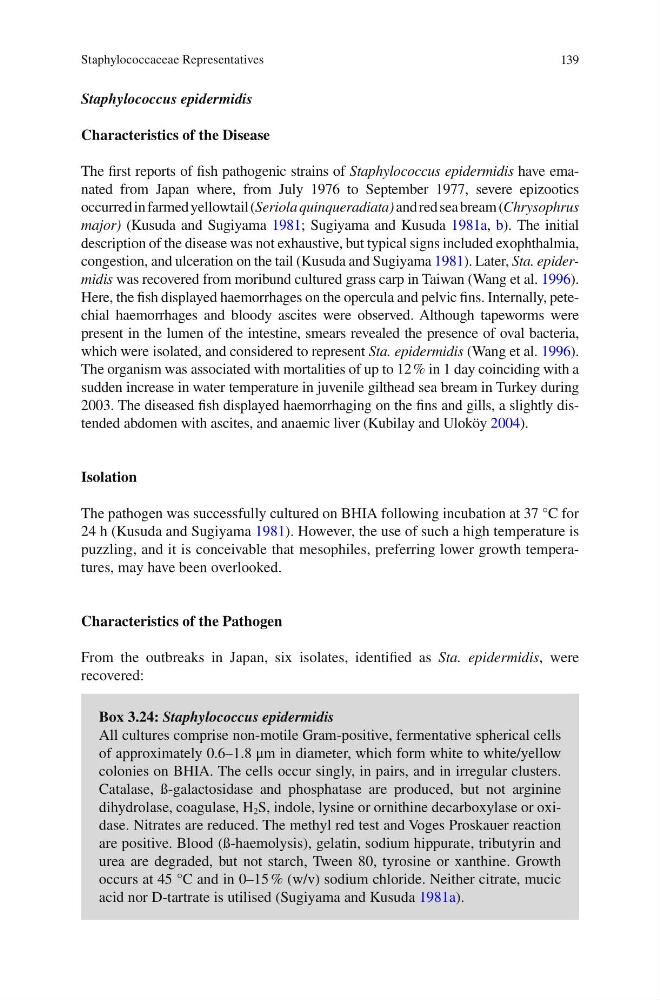
Box 3.24: Staphylococcus epidermidis
All cultures comprise non-motile Gram-positive, fermentative spherical cells
of approximately 0.6–1.8 μm in diameter, which form white to white/yellow
colonies on BHIA. The cells occur singly, in pairs, and in irregular clusters.
Catalase, ß-galactosidase and phosphatase are produced, but not arginine
dihydrolase, coagulase, H 2 S, indole, lysine or ornithine decarboxylase or oxidase. Nitrates are reduced. The methyl red test and Voges Proskauer reaction
are positive. Blood (ß-haemolysis), gelatin, sodium hippurate, tributyrin and
urea are degraded, but not starch, Tween 80, tyrosine or xanthine. Growth
occurs at 45 °C and in 0–15 % (w/v) sodium chloride. Neither citrate, mucic
acid nor D-tartrate is utilised (Sugiyama and Kusuda 1981a ).
Staphylococcaceae Representatives
Staphylococcus epidermidis
Characteristics of the Disease
The fi rst reports of fi sh pathogenic strains of Staphylococcus epidermidis have emanated from Japan where, from July 1976 to September 1977, severe epizootics
occurred in farmed yellowtail ( Seriola quinqueradiata) and red sea bream ( Chrysophrus
major) (Kusuda and Sugiyama 1981 ; Sugiyama and Kusuda 1981a , b ). The initial
description of the disease was not exhaustive, but typical signs included exophthalmia,
congestion, and ulceration on the tail (Kusuda and Sugiyama 1981 ). Later, Sta. epidermidis was recovered from moribund cultured grass carp in Taiwan (Wang et al. 1996 ).
Here, the fi sh displayed haemorrhages on the opercula and pelvic fi ns. Internally, petechial haemorrhages and bloody ascites were observed. Although tapeworms were
present in the lumen of the intestine, smears revealed the presence of oval bacteria,
which were isolated, and considered to represent Sta. epidermidis (Wang et al. 1996 ).
The organism was associated with mortalities of up to 12 % in 1 day coinciding with a
sudden increase in water temperature in juvenile gilthead sea bream in Turkey during
2003. The diseased fi sh displayed haemorrhaging on the fi ns and gills, a slightly distended abdomen with ascites, and anaemic liver (Kubilay and Uloköy 2004 ).
Isolation
The pathogen was successfully cultured on BHIA following incubation at 37 °C for
24 h (Kusuda and Sugiyama 1981 ). However, the use of such a high temperature is
puzzling, and it is conceivable that mesophiles, preferring lower growth temperatures, may have been overlooked.
Characteristics of the Pathogen
From the outbreaks in Japan, six isolates, identifi ed as Sta. epidermidis , were
recovered:
Box 3.24: Staphylococcus epidermidis
All cultures comprise non-motile Gram-positive, fermentative spherical cells
of approximately 0.6–1.8 μm in diameter, which form white to white/yellow
colonies on BHIA. The cells occur singly, in pairs, and in irregular clusters.
Catalase, ß-galactosidase and phosphatase are produced, but not arginine
dihydrolase, coagulase, H 2 S, indole, lysine or ornithine decarboxylase or oxidase. Nitrates are reduced. The methyl red test and Voges Proskauer reaction
are positive. Blood (ß-haemolysis), gelatin, sodium hippurate, tributyrin and
urea are degraded, but not starch, Tween 80, tyrosine or xanthine. Growth
occurs at 45 °C and in 0–15 % (w/v) sodium chloride. Neither citrate, mucic
acid nor D-tartrate is utilised (Sugiyama and Kusuda 1981a ).
Staphylococcaceae Representatives