

93
regarded as having spread over the last century with the developments of aquaculture and stocking of fi sheries; lineage 2 was endemic in wild salmonids from the
eastern Atlantic Ocean (Brynildsrud et al. 2014 ).
Diagnosis
Histology Historically, diagnosis of BKD was achieved histologically, by the presence of Gram-positive cocco-bacilli in kidney tissue. However, the reliability was
impaired by the presence of melanin granules and other morphologically similar
bacteria (Chen et al. 1974 ). A subsequent derivative has been a histochemical technique using Lillie’s allochrome to stain glycogen in the bacteria (Bruno and Munro
1992 ). Again, interference could result from the presence of other morphologically
similar glycogen-containing bacteria.
Culturing The early spate of interest in culturing techniques improved diagnosis
but the effectiveness was marred by the apparently slow growth of the organisms,
i.e. up to 6 weeks at 15 °C. In fact, recent evidence suggests that 19 weeks may be
necessary for the initial incubation period. Therefore, there was widespread attention focused on serological procedures as being the saviour of diagnosticians.
Certainly, the selective medium (SKDM; Austin et al. 1983 ) has proved useful in
isolating Renibacterium from mixed cultures. In addition, during a comparative
exercise with KDM2, SKDM consistently enabled a greater recovery of cells from
infected fi sh. In some cases, scant growth of only one or two colonies were recovered from kidney tissue on SKDM, although the parallel KDM2 plates were devoid
of any growth (Fig. 3.5 ; Austin et al. 1983 ). Suspect cultures of renibacteria were
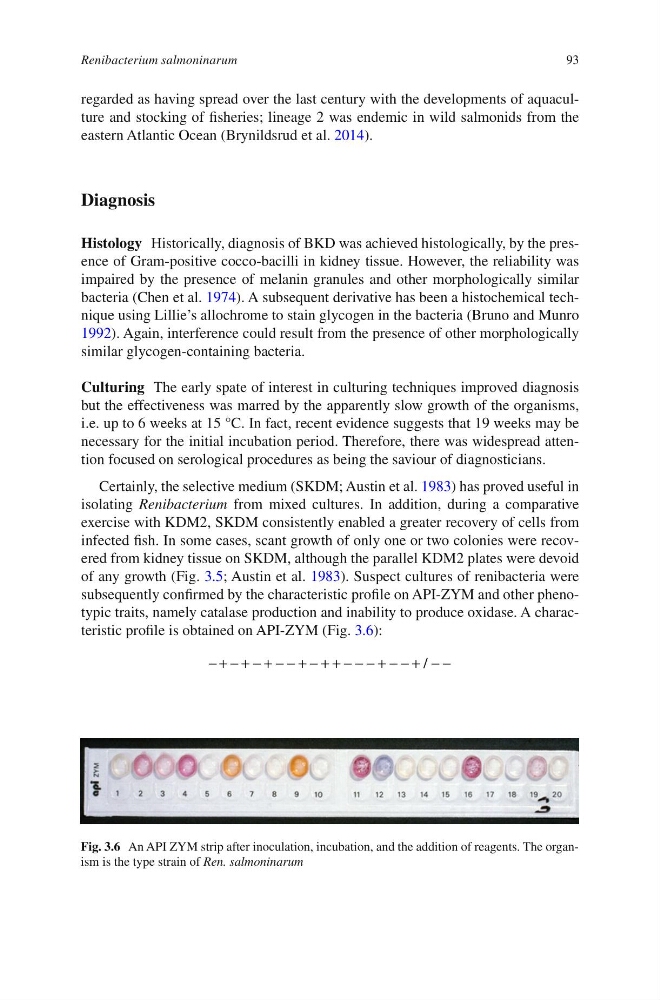
subsequently confi rmed by the characteristic profi le on API-ZYM and other phenotypic traits, namely catalase production and inability to produce oxidase. A characteristic profi le is obtained on API-ZYM (Fig. 3.6 ):
− + − + − + − − + − + + − − − + − − + − −
/
Fig. 3.6 An API ZYM strip after inoculation, incubation, and the addition of reagents. The organism is the type strain of Ren. salmoninarum
Renibacterium salmoninarum
regarded as having spread over the last century with the developments of aquaculture and stocking of fi sheries; lineage 2 was endemic in wild salmonids from the
eastern Atlantic Ocean (Brynildsrud et al. 2014 ).
Diagnosis
Histology Historically, diagnosis of BKD was achieved histologically, by the presence of Gram-positive cocco-bacilli in kidney tissue. However, the reliability was
impaired by the presence of melanin granules and other morphologically similar
bacteria (Chen et al. 1974 ). A subsequent derivative has been a histochemical technique using Lillie’s allochrome to stain glycogen in the bacteria (Bruno and Munro
1992 ). Again, interference could result from the presence of other morphologically
similar glycogen-containing bacteria.
Culturing The early spate of interest in culturing techniques improved diagnosis
but the effectiveness was marred by the apparently slow growth of the organisms,
i.e. up to 6 weeks at 15 °C. In fact, recent evidence suggests that 19 weeks may be
necessary for the initial incubation period. Therefore, there was widespread attention focused on serological procedures as being the saviour of diagnosticians.
Certainly, the selective medium (SKDM; Austin et al. 1983 ) has proved useful in
isolating Renibacterium from mixed cultures. In addition, during a comparative
exercise with KDM2, SKDM consistently enabled a greater recovery of cells from
infected fi sh. In some cases, scant growth of only one or two colonies were recovered from kidney tissue on SKDM, although the parallel KDM2 plates were devoid
of any growth (Fig. 3.5 ; Austin et al. 1983 ). Suspect cultures of renibacteria were
subsequently confi rmed by the characteristic profi le on API-ZYM and other phenotypic traits, namely catalase production and inability to produce oxidase. A characteristic profi le is obtained on API-ZYM (Fig. 3.6 ):
− + − + − + − − + − + + − − − + − − + − −
/
Fig. 3.6 An API ZYM strip after inoculation, incubation, and the addition of reagents. The organism is the type strain of Ren. salmoninarum
Renibacterium salmoninarum