

92
The exact taxonomic position of Ren. salmoninarum is uncertain. However, the
numerical phenetic study of Goodfellow et al. ( 1985 ) confi rmed the homogeneity of
the taxon, and demonstrated its dissimilarity to Lactobacillus and Listeria (Lis. denitrifi cans) . The results of the chemotaxonomy study discussed above, also indicated
the unique position of renibacteria. On the basis of the fatty acid data, Renibacterium
is distinguishable from Corynebacterium sensu stricto and other representatives of
mycolic-acid-containing taxa, which have predominantly straight chain and monounsaturated fatty acids. In short, the data indicate that Renibacterium is distinct from
other Gram-positive organisms (Embley 1983 ; Embley et al. 1983 ; Goodfellow et al.
1985 ), although its relationship to Cor. (Actinomyces) pyogenes needs clarifi cation.
On the basis of 16S rRNA cataloguing, Ren. salmoninarum was considered to comprise a member of the actinomycete subdivision, being related to Arthrobacter,
Brevibacterium, Cellulomonas, Jonesia, Micrococcus, Promicromonospora,
Stomatococcus and Terrabacter (Stackebrandt et al. 1988 ; Gutenberger et al. 1991 ).
The complete genome of the pathogen was determined, and revealed a circular chromosome of 3155250 bp that was predicted to contain 3507 ORFs. The genome is
1.9 Mb smaller than Arthrobacter sp. FB24 and Arthrobacter aurescens TC1 genomes,
and has a lower G + C content. The suggestion is that Ren. salmoninarum underwent
signifi cant reductive evolution from an ancestral Arthrobacter with the acquisition of
putative virulence genes by horizontal gene transfer (Wiens et al. 2008 ).
Multilocus VNTRs have been used to investigate inter-strain variation, and distinguished 17 different haplotypes amongst 41 isolates from Atlantic salmon and rainbow
trout in Scotland, Norway and the USA. The fi rst group of two haplotypes featured
isolates from Atlantic salmon and rainbow trout in Norwegian and Scottish aquaculture,
and the type strain. The second group comprised isolates from only Atlantic salmon, of
mostly wild origin, and including the original Dee disease isolates from Scotland
(Matejusova et al. 2013 ). The data suggested a possible exchange of pathogens between
Atlantic salmon and rainbow trout in Norwegian and Scottish aquaculture over the last
two decades. Moreover, it would appear that isolates from European aquaculture are
genetically distant to to those of the original Dee disease (Matejusova et al. 2013 ).
Next-generation sequencing technology was used to generate genome-wide SNP
data from 68 isolates representing a wide range of hosts and geographical and temporal origin, with the result that two lineages were delineated. Lineage 1 was
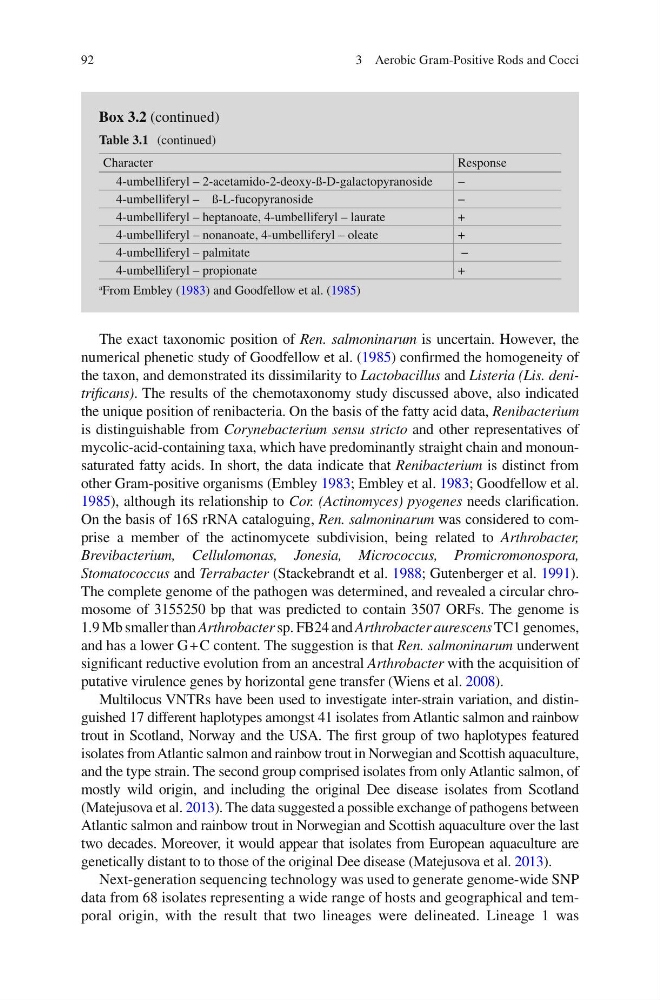
Box 3.2 (continued)
Table 3.1 (continued)
Character
Response
4-umbelliferyl – 2-acetamido-2- deoxy-ß-D-galactopyranoside
−
4-umbelliferyl – ß-L-fucopyranoside
−
4-umbelliferyl – heptanoate, 4-umbelliferyl – laurate
+
4-umbelliferyl – nonanoate, 4-umbelliferyl – oleate
+
4-umbelliferyl – palmitate
−
4-umbelliferyl – propionate
+
a
From Embley ( 1983 ) and Goodfellow et al. ( 1985 )
3 Aerobic Gram-Positive Rods and Cocci
The exact taxonomic position of Ren. salmoninarum is uncertain. However, the
numerical phenetic study of Goodfellow et al. ( 1985 ) confi rmed the homogeneity of
the taxon, and demonstrated its dissimilarity to Lactobacillus and Listeria (Lis. denitrifi cans) . The results of the chemotaxonomy study discussed above, also indicated
the unique position of renibacteria. On the basis of the fatty acid data, Renibacterium
is distinguishable from Corynebacterium sensu stricto and other representatives of
mycolic-acid-containing taxa, which have predominantly straight chain and monounsaturated fatty acids. In short, the data indicate that Renibacterium is distinct from
other Gram-positive organisms (Embley 1983 ; Embley et al. 1983 ; Goodfellow et al.
1985 ), although its relationship to Cor. (Actinomyces) pyogenes needs clarifi cation.
On the basis of 16S rRNA cataloguing, Ren. salmoninarum was considered to comprise a member of the actinomycete subdivision, being related to Arthrobacter,
Brevibacterium, Cellulomonas, Jonesia, Micrococcus, Promicromonospora,
Stomatococcus and Terrabacter (Stackebrandt et al. 1988 ; Gutenberger et al. 1991 ).
The complete genome of the pathogen was determined, and revealed a circular chromosome of 3155250 bp that was predicted to contain 3507 ORFs. The genome is
1.9 Mb smaller than Arthrobacter sp. FB24 and Arthrobacter aurescens TC1 genomes,
and has a lower G + C content. The suggestion is that Ren. salmoninarum underwent
signifi cant reductive evolution from an ancestral Arthrobacter with the acquisition of
putative virulence genes by horizontal gene transfer (Wiens et al. 2008 ).
Multilocus VNTRs have been used to investigate inter-strain variation, and distinguished 17 different haplotypes amongst 41 isolates from Atlantic salmon and rainbow
trout in Scotland, Norway and the USA. The fi rst group of two haplotypes featured
isolates from Atlantic salmon and rainbow trout in Norwegian and Scottish aquaculture,
and the type strain. The second group comprised isolates from only Atlantic salmon, of
mostly wild origin, and including the original Dee disease isolates from Scotland
(Matejusova et al. 2013 ). The data suggested a possible exchange of pathogens between
Atlantic salmon and rainbow trout in Norwegian and Scottish aquaculture over the last
two decades. Moreover, it would appear that isolates from European aquaculture are
genetically distant to to those of the original Dee disease (Matejusova et al. 2013 ).
Next-generation sequencing technology was used to generate genome-wide SNP
data from 68 isolates representing a wide range of hosts and geographical and temporal origin, with the result that two lineages were delineated. Lineage 1 was
Box 3.2 (continued)
Table 3.1 (continued)
Character
Response
4-umbelliferyl – 2-acetamido-2- deoxy-ß-D-galactopyranoside
−
4-umbelliferyl – ß-L-fucopyranoside
−
4-umbelliferyl – heptanoate, 4-umbelliferyl – laurate
+
4-umbelliferyl – nonanoate, 4-umbelliferyl – oleate
+
4-umbelliferyl – palmitate
−
4-umbelliferyl – propionate
+
a
From Embley ( 1983 ) and Goodfellow et al. ( 1985 )
3 Aerobic Gram-Positive Rods and Cocci