

85
1969 ; Evelyn et al. 1973 ; Wood 1974 ; Ellis et al. 1978 ; Paterson et al. 1979 , 1981 ;
Mitchum and Sherman 1981 ; Banner et al. 1986 ; Loch et al. 2012 ), and it was cultured in two specimens of wild caught grayling ( Thymallus thymallus ) and Atlantic
salmon in the UK; additional PCR positive wild fi sh were also identifi ed mostly
from rivers with rainbow trout farms known to be positive for BKD (Chambers et al.
2008 ). The presence of BKD in Japanese farmed ayu from April to July 2001, possibly refl ecting horizontal transmission from masu salmon, has been documented
(Nagai and Iida 2002 ). BKD may be exacerbated by or exacerbate other conditions,
for example, Weiland et al. ( 1999 ) documented that Chinook salmon that were traumatized with gas (= gas bubble trauma) died more rapidly than those fi sh that were
only exposed to renibacterium alone. Wire-tagging appears to infl uence horizontal
transmission of the disease insofar as the wounds in the snout caused by tagging can
become infected with renibacteria, and lead to the spread to internal organs. Possibly
renibacteria are spread with the tagging devises (Elliott and Pascho 2001 ).
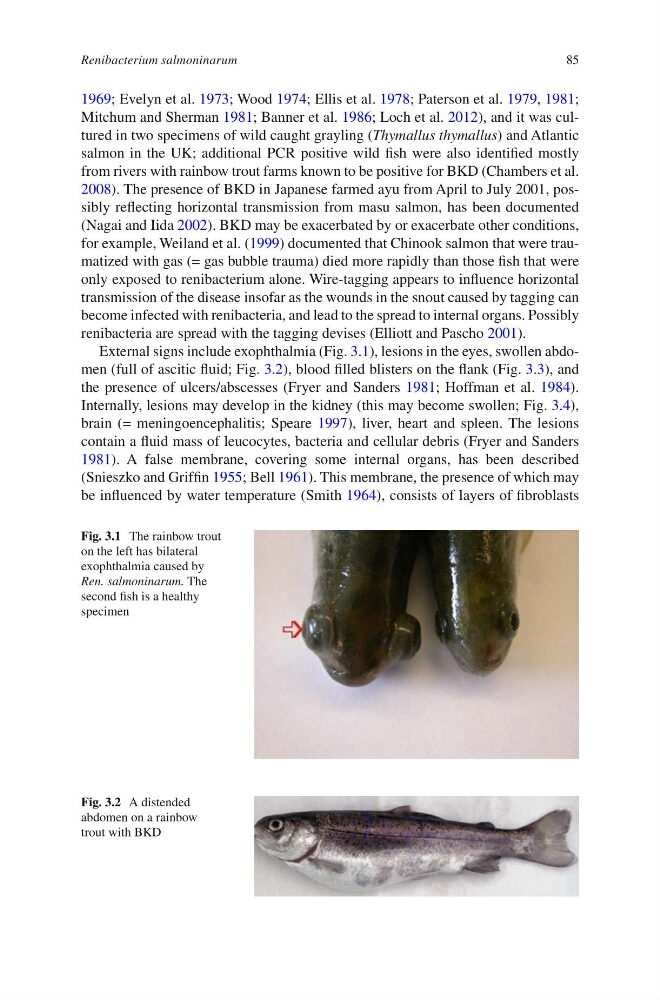
External signs include exophthalmia (Fig. 3.1 ), lesions in the eyes, swollen abdomen (full of ascitic fl uid; Fig. 3.2 ), blood fi lled blisters on the fl ank (Fig. 3.3 ), and
the presence of ulcers/abscesses (Fryer and Sanders 1981 ; Hoffman et al. 1984 ).
Internally, lesions may develop in the kidney (this may become swollen; Fig. 3.4 ),
brain (= meningoencephalitis; Speare 1997 ), liver, heart and spleen. The lesions
contain a fl uid mass of leucocytes, bacteria and cellular debris (Fryer and Sanders
1981 ). A false membrane, covering some internal organs, has been described
(Snieszko and Griffi n 1955 ; Bell 1961 ). This membrane, the presence of which may
be infl uenced by water temperature (Smith 1964 ), consists of layers of fi broblasts
Fig. 3.1 The rainbow trout
on the left has bilateral
exophthalmia caused by
Ren. salmoninarum. The
second fi sh is a healthy
specimen
Fig. 3.2 A distended
abdomen on a rainbow
trout with BKD
Renibacterium salmoninarum
1969 ; Evelyn et al. 1973 ; Wood 1974 ; Ellis et al. 1978 ; Paterson et al. 1979 , 1981 ;
Mitchum and Sherman 1981 ; Banner et al. 1986 ; Loch et al. 2012 ), and it was cultured in two specimens of wild caught grayling ( Thymallus thymallus ) and Atlantic
salmon in the UK; additional PCR positive wild fi sh were also identifi ed mostly
from rivers with rainbow trout farms known to be positive for BKD (Chambers et al.
2008 ). The presence of BKD in Japanese farmed ayu from April to July 2001, possibly refl ecting horizontal transmission from masu salmon, has been documented
(Nagai and Iida 2002 ). BKD may be exacerbated by or exacerbate other conditions,
for example, Weiland et al. ( 1999 ) documented that Chinook salmon that were traumatized with gas (= gas bubble trauma) died more rapidly than those fi sh that were
only exposed to renibacterium alone. Wire-tagging appears to infl uence horizontal
transmission of the disease insofar as the wounds in the snout caused by tagging can
become infected with renibacteria, and lead to the spread to internal organs. Possibly
renibacteria are spread with the tagging devises (Elliott and Pascho 2001 ).
External signs include exophthalmia (Fig. 3.1 ), lesions in the eyes, swollen abdomen (full of ascitic fl uid; Fig. 3.2 ), blood fi lled blisters on the fl ank (Fig. 3.3 ), and
the presence of ulcers/abscesses (Fryer and Sanders 1981 ; Hoffman et al. 1984 ).
Internally, lesions may develop in the kidney (this may become swollen; Fig. 3.4 ),
brain (= meningoencephalitis; Speare 1997 ), liver, heart and spleen. The lesions
contain a fl uid mass of leucocytes, bacteria and cellular debris (Fryer and Sanders
1981 ). A false membrane, covering some internal organs, has been described
(Snieszko and Griffi n 1955 ; Bell 1961 ). This membrane, the presence of which may
be infl uenced by water temperature (Smith 1964 ), consists of layers of fi broblasts
Fig. 3.1 The rainbow trout
on the left has bilateral
exophthalmia caused by
Ren. salmoninarum. The
second fi sh is a healthy
specimen
Fig. 3.2 A distended
abdomen on a rainbow
trout with BKD
Renibacterium salmoninarum