

grainsupportstone deposits. Reef reservoir pore systems are
generally characterized by some combination of primary
depositional, and diagenetic pore types. Porosity ranges
from patchy to uniform, resulting in vertical and horizontal
heterogeneity. Climate controls the effects of early diagenesis. Greenhouse reservoirs show less effect of subaerial dissolution and greater internal continuity. Icehouse reservoirs
that have been affected by humid karst conditions show significant pore system modification. The Neogene coral/algal
reservoirs are most similar to modern reef systems and
exhibit dissolution modification of their pore systems.
Bibliography
Abdullah, M., and Jordan, C. F., 1987. The geology of Arun field,
Miocene reef complex. Proceedings of the Indonesian
Petroleum Association, 16th Annual Conference, pp. 65–96.
Beach, D. K., 1982. Depositional and diagenetic history of Pliocene-Pleistocene carbonates of northwestern Great Bahama
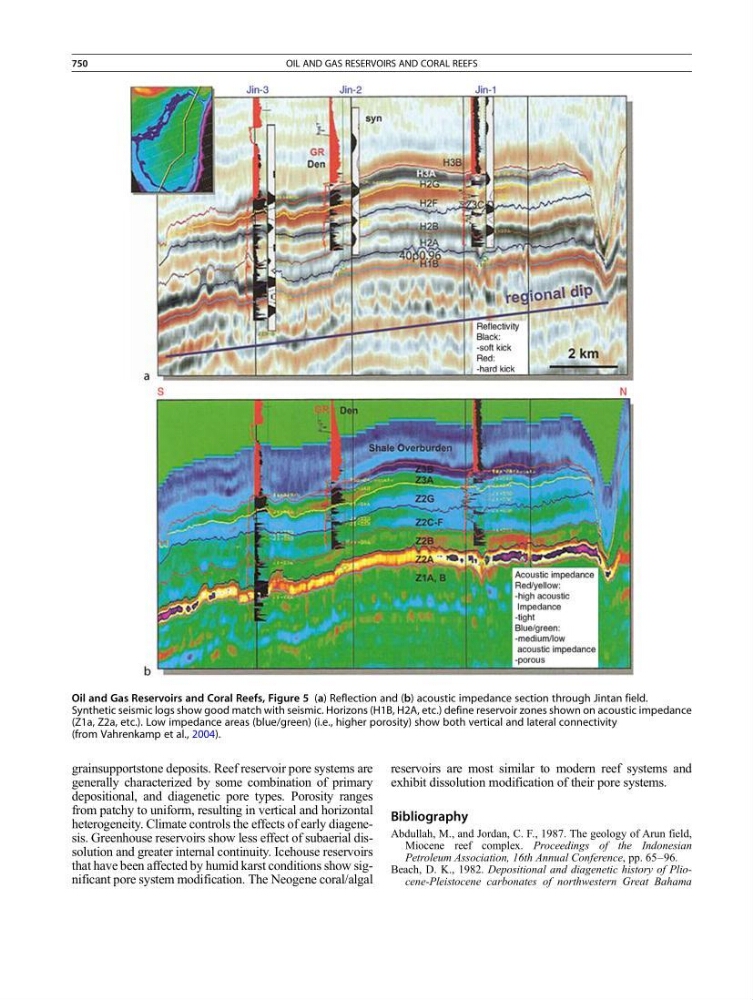
Oil and Gas Reservoirs and Coral Reefs, Figure 5 (a) Reflection and (b) acoustic impedance section through Jintan field.
Synthetic seismic logs show good match with seismic. Horizons (H1B, H2A, etc.) define reservoir zones shown on acoustic impedance
(Z1a, Z2a, etc.). Low impedance areas (blue/green) (i.e., higher porosity) show both vertical and lateral connectivity
(from Vahrenkamp et al., 2004).
750
OIL AND GAS RESERVOIRS AND CORAL REEFS