

The lack of meteoric water allows primary pores to remain
open and allows preservation of permeable networks. The
Neogene reef reservoirs of the Australasian region are characterized by humid karst-modified primary pore systems.
Because of their similarities to Pleistocene and Modern reef
systems (Melim et al., 2001) and their significance as oil
and gas reservoirs, they are summarized below.
Neogene reef platform oil and gas reservoirs
The late Oligocene through Miocene was a period of widespread coral/algal carbonate platform development in the
Australasian
region
(Epting,
1980;
Fulthorpe
and Schlanger, 1989; Ehrlich et al., 1993; Saller et al.,
1993; Gucci and Clark, 1993; Sun and Esteban, 1994).
These Neogene reef platforms have been the targets of
hydrocarbon exploration and there have been numerous
discoveries (Table 1) [i.e., Malaysia: central Luconia (Ho,
1978; Epting, 1980, 1989; Sulaiman, 1995); Philippines:
Nido (Withjack, 1985) and Malampaya (Grötsch and
Mercadier, 1999); Indonesia: Arun (Abdullah and Jordan,
1987; Jordan and Abdullah, 1992), northwest Java Sea
(Yaman et al., 1991); Ramba (Longman et al., 1987); South
Lho Sukon (Maliki and Soenarawi, 1991), Natuna (May
and Eyles, 1985; Rudolph and Lehmann, 1989); China:
Liuhua, Pearl River (Moldovanje et al., 1995)].
Two of these fields, Natuna L (Rudolph and Lehmann,
1989) (Figures 3 and 4), and Jintan, Luconia Province
(Vahrenkamp et al., 2004) (Figure 5) illustrate aspects
coral reef reservoir architecture and lithofacies. Both of
these field examples are isolated reef platforms of middle
to late and middle Miocene age, respectively. Reservoir
columns are approximately 300 (Jintan) to 1,000 (Natuna)
meters in thickness. Reservoir lithofacies range from
coral-algal
boundstones,
rudstones,
floatstones,
grainstones, and packstones (Figures 1 and 3). Bioclasts
also include abundant foraminifera, mollusks, and echinoderms. Porosity ranges from 5 to 40%, and pore types are
dominantly Vug, Moldic (Mo), and Interparticle (BP).
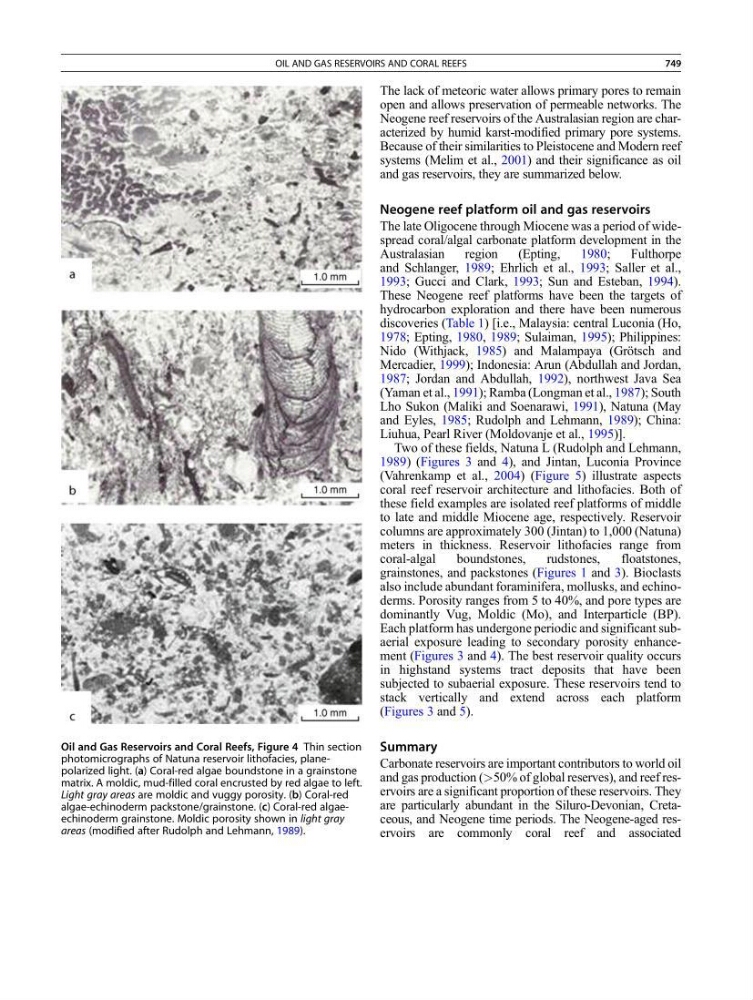
Each platform has undergone periodic and significant subaerial exposure leading to secondary porosity enhancement (Figures 3 and 4). The best reservoir quality occurs
in highstand systems tract deposits that have been
subjected to subaerial exposure. These reservoirs tend to
stack vertically and extend across each platform
(Figures 3 and 5).
Summary
Carbonate reservoirs are important contributors to world oil
and gas production (>50% of global reserves), and reef reservoirs are a significant proportion of these reservoirs. They
are particularly abundant in the Siluro-Devonian, Cretaceous, and Neogene time periods. The Neogene-aged reservoirs are commonly coral reef and associated
Oil and Gas Reservoirs and Coral Reefs, Figure 4 Thin section
photomicrographs of Natuna reservoir lithofacies, planepolarized light. (a) Coral-red algae boundstone in a grainstone
matrix. A moldic, mud-filled coral encrusted by red algae to left.
Light gray areas are moldic and vuggy porosity. (b) Coral-red
algae-echinoderm packstone/grainstone. (c) Coral-red algaeechinoderm grainstone. Moldic porosity shown in light gray
areas (modified after Rudolph and Lehmann, 1989).
OIL AND GAS RESERVOIRS AND CORAL REEFS
749