

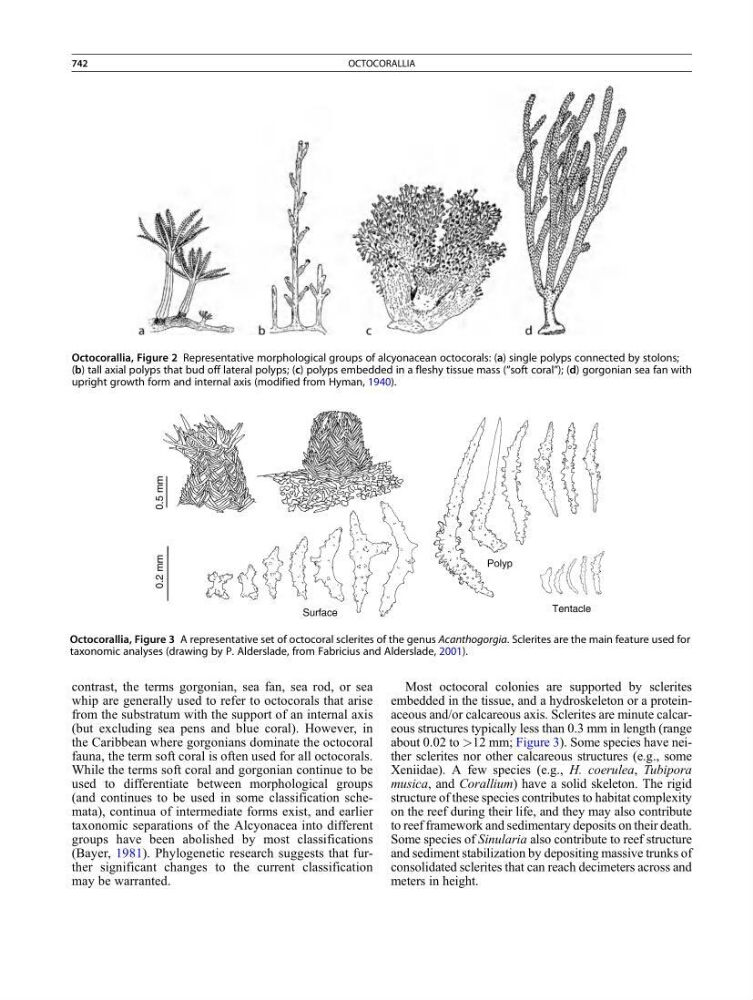
contrast, the terms gorgonian, sea fan, sea rod, or sea
whip are generally used to refer to octocorals that arise
from the substratum with the support of an internal axis
(but excluding sea pens and blue coral). However, in
the Caribbean where gorgonians dominate the octocoral
fauna, the term soft coral is often used for all octocorals.
While the terms soft coral and gorgonian continue to be
used to differentiate between morphological groups
(and continues to be used in some classification schemata), continua of intermediate forms exist, and earlier
taxonomic separations of the Alcyonacea into different
groups have been abolished by most classifications
(Bayer, 1981). Phylogenetic research suggests that further significant changes to the current classification
may be warranted.
Most octocoral colonies are supported by sclerites
embedded in the tissue, and a hydroskeleton or a proteinaceous and/or calcareous axis. Sclerites are minute calcareous structures typically less than 0.3 mm in length (range
about 0.02 to >12 mm; Figure 3). Some species have neither sclerites nor other calcareous structures (e.g., some
Xeniidae). A few species (e.g., H. coerulea, Tubipora
musica, and Corallium) have a solid skeleton. The rigid
structure of these species contributes to habitat complexity
on the reef during their life, and they may also contribute
to reef framework and sedimentary deposits on their death.
Some species of Sinularia also contribute to reef structure
and sediment stabilization by depositing massive trunks of
consolidated sclerites that can reach decimeters across and
meters in height.
Octocorallia, Figure 2 Representative morphological groups of alcyonacean octocorals: (a) single polyps connected by stolons;
(b) tall axial polyps that bud off lateral polyps; (c) polyps embedded in a fleshy tissue mass (“soft coral”); (d) gorgonian sea fan with
upright growth form and internal axis (modified from Hyman, 1940).
Octocorallia, Figure 3 A representative set of octocoral sclerites of the genus Acanthogorgia. Sclerites are the main feature used for
taxonomic analyses (drawing by P. Alderslade, from Fabricius and Alderslade, 2001).
742
OCTOCORALLIA