

formed, autozooids and siphonozooids, with mesozooids
as an additional third type of polyps in a few taxa.
Pennatulaceans typically live in soft bottom habitats,
being completely retracted during the day and emerging
in the dark. The greatest pennatulacean diversity is found
in the tropical Indo-Pacific (nine genera in five families).
The Alcyonacea (soft corals and gorgonians) contain
the large majority of octocoral species. The number of species is unknown, as numerous species await taxonomic
description and many genera need urgent revision. In
shallow tropical and subtropical Indo-Pacific reefs alone,
about 100 alcyonacean genera in 23 families are currently described (Fabricius and Alderslade, 2001). Their
growth forms range from small colonies with few polyps
connected by stolons, to fleshy soft corals to up to 3 m
large sea fans (Figure 2). Within the order Alcyonacea,
the term “soft coral” is commonly used to only refer to
octocorals without internal axis or solid skeleton. In
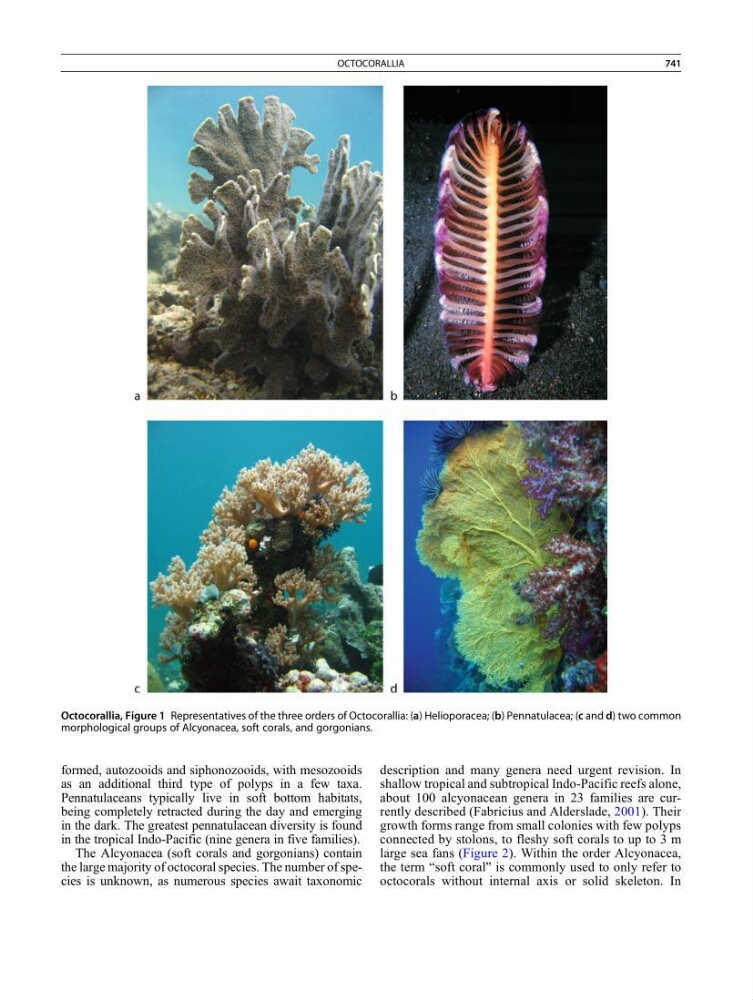
Octocorallia, Figure 1 Representatives of the three orders of Octocorallia: (a) Helioporacea; (b) Pennatulacea; (c and d) two common
morphological groups of Alcyonacea, soft corals, and gorgonians.
OCTOCORALLIA
741