

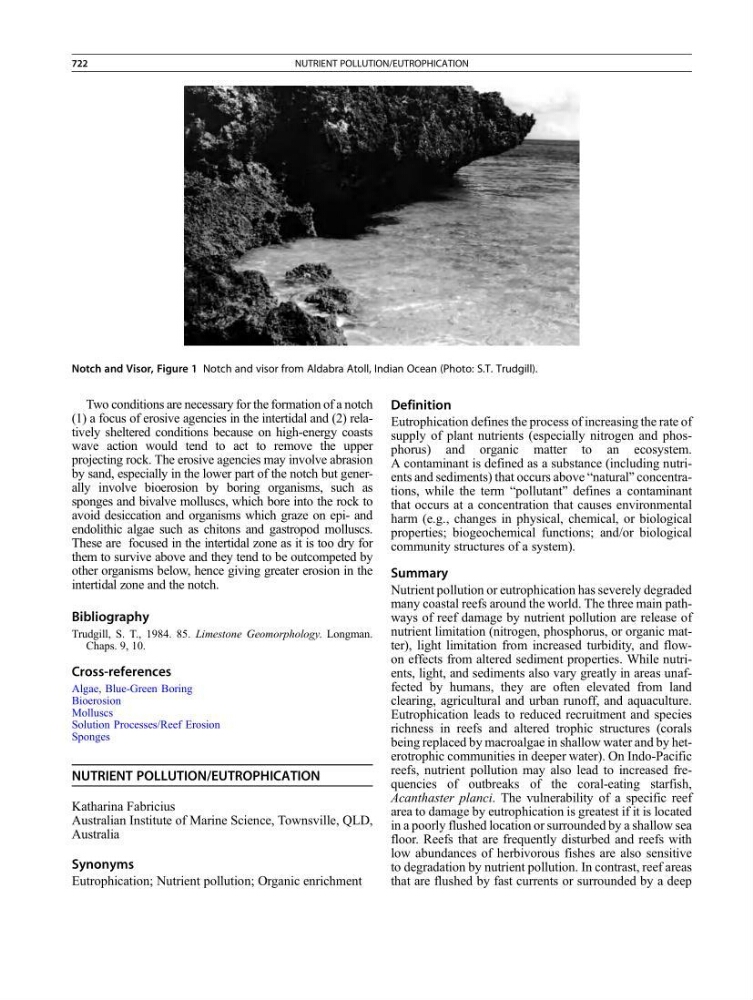
Two conditions are necessary for the formation of a notch
(1) a focus of erosive agencies in the intertidal and (2) relatively sheltered conditions because on high-energy coasts
wave action would tend to act to remove the upper
projecting rock. The erosive agencies may involve abrasion
by sand, especially in the lower part of the notch but generally involve bioerosion by boring organisms, such as
sponges and bivalve molluscs, which bore into the rock to
avoid desiccation and organisms which graze on epi- and
endolithic algae such as chitons and gastropod molluscs.
These are focused in the intertidal zone as it is too dry for
them to survive above and they tend to be outcompeted by
other organisms below, hence giving greater erosion in the
intertidal zone and the notch.
Bibliography
Trudgill, S. T., 1984. 85. Limestone Geomorphology. Longman.
Chaps. 9, 10.
Cross-references
Algae, Blue-Green Boring
Bioerosion
Molluscs
Solution Processes/Reef Erosion
Sponges
NUTRIENT POLLUTION/EUTROPHICATION
Katharina Fabricius
Australian Institute of Marine Science, Townsville, QLD,
Australia
Synonyms
Eutrophication; Nutrient pollution; Organic enrichment
Definition
Eutrophication defines the process of increasing the rate of
supply of plant nutrients (especially nitrogen and phosphorus) and organic matter to an ecosystem.
A contaminant is defined as a substance (including nutrients and sediments) that occurs above “natural” concentrations, while the term “pollutant” defines a contaminant
that occurs at a concentration that causes environmental
harm (e.g., changes in physical, chemical, or biological
properties; biogeochemical functions; and/or biological
community structures of a system).
Summary
Nutrient pollution or eutrophication has severely degraded
many coastal reefs around the world. The three main pathways of reef damage by nutrient pollution are release of
nutrient limitation (nitrogen, phosphorus, or organic matter), light limitation from increased turbidity, and flowon effects from altered sediment properties. While nutrients, light, and sediments also vary greatly in areas unaffected by humans, they are often elevated from land
clearing, agricultural and urban runoff, and aquaculture.
Eutrophication leads to reduced recruitment and species
richness in reefs and altered trophic structures (corals
being replaced by macroalgae in shallow water and by heterotrophic communities in deeper water). On Indo-Pacific
reefs, nutrient pollution may also lead to increased frequencies of outbreaks of the coral-eating starfish,
Acanthaster planci. The vulnerability of a specific reef
area to damage by eutrophication is greatest if it is located
in a poorly flushed location or surrounded by a shallow sea
floor. Reefs that are frequently disturbed and reefs with
low abundances of herbivorous fishes are also sensitive
to degradation by nutrient pollution. In contrast, reef areas
that are flushed by fast currents or surrounded by a deep
Notch and Visor, Figure 1 Notch and visor from Aldabra Atoll, Indian Ocean (Photo: S.T. Trudgill).
722
NUTRIENT POLLUTION/EUTROPHICATION