

Montaggioni et al. (2006) concluded that the upwellings
seem to have been more active than today at about 6 ka,
marked by occasional brief cooling events, while the
SST was 1
C higher than now, explaining that the retardation of the reef development in the southwest areas of New
Caledonia. It appears that nutrient supply from upwelling
may have a major role in the control of the reef growth.
Summary
New Caledonia is characterized by a broad diversity of
continental and oceanic reef structures, but at this day,
only the growth history of fringing and barrier reefs from
the main island or Grande Terre was intensively investigated and relatively well known. It appears that the morphology and the distribution of modern reefs can be
explained by several parameters: (1) the nature and the
morphology of the antecedent topography resulting of
both vertical motions and climatic factors; (2) the growth
pattern depending on variations of local ecological factors
and oceanographic factors including SST and SSS data
and also the nutrient supply from upwellings. Moreover,
this region appears to be a key region to analyze the reef
Poindimié
0
2
4
6
6,050
D
Mamié-Ounia
0
2
4
6
D
7,160
Depth (m)
Depth (m)
5,030
4,400
2,790
2,600
5,710
5,000
4,740
4,620
Depth (m)
Poum
0
2
4
D
3,900
3,460
4,020
6,010
4,910
Ricaudy
0
2
4
6
D
Depth (m)
Old reef foundation
Bedrock
D
Unconformity
7,160
Coral C14 dates
Open cavities, partly filled by fine
skeletal detritus and sands
Branching and tabular coral facies
Domal coral facies
Coral rubble & skeletal detritus
5,700
Poya
(after Fontes et al., 1977)
0
2
4
6
D
8
5,410
5,330
1,635
1,680
1,315
G r a n d e t e r r e
Depth (m)
D
0
2
4
Thio
4,120
3,990
3,590
Depth (m)
Clay and detrital debris
Unidentified coralgal and reefal
facies (after Fontes et al., 1977)
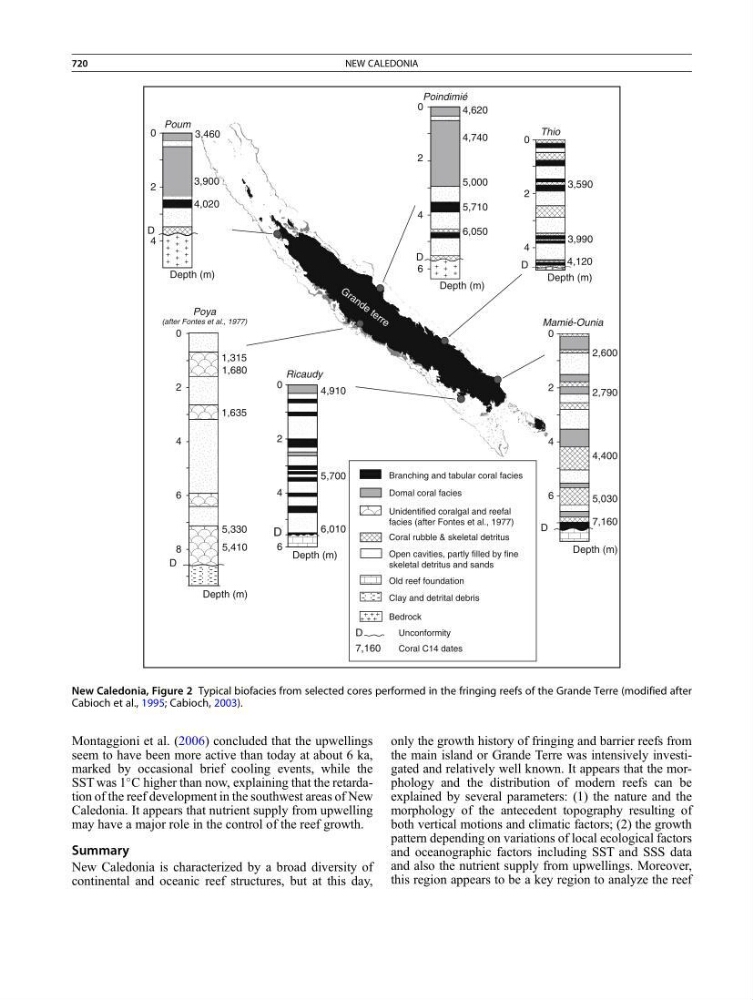
New Caledonia, Figure 2 Typical biofacies from selected cores performed in the fringing reefs of the Grande Terre (modified after
Cabioch et al., 1995; Cabioch, 2003).
720
NEW CALEDONIA