

limited sampling of one coral species, with little attention
directed at crustose coralline algae that dominate shallow
reefs at Kure, Midway, and neighboring islands and atolls.
The hypothesis also relied on annual mean seawater temperatures and ignored seasonal fluctuations, especially at
Kure, Midway, and Pearl and Hermes Atolls. Cooler winter temperatures are thought to reduce coral growth rates,
but the summer temperatures are similar along the entire
NWHI and high enough not to reduce coral growth rates.
Moreover, the warmest summer temperatures that resulted
in the coral bleaching events of 2002 and 2004 at the
northernmost atolls may be caused by reduced mixing
from weaker winds situated closer to the center of the
North Pacific high pressure ridge and by decreased circulation within large shallow lagoons (Brainard et al., 2004).
Regardless, the atolls have fully recovered from the earlier
bleaching as documented by coral re-growth and recolonization of earlier bleached habitats.
Siciliano (2005) reexamined the Darwin Point hypothesis and reported that, although coral growth rates generally decline as a function of increasing latitude in the
NWHI, as first suggested by Grigg (1982), this decrease
is habitat-specific. Coral colonies found in protected habitats throughout the NWHI chain (back reef and lagoon habitats on the atolls; bays sheltered from wave action at the
islands lacking lagoons) show comparable growth rates of
corals regardless of latitude. This may be explained by the
microclimatic conditions experienced by corals growing in
the shallower, and often warmer lagoon and back reef habitats, where they are not closely related to offshore SST. Conversely, corals growing in exposed habitats throughout the
NWHI (fore reef of atolls and reef islands), experience temperatures more akin to offshore SST conditions, and therefore may be more likely to correlate to regional SST
gradients, such as decreasing SST with increasing latitude
corresponding to decreasing growth rates.
However, the growth rates measured by Grigg (1982)
may also be underestimated at Kure Atoll because of
selective sampling. In his assessment of coral growth rate
throughout the NWHI, Grigg (1982) sampled Porites
lobata exclusively at 10 m depths at exposed southwest
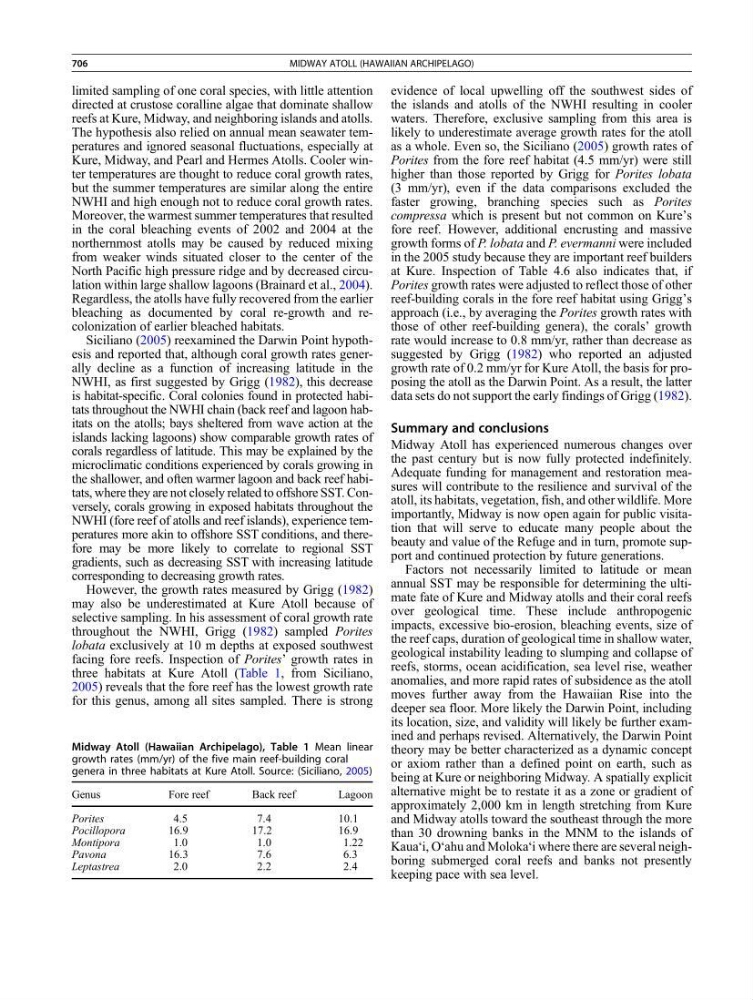
facing fore reefs. Inspection of Porites’ growth rates in
three habitats at Kure Atoll (Table 1, from Siciliano,
2005) reveals that the fore reef has the lowest growth rate
for this genus, among all sites sampled. There is strong
evidence of local upwelling off the southwest sides of
the islands and atolls of the NWHI resulting in cooler
waters. Therefore, exclusive sampling from this area is
likely to underestimate average growth rates for the atoll
as a whole. Even so, the Siciliano (2005) growth rates of
Porites from the fore reef habitat (4.5 mm/yr) were still
higher than those reported by Grigg for Porites lobata
(3 mm/yr), even if the data comparisons excluded the
faster growing, branching species such as Porites
compressa which is present but not common on Kure’s
fore reef. However, additional encrusting and massive
growth forms of P. lobata and P. evermanni were included
in the 2005 study because they are important reef builders
at Kure. Inspection of Table 4.6 also indicates that, if
Porites growth rates were adjusted to reflect those of other
reef-building corals in the fore reef habitat using Grigg’s
approach (i.e., by averaging the Porites growth rates with
those of other reef-building genera), the corals’ growth
rate would increase to 0.8 mm/yr, rather than decrease as
suggested by Grigg (1982) who reported an adjusted
growth rate of 0.2 mm/yr for Kure Atoll, the basis for proposing the atoll as the Darwin Point. As a result, the latter
data sets do not support the early findings of Grigg (1982).
Summary and conclusions
Midway Atoll has experienced numerous changes over
the past century but is now fully protected indefinitely.
Adequate funding for management and restoration measures will contribute to the resilience and survival of the
atoll, its habitats, vegetation, fish, and other wildlife. More
importantly, Midway is now open again for public visitation that will serve to educate many people about the
beauty and value of the Refuge and in turn, promote support and continued protection by future generations.
Factors not necessarily limited to latitude or mean
annual SST may be responsible for determining the ultimate fate of Kure and Midway atolls and their coral reefs
over geological time. These include anthropogenic
impacts, excessive bio-erosion, bleaching events, size of
the reef caps, duration of geological time in shallow water,
geological instability leading to slumping and collapse of
reefs, storms, ocean acidification, sea level rise, weather
anomalies, and more rapid rates of subsidence as the atoll
moves further away from the Hawaiian Rise into the
deeper sea floor. More likely the Darwin Point, including
its location, size, and validity will likely be further examined and perhaps revised. Alternatively, the Darwin Point
theory may be better characterized as a dynamic concept
or axiom rather than a defined point on earth, such as
being at Kure or neighboring Midway. A spatially explicit
alternative might be to restate it as a zone or gradient of
approximately 2,000 km in length stretching from Kure
and Midway atolls toward the southeast through the more
than 30 drowning banks in the MNM to the islands of
Kaua‘i, O‘ahu and Moloka‘i where there are several neighboring submerged coral reefs and banks not presently
keeping pace with sea level.
Midway Atoll (Hawaiian Archipelago), Table 1 Mean linear
growth rates (mm/yr) of the five main reef-building coral
genera in three habitats at Kure Atoll. Source: (Siciliano, 2005)
Genus
Fore reef
Back reef
Lagoon
Porites
4.5
7.4
10.1
Pocillopora
16.9
17.2
16.9
Montipora
1.0
1.0
1.22
Pavona
16.3
7.6
6.3
Leptastrea
2.0
2.2
2.4
706
MIDWAY ATOLL (HAWAIIAN ARCHIPELAGO)