

its relay stations. Cable Company employees reported foreigners landing at Midway, and especially disturbing were
Japanese feather hunters who since the 1880s had decimated nesting seabird colonies. In January 1903, President
Theodore Roosevelt placed the Midway Islands under the
jurisdiction and control of the Navy Department to stop
the “wanton destruction of birds that breed on Midway”
and to establish a coaling station for Navy warships. In
1935, Pan American World Airways established
a seaplane base in the harbor, including the clearing of
some coral heads from the lagoon, and constructed
a small luxury hotel on Sand Island. Midway became
a regular refueling stop on a trans-Pacific route that also
included Honolulu, Wake Island, Guam, and Manila.
The short-lived era of the “flying clipper” seaplanes ended
with the onset of World War II, and in early 1941, a U.S.
Naval Air Station was commissioned on Midway. In the
summer of 1941, 1,500 workers and a dozen dredges
began excavation of the deep ship channel through the
southern perimeter reef. “The big lagoon impounded
incalculable tons of water coming in over the reefs, and
poured it all out through the new channel in a current that
often reached six miles per hour”, Woodbury (1946)
reported. The dredging lowered lagoon water levels and
exposed some of the perimeter back reefs. Likely changes
in lagoon circulation included suspension of fine colloidal
sediments accumulating on the lagoon floor caused by
changes in deep water circulation patterns attributed to
the new channel. On December 7, 1941, Japanese war
planes bombed both Midway and Pearl Harbor.
Midway is well known for its role in the Battle of Midway. On June 3, 1942, a Japanese occupation fleet was
spotted by a Midway patrol plane, and early on June 4,
Japanese carriers launched three waves of planes to
destroy the air base at Midway and clear the way for
occupation. Airplanes on both sides of the battle were lost,
and extensive physical damage and casualties occurred on
Sand and Eastern islands. From June 4–6, most of the battle was fought in open seas northwest of Midway. The
Japanese Navy never fully recovered from the loss of all
four of its carriers, 256 aircraft, and more than 400 of its
best aircrew, and the battle terminated Japanese eastward
expansion in the Pacific. The WWII facilities at Sand
and Eastern Islands were listed on the National Register
of Historic Places on May 28, 1987.
Midway continued to serve as a strategic location for
the military after the war. During the Korean conflict,
Midway served as a refueling station, and in the late
1950s “Cold War”, Midway was substantially upgraded
and became a central location for the Distant Early Warning Line’s Pacific Barrier, extending from Midway to
Adak, Alaska. During the Vietnam War, Midway was
a main aircraft and ship refueling station and served as
a listening post for foreign submarine activity. Midway
was the site of the June 1969 meeting of President Thieu
of the Republic of Vietnam and President Richard Nixon.
In the waning years of the Cold War, Midway’s strategic
importance as a military base diminished, but its unique
historic associations and superb wildlife habitat quickly
gained recognition.
An overlay refuge at Midway Atoll was established in
1988 when the U.S. Navy invited the U.S. Fish and Wildlife Service (FWS) to manage the atoll’s extensive wildlife
resources. In 1992, the Department of Defense announced
plans to close the Midway Naval Air Facility, and in 1996,
the FWS assumed expanded jurisdiction over Midway
after President Bill Clinton signed an Executive Order that
transferred the atoll to the Service. Despite the efforts of
Navy to clean up the atoll before transfer to the FWS, there
are residual contaminated areas on the main islands where
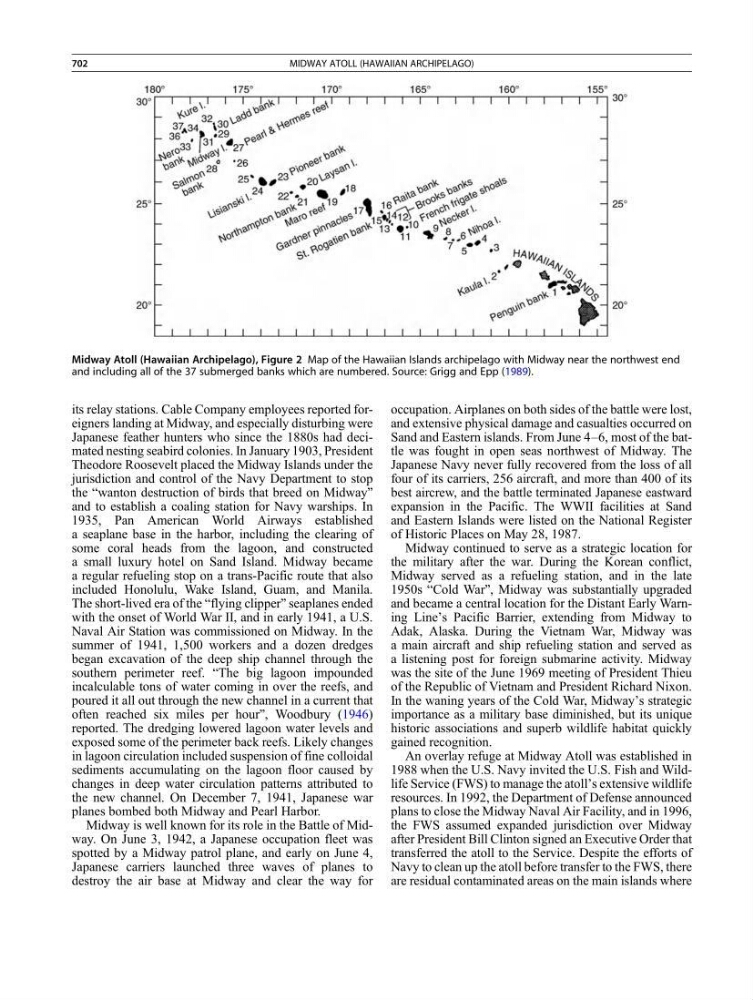
Midway Atoll (Hawaiian Archipelago), Figure 2 Map of the Hawaiian Islands archipelago with Midway near the northwest end
and including all of the 37 submerged banks which are numbered. Source: Grigg and Epp (1989).
702
MIDWAY ATOLL (HAWAIIAN ARCHIPELAGO)