

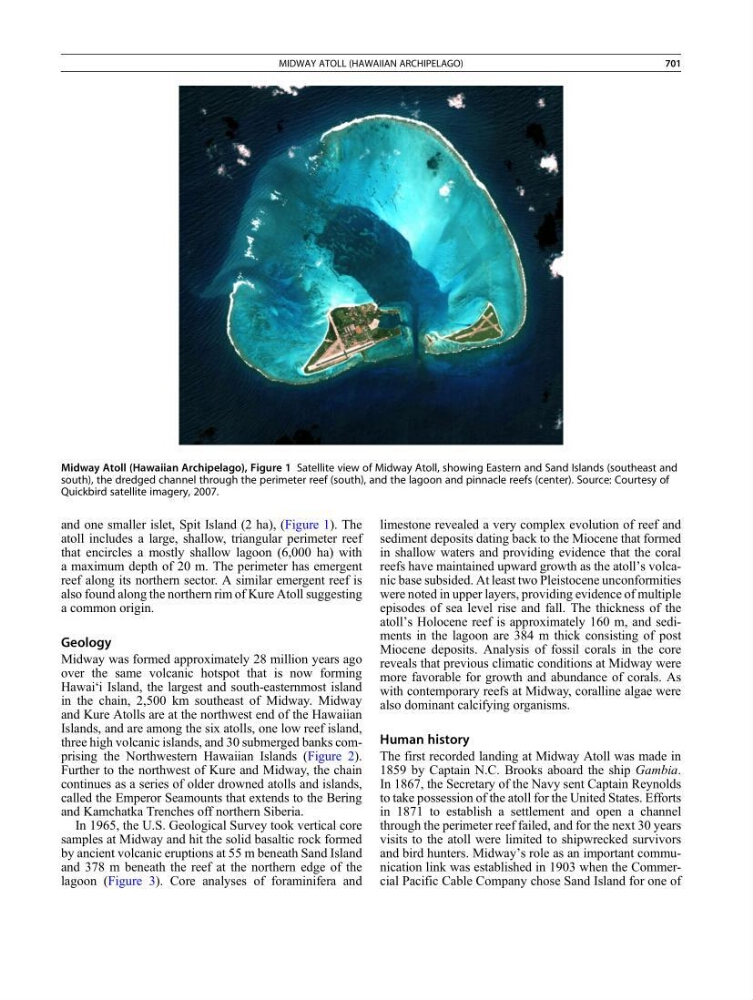
and one smaller islet, Spit Island (2 ha), (Figure 1). The
atoll includes a large, shallow, triangular perimeter reef
that encircles a mostly shallow lagoon (6,000 ha) with
a maximum depth of 20 m. The perimeter has emergent
reef along its northern sector. A similar emergent reef is
also found along the northern rim of Kure Atoll suggesting
a common origin.
Geology
Midway was formed approximately 28 million years ago
over the same volcanic hotspot that is now forming
Hawai‘i Island, the largest and south-easternmost island
in the chain, 2,500 km southeast of Midway. Midway
and Kure Atolls are at the northwest end of the Hawaiian
Islands, and are among the six atolls, one low reef island,
three high volcanic islands, and 30 submerged banks comprising the Northwestern Hawaiian Islands (Figure 2).
Further to the northwest of Kure and Midway, the chain
continues as a series of older drowned atolls and islands,
called the Emperor Seamounts that extends to the Bering
and Kamchatka Trenches off northern Siberia.
In 1965, the U.S. Geological Survey took vertical core
samples at Midway and hit the solid basaltic rock formed
by ancient volcanic eruptions at 55 m beneath Sand Island
and 378 m beneath the reef at the northern edge of the
lagoon (Figure 3). Core analyses of foraminifera and
limestone revealed a very complex evolution of reef and
sediment deposits dating back to the Miocene that formed
in shallow waters and providing evidence that the coral
reefs have maintained upward growth as the atoll’s volcanic base subsided. At least two Pleistocene unconformities
were noted in upper layers, providing evidence of multiple
episodes of sea level rise and fall. The thickness of the
atoll’s Holocene reef is approximately 160 m, and sediments in the lagoon are 384 m thick consisting of post
Miocene deposits. Analysis of fossil corals in the core
reveals that previous climatic conditions at Midway were
more favorable for growth and abundance of corals. As
with contemporary reefs at Midway, coralline algae were
also dominant calcifying organisms.
Human history
The first recorded landing at Midway Atoll was made in
1859 by Captain N.C. Brooks aboard the ship Gambia.
In 1867, the Secretary of the Navy sent Captain Reynolds
to take possession of the atoll for the United States. Efforts
in 1871 to establish a settlement and open a channel
through the perimeter reef failed, and for the next 30 years
visits to the atoll were limited to shipwrecked survivors
and bird hunters. Midway’s role as an important communication link was established in 1903 when the Commercial Pacific Cable Company chose Sand Island for one of
Midway Atoll (Hawaiian Archipelago), Figure 1 Satellite view of Midway Atoll, showing Eastern and Sand Islands (southeast and
south), the dredged channel through the perimeter reef (south), and the lagoon and pinnacle reefs (center). Source: Courtesy of
Quickbird satellite imagery, 2007.
MIDWAY ATOLL (HAWAIIAN ARCHIPELAGO)
701