

marina, Acanthus ilicifolius, and Aegiceras corniculatum,
are observed at high and low intertidal positions.
Conclusion
Mangroves and tidal wetlands are essential to the sustainability of highly productive natural coastal environments.
However, these ecosystems and their dependant biota
(Figures 4, 5, and 9) are under serious threat from the escalation this century of large-scale land clearing and conversion of coastal forested wetlands (including mangroves)
with the development of coastal lands for agricultural,
aquaculture, port, and urban and industrial use (Field,
1995; Duke et al., 2007). In populated areas, key coastal
rivers have become little more than drains transporting
eroded mud and effluent to settle in downstream estuarine
reaches, as well as in shallow embayments and inshore
coral reefs. Remaining mangroves have become depauperate, poorly functional vestiges with relatively low resilience. Where healthy, mangrove-lined estuaries had once
offered respite and critical dampening of land runoff, in
recent years these bastions of coastal buffering and filtering – dubbed “coastal kidneys” – are not responding well
to expanding human activities. Efforts to remediate these
impacts is being undertaken in many ways with international and regional partnerships, but more is needed as
the full impact of global climate change and sea level rise
begin to take effect.
Bibliography
Duke, N. C., 1992. Mangrove floristics and biogeography, pp.
63–100. In Robertson, A. I., and Alongi, D. M. (eds.), Tropical
Mangrove Ecosystems. Washington, DC: Coastal and Estuarine
Studies Series, American Geophysical Union, 329 pp.
Duke, N. C., 2006. Australia’s Mangroves. The Authoritative Guide
to Australia’s Mangrove Plants. Brisbane: The University of
Queensland and Norman C Duke, 200 pp.
Duke, N. C., 2010. Overlap of eastern and western mangroves in the
SW Pacific: Hybridization of all three Rhizophora combinations
in New Caledonia. Blumea, 55(2): in press.
Duke, N. C., Ball, M. C., and Ellison, J. C., 1998. Factors influencing biodiversity and distributional gradients in mangroves.
Global Ecology and Biogeography Letters, 7, 27–47.
Duke, N. C., Meynecke, J.-O., Dittmann, S., Ellison, A. M., Anger,
K., Berger, U., Cannicci, S., Diele, K., Ewel, K. C., Field, C. D.,
Koedam, N., Lee, S.Y., Marchand, C., Nordhaus, I., and
Dahdouh-Guebas, F., 2007. A world without mangroves?
Science, 317, 41–42.
FAO, 2007. The World’s Mangroves 1980–2005, FAO Forestry
Paper 153. Rome: Forest Resources Division, FAO, 77 pp.
Field, C. D., 1995. Journey amongst Mangroves. Okinawa, Japan:
International Society for Mangrove Ecosystems (ISME), 140 pp.
Hogarth, P. J., 1999. The Biology of Mangroves. Oxford, New York:
Oxford University Press.
W America
E America
W Africa
E Africa
Indo-Malesia
Australasia
Atlantic East Pacific (AEP)
Indo West Pacific (IWP)
1
2
3
4
5
6
Mangrove distribution
Lambert’s Equal Area Projection
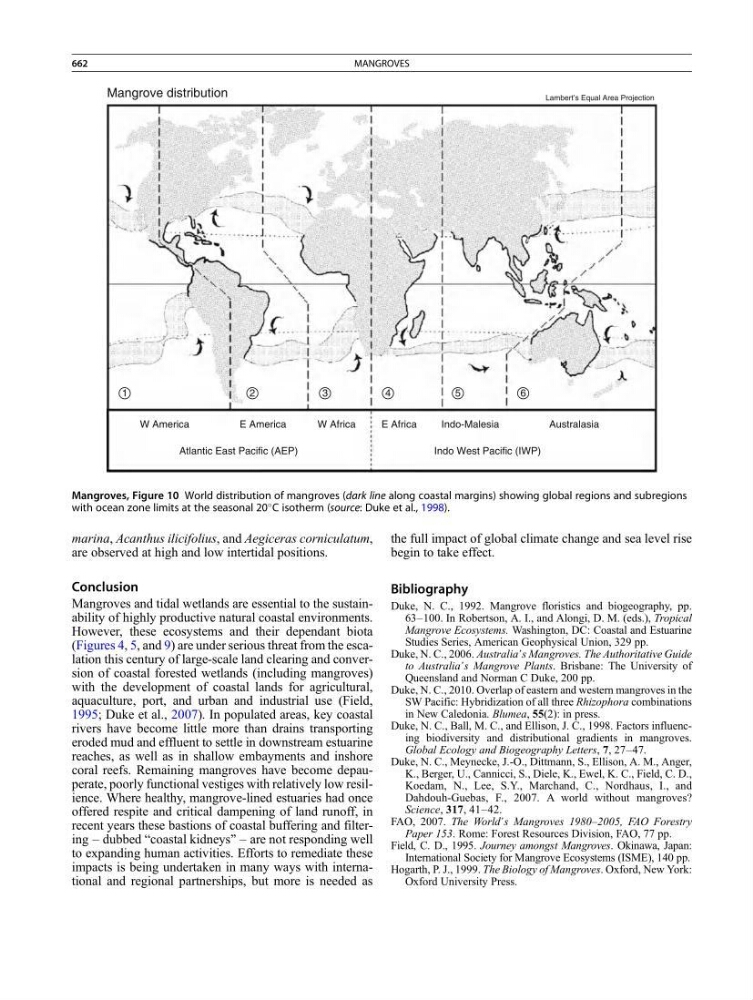
Mangroves, Figure 10 World distribution of mangroves (dark line along coastal margins) showing global regions and subregions
with ocean zone limits at the seasonal 20
C isotherm (source: Duke et al., 1998).
662
MANGROVES