

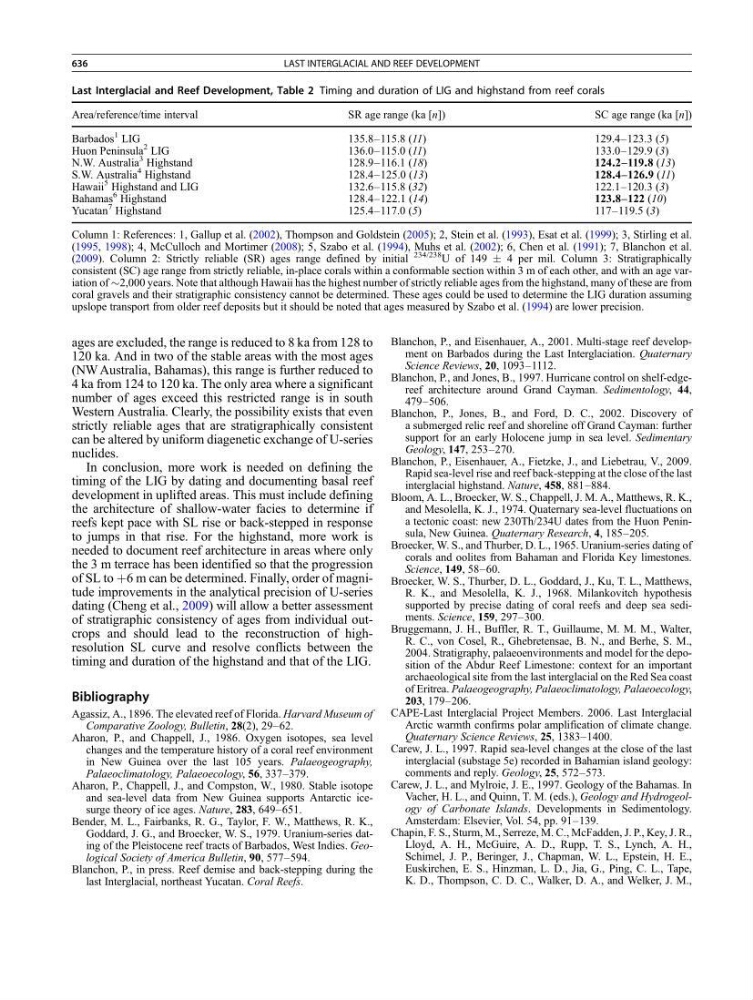
ages are excluded, the range is reduced to 8 ka from 128 to
120 ka. And in two of the stable areas with the most ages
(NW Australia, Bahamas), this range is further reduced to
4 ka from 124 to 120 ka. The only area where a significant
number of ages exceed this restricted range is in south
Western Australia. Clearly, the possibility exists that even
strictly reliable ages that are stratigraphically consistent
can be altered by uniform diagenetic exchange of U-series
nuclides.
In conclusion, more work is needed on defining the
timing of the LIG by dating and documenting basal reef
development in uplifted areas. This must include defining
the architecture of shallow-water facies to determine if
reefs kept pace with SL rise or back-stepped in response
to jumps in that rise. For the highstand, more work is
needed to document reef architecture in areas where only
the 3 m terrace has been identified so that the progression
of SL to þ6 m can be determined. Finally, order of magnitude improvements in the analytical precision of U-series
dating (Cheng et al., 2009) will allow a better assessment
of stratigraphic consistency of ages from individual outcrops and should lead to the reconstruction of highresolution SL curve and resolve conflicts between the
timing and duration of the highstand and that of the LIG.
Bibliography
Agassiz, A., 1896. The elevated reef of Florida. Harvard Museum of
Comparative Zoology, Bulletin, 28(2), 29–62.
Aharon, P., and Chappell, J., 1986. Oxygen isotopes, sea level
changes and the temperature history of a coral reef environment
in New Guinea over the last 105 years. Palaeogeography,
Palaeoclimatology, Palaeoecology, 56, 337–379.
Aharon, P., Chappell, J., and Compston, W., 1980. Stable isotope
and sea-level data from New Guinea supports Antarctic icesurge theory of ice ages. Nature, 283, 649–651.
Bender, M. L., Fairbanks, R. G., Taylor, F. W., Matthews, R. K.,
Goddard, J. G., and Broecker, W. S., 1979. Uranium-series dating of the Pleistocene reef tracts of Barbados, West Indies. Geological Society of America Bulletin, 90, 577–594.
Blanchon, P., in press. Reef demise and back-stepping during the
last Interglacial, northeast Yucatan. Coral Reefs.
Blanchon, P., and Eisenhauer, A., 2001. Multi-stage reef development on Barbados during the Last Interglaciation. Quaternary
Science Reviews, 20, 1093–1112.
Blanchon, P., and Jones, B., 1997. Hurricane control on shelf-edgereef architecture around Grand Cayman. Sedimentology, 44,
479–506.
Blanchon, P., Jones, B., and Ford, D. C., 2002. Discovery of
a submerged relic reef and shoreline off Grand Cayman: further
support for an early Holocene jump in sea level. Sedimentary
Geology, 147, 253–270.
Blanchon, P., Eisenhauer, A., Fietzke, J., and Liebetrau, V., 2009.
Rapid sea-level rise and reef back-stepping at the close of the last
interglacial highstand. Nature, 458, 881–884.
Bloom, A. L., Broecker, W. S., Chappell, J. M. A., Matthews, R. K.,
and Mesolella, K. J., 1974. Quaternary sea-level fluctuations on
a tectonic coast: new 230Th/234U dates from the Huon Peninsula, New Guinea. Quaternary Research, 4, 185–205.
Broecker, W. S., and Thurber, D. L., 1965. Uranium-series dating of
corals and oolites from Bahaman and Florida Key limestones.
Science, 149, 58–60.
Broecker, W. S., Thurber, D. L., Goddard, J., Ku, T. L., Matthews,
R. K., and Mesolella, K. J., 1968. Milankovitch hypothesis
supported by precise dating of coral reefs and deep sea sediments. Science, 159, 297–300.
Bruggemann, J. H., Buffler, R. T., Guillaume, M. M. M., Walter,
R. C., von Cosel, R., Ghebretensae, B. N., and Berhe, S. M.,
2004. Stratigraphy, palaeoenvironments and model for the deposition of the Abdur Reef Limestone: context for an important
archaeological site from the last interglacial on the Red Sea coast
of Eritrea. Palaeogeography, Palaeoclimatology, Palaeoecology,
203, 179–206.
CAPE-Last Interglacial Project Members. 2006. Last Interglacial
Arctic warmth confirms polar amplification of climate change.
Quaternary Science Reviews, 25, 1383–1400.
Carew, J. L., 1997. Rapid sea-level changes at the close of the last
interglacial (substage 5e) recorded in Bahamian island geology:
comments and reply. Geology, 25, 572–573.
Carew, J. L., and Mylroie, J. E., 1997. Geology of the Bahamas. In
Vacher, H. L., and Quinn, T. M. (eds.), Geology and Hydrogeology of Carbonate Islands. Developments in Sedimentology.
Amsterdam: Elsevier, Vol. 54, pp. 91–139.
Chapin, F. S., Sturm, M., Serreze, M. C., McFadden, J. P., Key, J. R.,
Lloyd, A. H., McGuire, A. D., Rupp, T. S., Lynch, A. H.,
Schimel, J. P., Beringer, J., Chapman, W. L., Epstein, H. E.,
Euskirchen, E. S., Hinzman, L. D., Jia, G., Ping, C. L., Tape,
K. D., Thompson, C. D. C., Walker, D. A., and Welker, J. M.,
Last Interglacial and Reef Development, Table 2 Timing and duration of LIG and highstand from reef corals
Area/reference/time interval
SR age range (ka [n])
SC age range (ka [n])
Barbados
1 LIG
135.8–115.8 (11)
129.4–123.3 (5)
Huon Peninsula
2 LIG
136.0–115.0 (11)
133.0–129.9 (3)
N.W. Australia
3 Highstand
128.9–116.1 (18)
124.2–119.8 (13)
S.W. Australia
4 Highstand
128.4–125.0 (13)
128.4–126.9 (11)
Hawaii
5 Highstand and LIG
132.6–115.8 (32)
122.1–120.3 (3)
Bahamas
6 Highstand
128.4–122.1 (14)
123.8–122 (10)
Yucatan
7 Highstand
125.4–117.0 (5)
1 1 7 –119.5 (3)
Column 1: References: 1, Gallup et al. (2002), Thompson and Goldstein (2005); 2, Stein et al. (1993), Esat et al. (1999); 3, Stirling et al.
(1995, 1998); 4, McCulloch and Mortimer (2008); 5, Szabo et al. (1994), Muhs et al. (2002); 6, Chen et al. (1991); 7, Blanchon et al.
(2009). Column 2: Strictly reliable (SR) ages range defined by initial
234/238 U of 149 Æ 4 per mil. Column 3: Stratigraphically
consistent (SC) age range from strictly reliable, in-place corals within a conformable section within 3 m of each other, and with an age variation of $2,000 years. Note that although Hawaii has the highest number of strictly reliable ages from the highstand, many of these are from
coral gravels and their stratigraphic consistency cannot be determined. These ages could be used to determine the LIG duration assuming
upslope transport from older reef deposits but it should be noted that ages measured by Szabo et al. (1994) are lower precision.
636
LAST INTERGLACIAL AND REEF DEVELOPMENT