

topographic relief (Figure 1). From this area, for example,
Blanchon and Eisenhauer (2001) reported a 17 m thick
reef-crest section composed of in-place A. palmata colonies and their boulder-sized fragments, topped by a 3 m
back-reef unit dominated by diverse branching corals
(Figure 1). They interpreted this section to represent a
keep-up reef which initially aggraded vertically in
response to a SL rise of between 14 and 20 m, and later
underwent progradation to produce a cap of back-reef
facies. As a consequence, Mesolella’s keep-up and prograde model may better represent terrace architecture along
the southeast coast, whereas Speed and Cheng’s retrogressive keep-up model better represents west-coast terraces.
However, exclusive application of either model to Barbadian reef terraces clearly underestimates the role of waveenergy in shaping reef architecture (Yamano et al., 2003).
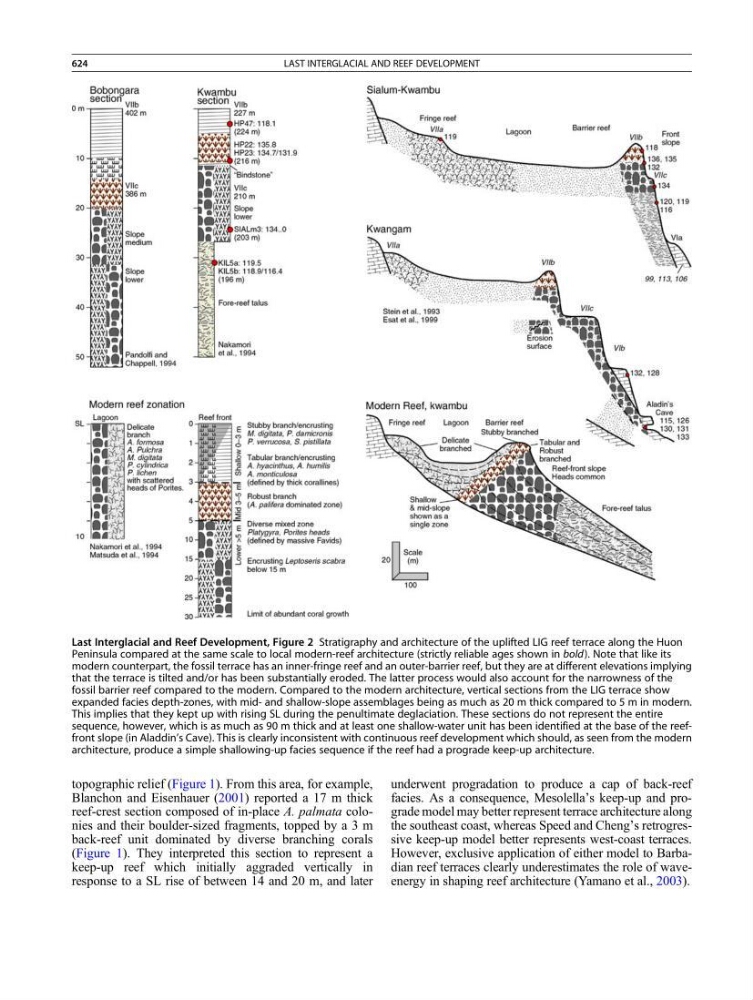
Last Interglacial and Reef Development, Figure 2 Stratigraphy and architecture of the uplifted LIG reef terrace along the Huon
Peninsula compared at the same scale to local modern-reef architecture (strictly reliable ages shown in bold). Note that like its
modern counterpart, the fossil terrace has an inner-fringe reef and an outer-barrier reef, but they are at different elevations implying
that the terrace is tilted and/or has been substantially eroded. The latter process would also account for the narrowness of the
fossil barrier reef compared to the modern. Compared to the modern architecture, vertical sections from the LIG terrace show
expanded facies depth-zones, with mid- and shallow-slope assemblages being as much as 20 m thick compared to 5 m in modern.
This implies that they kept up with rising SL during the penultimate deglaciation. These sections do not represent the entire
sequence, however, which is as much as 90 m thick and at least one shallow-water unit has been identified at the base of the reeffront slope (in Aladdin’s Cave). This is clearly inconsistent with continuous reef development which should, as seen from the modern
architecture, produce a simple shallowing-up facies sequence if the reef had a prograde keep-up architecture.
624
LAST INTERGLACIAL AND REEF DEVELOPMENT