

inter-grown with the fragile-branching A. cervicornis in
these thickets, and that neither are coated with shallow
encrusters, indicates that the peripheral ridge was
a submerged shelf-edge feature, not a reef-crest. This is
also supported by the fact that ridge development is
restricted to exposed east-facing sections of the subterrace where higher wave-energy would have encouraged
deeper A. palmata development seaward of the crest. Similar ridges, known as sill- or shelf-edge reefs, are common
in the Caribbean and have been reported rimming the
north coast of Jamaica, the western shelf of Barbados,
the Belize Barrier Reef, and the island of Grand Caymen
(Goreau and Goreau, 1973; Rützler and Macintyre,
1982; Macintyre et al., 1991; Blanchon and Jones, 1997).
Apart from resolving morphological complications,
Mesolella’s keep-up and prograde model has also been
reevaluated by Speed and Cheng (2004), who reported
an unusually deep road-cut on the west coast that exposed
the terrace base (Figure 2). That section showed a thin
basal unit of A. palmata clasts, in-place head corals, and
A. cervicornis, rising 20 m laterally upslope beneath
a thick reef-front unit of A. cervicornis. The basal unit
was interpreted by Speed and Cheng (2004) to be a lowenergy fringe reef which kept up with SL rise and produced a retrogressive and diachronous layer that was progressively buried by an A. cervicornis facies forming
seaward in deeper water. This section therefore provided
an answer to Mesolella’s dilemma, and proved that reefs
did not progress from deep-water pioneer into a shallow
climax communities as they caught up with SL, but initiated as fully zoned reefs that responded directly to SL rise,
producing a clear keep-up response.
The new retrogressive keep-up model of west-coast terraces was inferred by Speed and Cheng (2004) to exist
widely in other Barbadian terraces. But it is unclear how
applicable their model is to terraces on the southeast coast,
which developed under higher-energy wave-fields and
developed more extensive reef-crests with significant
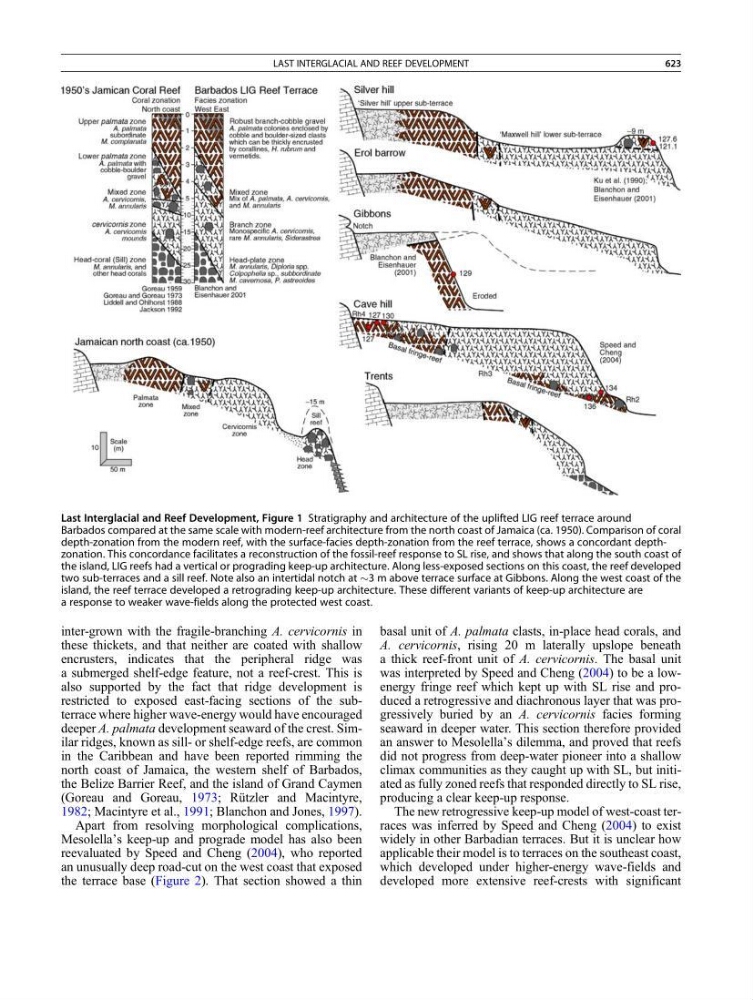
Last Interglacial and Reef Development, Figure 1 Stratigraphy and architecture of the uplifted LIG reef terrace around
Barbados compared at the same scale with modern-reef architecture from the north coast of Jamaica (ca. 1950). Comparison of coral
depth-zonation from the modern reef, with the surface-facies depth-zonation from the reef terrace, shows a concordant depthzonation. This concordance facilitates a reconstruction of the fossil-reef response to SL rise, and shows that along the south coast of
the island, LIG reefs had a vertical or prograding keep-up architecture. Along less-exposed sections on this coast, the reef developed
two sub-terraces and a sill reef. Note also an intertidal notch at $3 m above terrace surface at Gibbons. Along the west coast of the
island, the reef terrace developed a retrograding keep-up architecture. These different variants of keep-up architecture are
a response to weaker wave-fields along the protected west coast.
LAST INTERGLACIAL AND REEF DEVELOPMENT
623