

time of 2–5 days. Wave- and tide-driven flows through
shallow reef channels were important to ocean–lagoon
exchange, but along with wind were found to be less
important than tidal exchange as a driver of lagoon circulation. In the case of atoll-like platform reefs, such as One
Tree Reef of the Southern Great Barrier Reef, lagoon
water may be ponded behind the high rims of the platform
and may be largely isolated from oceanic energy (tides and
waves) that drives circulation in most reef lagoons
(Ludington, 1979; Frith and Mason, 1986).
Summary
Coral reef lagoons span a wide spectrum from small nearly
closed to large and open lagoons in atolls. Water circulation in these lagoons results from the strength and duration
of driving forces (e.g., wind speed and direction, waveswell height and direction, tides, major currents, and salinity and water temperature variations) and their interaction
with the morphology and geometry of the lagoon. In small
nearly closed lagoons, currents are directed nearly parallel
to the coastline because of the morphological and geometric constraints under the action of waves, tides, and winds.
As the size and openness of the lagoon increases, winds
and tides become the dominant forces of water circulation.
In large lagoons of atolls, winds and tides are the primary
forces of circulation assisted by the wave driven across the
reef flux. However, because these lagoons are much
deeper, water stratification becomes relevant and twolayer flows are common.
Bibliography
Coronado, C., Candela, J., Iglesias-Prieto, R., Sheinbaum, J.,
Lopez, M., and Ocampo-Torres, F. J., 2007. On the circulation
in the Puerto Morelos fringing reef lagoon. Coral Reefs, 26,
149–163.
Friedman, G. M., 1968. Geology and geochemistry of reefs, carbonate sediments and waters, Gulf of Aqaba, Red Sea. Journal of
Sedimentary and Petrology, 38, 895–919.
Frith, C. A., and Mason, L. B., 1986. Modeling wind driven circulation One Tree Reef, Southern Great Barrier Reef. Coral Reefs,
4, 201–211.
Gourlay, M. R., 1993. Wave set-up and wave generated current on
coral reefs. In Proceedings 11th Australian Conference on
Coastal and Ocean Engineering, National Conference Publication No. 93/4, Canberra, Australia: Institute of Engineers,
pp. 479–484.
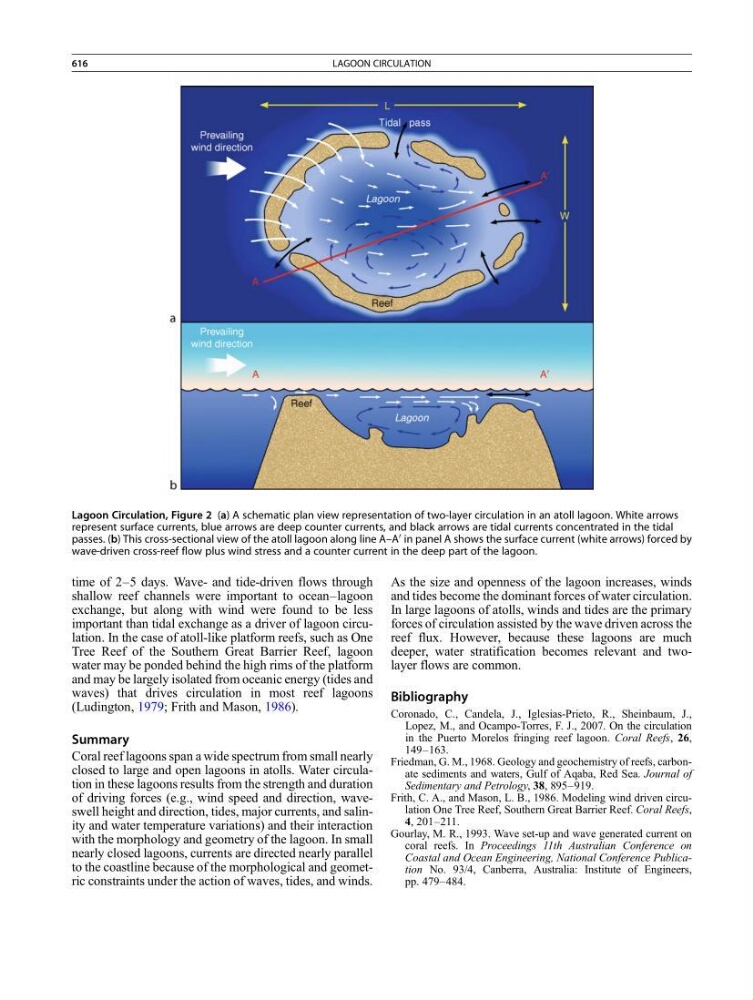
Lagoon Circulation, Figure 2 (a) A schematic plan view representation of two-layer circulation in an atoll lagoon. White arrows
represent surface currents, blue arrows are deep counter currents, and black arrows are tidal currents concentrated in the tidal
passes. (b) This cross-sectional view of the atoll lagoon along line A–A
0
in panel A shows the surface current (white arrows) forced by
wave-driven cross-reef flow plus wind stress and a counter current in the deep part of the lagoon.
616
LAGOON CIRCULATION