

INTERNAL CIRCULATION
Kevin E. Parnell
James Cook University, Townsville, QLD, Australia
Synonyms
Pore-water dynamics; Reef framework circulation
Definition
Internal circulation is the movement of water through the
reef framework caused by hydraulic gradients at a range
of time and space scales.
Introduction
The driving mechanisms, the pathways, and the speeds of
water movement through the reef framework are important for reef diagenesis, for the mass transport of solutes
(such as nutrients) between the sub-surface (pore) waters,
the benthic layer, and the surface waters (with biological
and geochemical implications), and for the understanding
of coral cay and fringing reef geohydrology (Buddemeier
and Oberdorfer, 1988). For laminar flow, Darcy’s Law
that relates water movement through a homogeneous
porous media to the hydraulic gradient and the hydraulic
conductivity (primarily a function of permeability)
applies. The assumption of laminar flow is likely to hold
for all but a few environments, such as in large cavities
in the vicinity of breaking waves. Coral reef environments, however, rarely have homogeneous framework at
all but the smallest spatial scales, with sometimes extreme
differences in both the horizontal and the vertical. Cavities
and loose sediments composed of rubble and/or coarse
sands exist alongside solid coral heads and densely packed
fine sediments, meaning that flows can be variable over
very short distances. Advective flows clearly dominate
internal circulation, but molecular diffusion, with
diffusion coefficients in the order of 10
À10
–10
À9 ms
À2
(Li and Gregory, 1974) must also be recognized.
Driving mechanisms
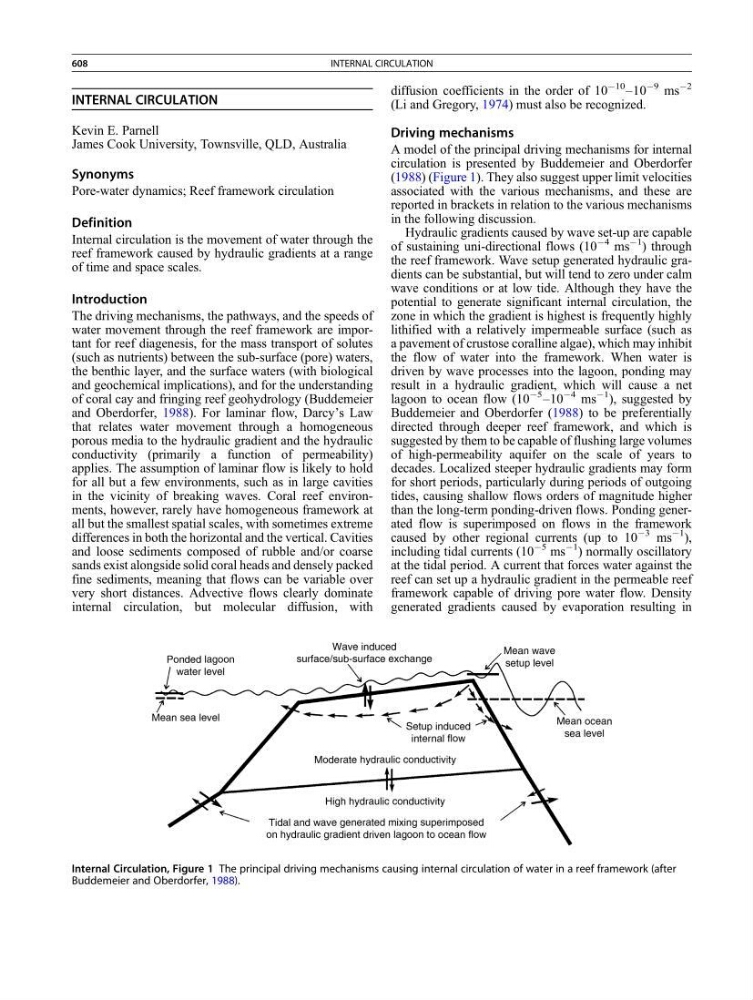
A model of the principal driving mechanisms for internal
circulation is presented by Buddemeier and Oberdorfer
(1988) (Figure 1). They also suggest upper limit velocities
associated with the various mechanisms, and these are
reported in brackets in relation to the various mechanisms
in the following discussion.
Hydraulic gradients caused by wave set-up are capable
of sustaining uni-directional flows (10
À4 ms
À1
) through
the reef framework. Wave setup generated hydraulic gradients can be substantial, but will tend to zero under calm
wave conditions or at low tide. Although they have the
potential to generate significant internal circulation, the
zone in which the gradient is highest is frequently highly
lithified with a relatively impermeable surface (such as
a pavement of crustose coralline algae), which may inhibit
the flow of water into the framework. When water is
driven by wave processes into the lagoon, ponding may
result in a hydraulic gradient, which will cause a net
lagoon to ocean flow (10
À5
–10
À4 ms
À1
), suggested by
Buddemeier and Oberdorfer (1988) to be preferentially
directed through deeper reef framework, and which is
suggested by them to be capable of flushing large volumes
of high-permeability aquifer on the scale of years to
decades. Localized steeper hydraulic gradients may form
for short periods, particularly during periods of outgoing
tides, causing shallow flows orders of magnitude higher
than the long-term ponding-driven flows. Ponding generated flow is superimposed on flows in the framework
caused by other regional currents (up to 10
À3 ms
À1
),
including tidal currents (10
À5 ms
À1
) normally oscillatory
at the tidal period. A current that forces water against the
reef can set up a hydraulic gradient in the permeable reef
framework capable of driving pore water flow. Density
generated gradients caused by evaporation resulting in
Internal Circulation, Figure 1 The principal driving mechanisms causing internal circulation of water in a reef framework (after
Buddemeier and Oberdorfer, 1988).
608
INTERNAL CIRCULATION