

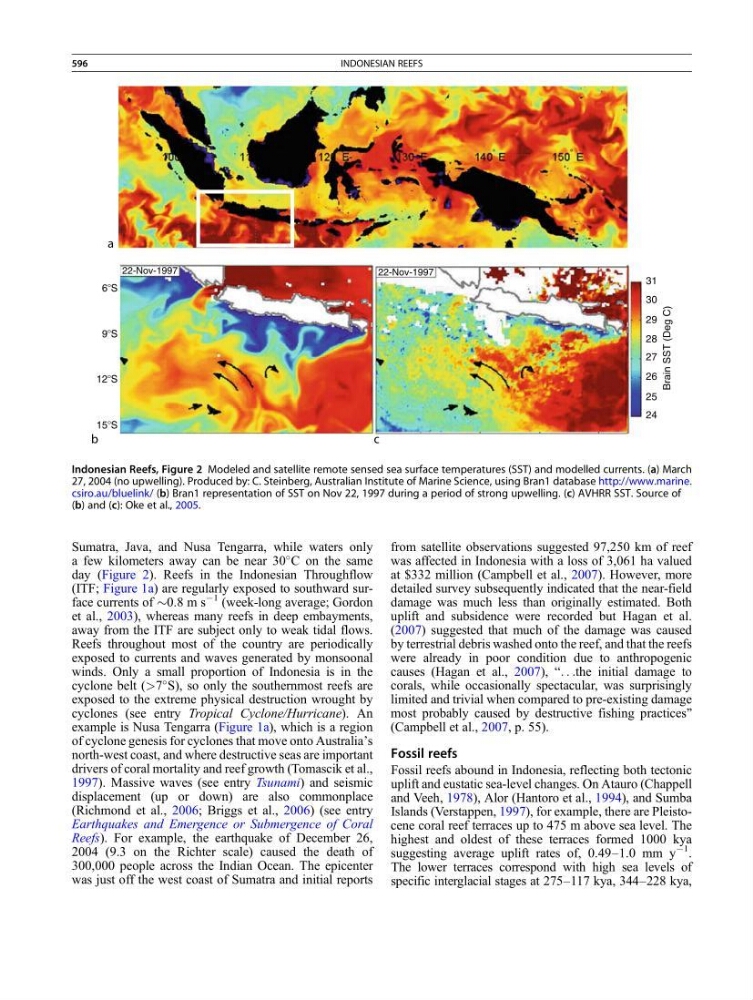
Sumatra, Java, and Nusa Tengarra, while waters only
a few kilometers away can be near 30
C on the same
day (Figure 2). Reefs in the Indonesian Throughflow
(ITF; Figure 1a) are regularly exposed to southward surface currents of $0.8 m s
À1 (week-long average; Gordon
et al., 2003), whereas many reefs in deep embayments,
away from the ITF are subject only to weak tidal flows.
Reefs throughout most of the country are periodically
exposed to currents and waves generated by monsoonal
winds. Only a small proportion of Indonesia is in the
cyclone belt (>7
S), so only the southernmost reefs are
exposed to the extreme physical destruction wrought by
cyclones (see entry Tropical Cyclone/Hurricane). An
example is Nusa Tengarra (Figure 1a), which is a region
of cyclone genesis for cyclones that move onto Australia’s
north-west coast, and where destructive seas are important
drivers of coral mortality and reef growth (Tomascik et al.,
1997). Massive waves (see entry Tsunami) and seismic
displacement (up or down) are also commonplace
(Richmond et al., 2006; Briggs et al., 2006) (see entry
Earthquakes and Emergence or Submergence of Coral
Reefs). For example, the earthquake of December 26,
2004 (9.3 on the Richter scale) caused the death of
300,000 people across the Indian Ocean. The epicenter
was just off the west coast of Sumatra and initial reports
from satellite observations suggested 97,250 km of reef
was affected in Indonesia with a loss of 3,061 ha valued
at $332 million (Campbell et al., 2007). However, more
detailed survey subsequently indicated that the near-field
damage was much less than originally estimated. Both
uplift and subsidence were recorded but Hagan et al.
(2007) suggested that much of the damage was caused
by terrestrial debris washed onto the reef, and that the reefs
were already in poor condition due to anthropogenic
causes (Hagan et al., 2007), “. . .the initial damage to
corals, while occasionally spectacular, was surprisingly
limited and trivial when compared to pre-existing damage
most probably caused by destructive fishing practices”
(Campbell et al., 2007, p. 55).
Fossil reefs
Fossil reefs abound in Indonesia, reflecting both tectonic
uplift and eustatic sea-level changes. On Atauro (Chappell
and Veeh, 1978), Alor (Hantoro et al., 1994), and Sumba
Islands (Verstappen, 1997), for example, there are Pleistocene coral reef terraces up to 475 m above sea level. The
highest and oldest of these terraces formed 1000 kya
suggesting average uplift rates of, 0.49–1.0 mm y
À1
.
The lower terraces correspond with high sea levels of
specific interglacial stages at 275–117 kya, 344–228 kya,
6ЊS
9ЊS
12ЊS
15ЊS
22-Nov-1997
22-Nov-1997
31
30
29
28
27
26
25
24
Brain SST (Deg C)
a
b
c
Indonesian Reefs, Figure 2 Modeled and satellite remote sensed sea surface temperatures (SST) and modelled currents. (a) March
27, 2004 (no upwelling). Produced by: C. Steinberg, Australian Institute of Marine Science, using Bran1 database http://www.marine.
csiro.au/bluelink/ (b) Bran1 representation of SST on Nov 22, 1997 during a period of strong upwelling. (c) AVHRR SST. Source of
(b) and (c): Oke et al., 2005.
596
INDONESIAN REEFS