

distribution ranges. Some larval dispersing crustacea
(Barber et al., 2000) and coral species (Hoeksema, 2007)
that are abundant in Wallacea do not occur on Sunda Shelf
reefs in the west, suggesting there have been limits to their
dispersal and/or population establishment in the transgression following the LGM (17–18 kya). However, while
there are some coral species that do have distributions that
overlap only with the Indian Ocean or only with the Pacific
Ocean (Wallace and Wolstenholme, 1998), there are many
other coral species that do occur across the archipelago
(Edinger et al., 2000; Wallace and Wolstenholme, 1998).
Whereas the origins of this diversity is explained in
large part in terms of sea-level and oceanographic changes
and isolation leading to speciation in geological and evolutionary time (Barber et al., 2000; see entry East Indies
Triangle of Biodiversity), a great deal of the diversity
and productivity of marine life in Indonesia today
(Tomascik et al., 1997; Hoeksema, 2007) is maintained
by the immense extent and variety of its coral reefs.
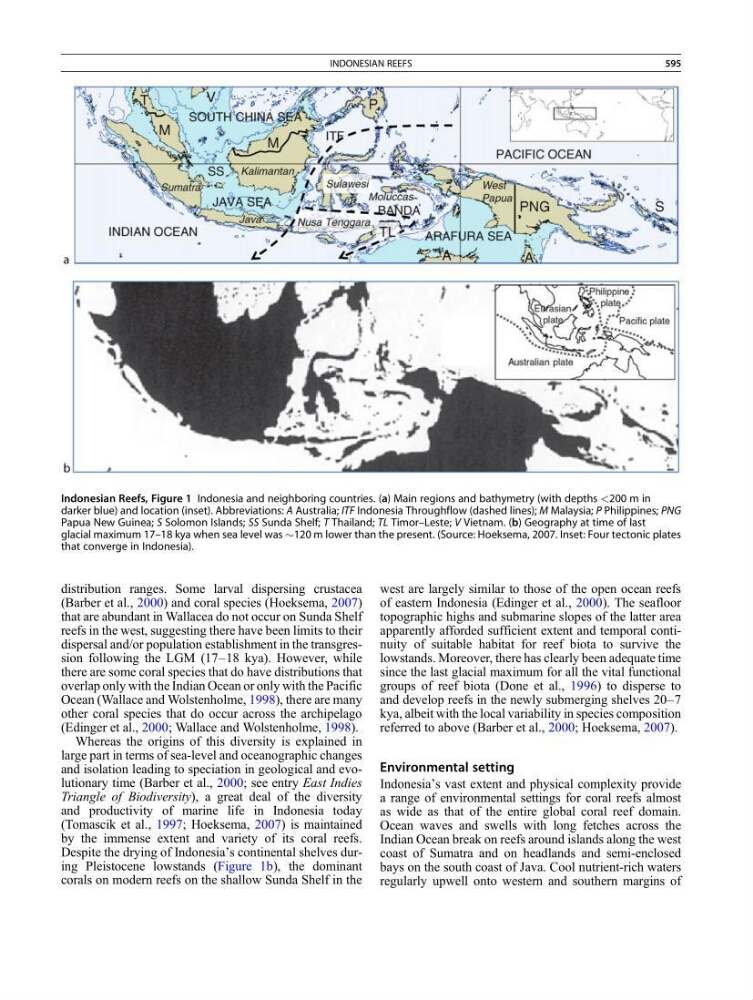
Despite the drying of Indonesia’s continental shelves during Pleistocene lowstands (Figure 1b), the dominant
corals on modern reefs on the shallow Sunda Shelf in the
west are largely similar to those of the open ocean reefs
of eastern Indonesia (Edinger et al., 2000). The seafloor
topographic highs and submarine slopes of the latter area
apparently afforded sufficient extent and temporal continuity of suitable habitat for reef biota to survive the
lowstands. Moreover, there has clearly been adequate time
since the last glacial maximum for all the vital functional
groups of reef biota (Done et al., 1996) to disperse to
and develop reefs in the newly submerging shelves 20–7
kya, albeit with the local variability in species composition
referred to above (Barber et al., 2000; Hoeksema, 2007).
Environmental setting
Indonesia’s vast extent and physical complexity provide
a range of environmental settings for coral reefs almost
as wide as that of the entire global coral reef domain.
Ocean waves and swells with long fetches across the
Indian Ocean break on reefs around islands along the west
coast of Sumatra and on headlands and semi-enclosed
bays on the south coast of Java. Cool nutrient-rich waters
regularly upwell onto western and southern margins of
Indonesian Reefs, Figure 1 Indonesia and neighboring countries. (a) Main regions and bathymetry (with depths <200 m in
darker blue) and location (inset). Abbreviations: A Australia; ITF Indonesia Throughflow (dashed lines); M Malaysia; P Philippines; PNG
Papua New Guinea; S Solomon Islands; SS Sunda Shelf; T Thailand; TL Timor–Leste; V Vietnam. (b) Geography at time of last
glacial maximum 17–18 kya when sea level was $120 m lower than the present. (Source: Hoeksema, 2007. Inset: Four tectonic plates
that converge in Indonesia).
INDONESIAN REEFS
595