

Trace elements in coral skeletons can be measured by
drilling out samples of coral skeleton, followed by wet
chemical analysis using atomic absorption spectrometry
(AAS; Khaled et al., 2003), inductively coupled plasma
mass spectrometry (ICP-MS; e.g., Fleitmann et al.,
2007), or inductively coupled plasma atomic emission
spectrometry (ICP-AES; Bastidas and Garcia, 1997;
David, 2003). Of these, the standard method
recommended by USGS is ICP-AES (see Bastidas and
Garcia, 1997; David, 2003). Recent developments in
laser-ablation mass spectrometry (LAM-ICPMS) and secondary ion mass spectrometry (SIMS) allow highresolution sampling of trace elements in coral skeletons
without wet chemistry (Sinclair et al., 1998; Fallon et al.,
2002, 2003; Rollion-Bard et al., 2003), but function most
effectively on elements incorporated directly into the coral
skeleton, and may require custom modifications to offthe-shelf analytical systems (Fallon et al., 2003). Incorporation of metals and metalloids into coral skeletons varies
as a result of atomic radius – cations with radius similar to
that of calcium, such as Ba, Cu, Fe, Pb, Sn, and Zn are
most readily incorporated from a dissolved state into the
lattice (see Howard and Brown, 1984, for review). Of
these, Ba is the best indicator of sedimentation from fluvial sources, and can record spatial and temporal variation
in fluvial input far from river mouths, with concentration
increasing with proximity to source (Fallon et al., 2003;
McCulloch et al., 2003b). Ba/Ca ratios in coral skeletons
have documented increased sediment flux to coastal coral
reefs through soil erosion associated with agricultural
expansion and deforestation (e.g., Anderegg et al., 1997;
McCulloch et al., 2003a; Fleitmann et al., 2007). In areas
with basaltic soils, soil erosion and sedimentation also
results in increased phosphorus delivery to reefs
(McCulloch et al., 2003b). Combined with increased
anthropogenic nitrogen fixation and delivery to coastal
watersheds (Vitousek et al., 1997), this sedimentation is
often accompanied by eutrophication.
Chemical analysis of coral skeletons accurately records
sedimentation from point or non-point sources containing
these metals, such as urban runoff (e.g., Bastidas and
Garcia, 1997; Runnalls and Coleman, 2003), offshore oil
exploration and production near cold-water coral reefs
(e.g., Gass and Roberts, 2006; Lepland and Mortensen,
2008), or some mine tailings, particularly from tin, copper,
lead–zinc, and iron mines (e.g., Changsang, 1988; David,
2003), or some gold and silver mines containing aragonite-compatible trace elements.
Other elements, such as Co, Cr, Ni, As, Sb, and Hg are
not readily incorporated into the aragonite crystal lattice,
and are present in coral skeletons at much lower concentrations, mostly as included sediment particles. These elements, which are often associated with nickel mines or
sediment-hosted gold mines, exhibit high spatial variation
within coral skeletons, and generally low concentrations in
coral skeletons compared to their concentrations in reef sediment (Edinger et al., 2008). Although these elements can be
directly measured in coral skeletons using LAM-ICPMS,
spatial variation in concentration including sediment particles within the skeleton requires extensive sampling to integrate over a large area of coral skeleton (e.g., 50 Â 500 µm
mask, Fallon et al., 2002), or drilling of subsamples
followed by wet-chemical analysis using ICP-AES.
Corals may then be used to monitor sediment influx,
river discharge, industrial activity, and several other types
of input. Care needs to be taken in chemical analyses of
coral skeletons, because exogenous compounds may
either be trapped/bound directly into the skeletal structure,
or be part of individual sediment grains trapped within
skeletal cavities. Notwithstanding this reservation, the
information gathered by such geochemical techniques
can be extremely useful. In some cases, the temporal resolution of individual events may be excellent. Heikoop
et al. (1996) describe the effects of a short-lived eruption
of the volcano Gunung Api (“Fire Mountain”) in May
1988, in the Banda Islands, Eastern Indonesia. The ash fall
from the eruption was several centimeters in thickness on
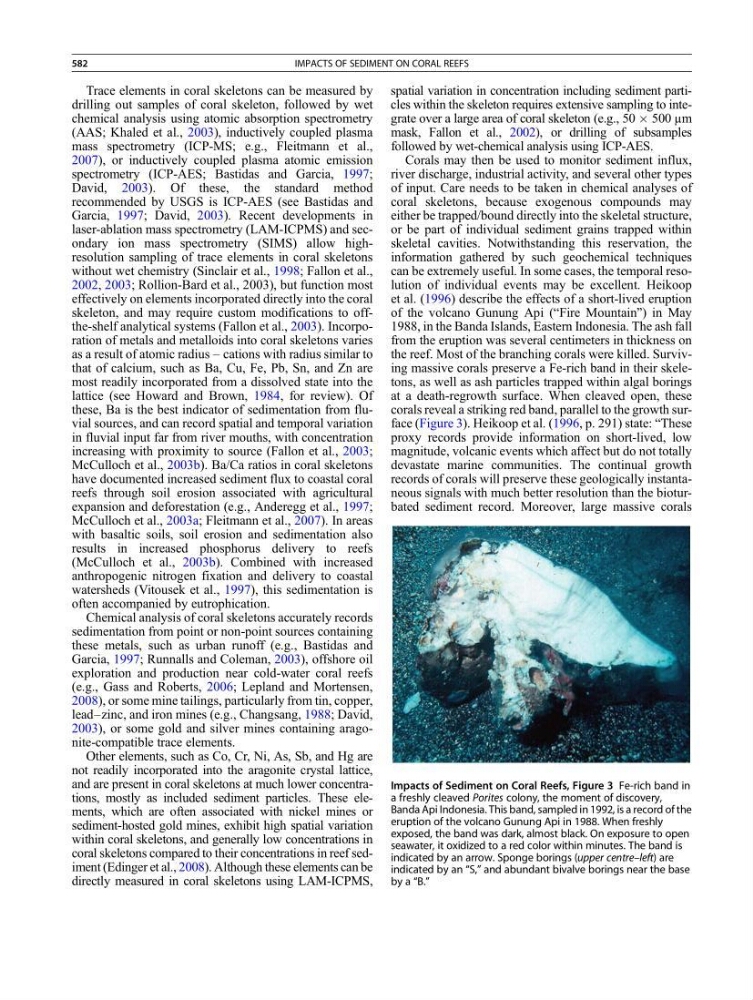
the reef. Most of the branching corals were killed. Surviving massive corals preserve a Fe-rich band in their skeletons, as well as ash particles trapped within algal borings
at a death-regrowth surface. When cleaved open, these
corals reveal a striking red band, parallel to the growth surface (Figure 3). Heikoop et al. (1996, p. 291) state: “These
proxy records provide information on short-lived, low
magnitude, volcanic events which affect but do not totally
devastate marine communities. The continual growth
records of corals will preserve these geologically instantaneous signals with much better resolution than the bioturbated sediment record. Moreover, large massive corals
Impacts of Sediment on Coral Reefs, Figure 3 Fe-rich band in
a freshly cleaved Porites colony, the moment of discovery,
Banda Api Indonesia. This band, sampled in 1992, is a record of the
eruption of the volcano Gunung Api in 1988. When freshly
exposed, the band was dark, almost black. On exposure to open
seawater, it oxidized to a red color within minutes. The band is
indicated by an arrow. Sponge borings (upper centre–left) are
indicated by an “S,” and abundant bivalve borings near the base
by a “B.”
582
IMPACTS OF SEDIMENT ON CORAL REEFS