

elevation. This is based on the water level inside the coral
system remaining very close to that in the outside ocean
and requires that the size of the system be much less than
the distance traveled by a gravity wave in one tidal cycle
(this is satisfied by most systems of size a few tens of
kilometers).
In addition to these “out of phase” tidal currents, time
series of water elevation and currents in a reef system,
show currents that are “in phase” with the elevation
(Kraines et al., 1998). If these are comparable in magnitude to the measured wave driven currents over the reef,
it is likely that they are due to the modulation of those currents caused by the changing water level. If the periodic
in-phase currents are positively directed over the reef on
the rising tide, this means that increasing the water level
increases the wave driven current. That may be due to
the dilution of the effects of friction with increased height
of the water column. Conversely, a decrease in current
might be due to reduced wave breaking. This was studied
in detail by Hearn (1999) and modeled by Hearn and
Atkinson (2000) and is confirmed by measurements at
Ningaloo Reef by Hearn and Parker (1988) (“entry Sea
level changes and effects on reef growth”).
Turbulent energy
Friction in reef systems produces turbulent kinetic energy in
the water column. The rate of production depends on both
friction and current. The simplest physical picture of the turbulence is a set of vortices, or eddies, with continuous
variation of size. It is believed that after kinetic energy
enters the turbulence spectrum it cascades down through
the vortices, with decreasing spatial scales, until it is dissipated at small scales by molecular viscosity (as heat). Production rates of turbulent energy vary spatially across the
reef and are controlled by current strength and roughness
(which includes the wave-current interaction). Some part
of that energy production is transported to other parts of
the reef, where it may dissipate, or leave the reef system,
and the remainder is dissipated locally. This balance of turbulence generation by friction, transport of turbulence (by
advection and diffusion) and its dissipation, is important
to organisms for which biogeochemical and other processes
are controlled by some aspect of turbulence. Many organisms, such as coral, have a major role in the development
of the roughness elements which promote friction.
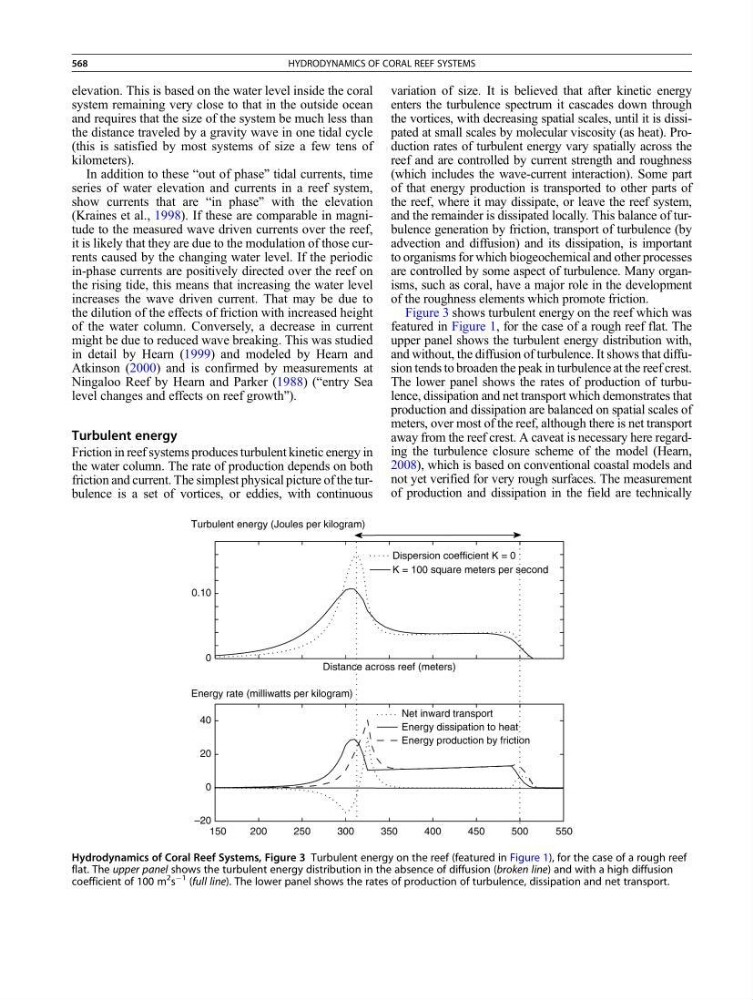
Figure 3 shows turbulent energy on the reef which was
featured in Figure 1, for the case of a rough reef flat. The
upper panel shows the turbulent energy distribution with,
and without, the diffusion of turbulence. It shows that diffusion tends to broaden the peak in turbulence at the reef crest.
The lower panel shows the rates of production of turbulence, dissipation and net transport which demonstrates that
production and dissipation are balanced on spatial scales of
meters, over most of the reef, although there is net transport
away from the reef crest. A caveat is necessary here regarding the turbulence closure scheme of the model (Hearn,
2008), which is based on conventional coastal models and
not yet verified for very rough surfaces. The measurement
of production and dissipation in the field are technically
Hydrodynamics of Coral Reef Systems, Figure 3 Turbulent energy on the reef (featured in Figure 1), for the case of a rough reef
flat. The upper panel shows the turbulent energy distribution in the absence of diffusion (broken line) and with a high diffusion
coefficient of 100 m
2 s
À1 (full line). The lower panel shows the rates of production of turbulence, dissipation and net transport.
568
HYDRODYNAMICS OF CORAL REEF SYSTEMS