

on the fore-reef which is mainly between radiation stress
and pressure gradient. The radiation stress is
a representation of the force from breaking waves and
the pressure gradient is due to a build up of water in the
direction of those breaking waves called the “wave set
up” (“entry Wave set up”). This results in the water level
at the reef crest being higher than the outside ocean by
as much as tens of centimeters. A similar effect can be seen
on a seawall as waves break against it. This wave set up
then causes water to flow across the reef flat, i.e., there is
a pressure gradient across the reef flat which is balanced
by the friction created by the current. Although smaller
waves propagate across the reef flat, wave breaking there
is very limited.
The zone of breaking waves is called the “surf zone”
and is the most easily recognized region of a coral reef
with its line of white breakers. The width of the surf zone
is controlled by the height of incoming waves (usually
swell) and the slope of the fore reef. The width varies
greatly amongst the coral reefs of the world. Fore reefs
with steep slope have narrow surf zones while gently sloping fore reefs have much wider surf zones. The current that
is forced across the reef flat by the breaking waves originates in the region beyond the surf zone. It must then pass
through the surf zone, onto the reef flat, and out to the
lagoon where it returns back to the surrounding ocean.
This essentially creates a large circulation cell, or a series
of cells, the sizes of which are mainly controlled by the
morphology of the lagoon. Circulation in the cells
becomes very dispersive in the deeper ocean outside of
the reef system. Water may also form closed gyres, or
eddies, on the reef itself because the wave set up can vary
laterally along the line of the reef crest. Water also flows
laterally along the fore reef. The extent of this lateral flow
is controlled by the lateral bathymetry and friction (which
may be highly anisotropic).
The dynamical force which moves water onto the fore
reef is a pressure gradient and this requires a “wave set
down” to be there, just in front of the surf zone which
causes water to flow inward towards the surf zone where
it must then ascend to the raised water level above the reef
crest (Figure 1). It does this by using its own momentum
or inertia. The region in front of the surf zone is therefore
called the “acceleration zone.” Friction opposes this acceleration and so tends to increase the wave set down. This is
illustrated in Figure 1. A major difference between the
wave set up, produced by wave breaking, and the wave
set down, due to friction, is that the latter increases with
current. The wave set down therefore acts as a form of
resistance which lowers the net water elevation at the crest
when the current over the reef flat would otherwise
become too high.
The model used in Figure 1 assumes that the lagoon is
sufficiently deep to produce negligible surface elevation
immediately behind the reef flat. In practice, most reefs
have a “back reef” which is also shallow so that narrow
lagoons behind fringing reefs such as Ningaloo (Hearn
and Parker, 1988) may experience significant wave set
up against the coast behind the lagoon.
Smooth reef flat
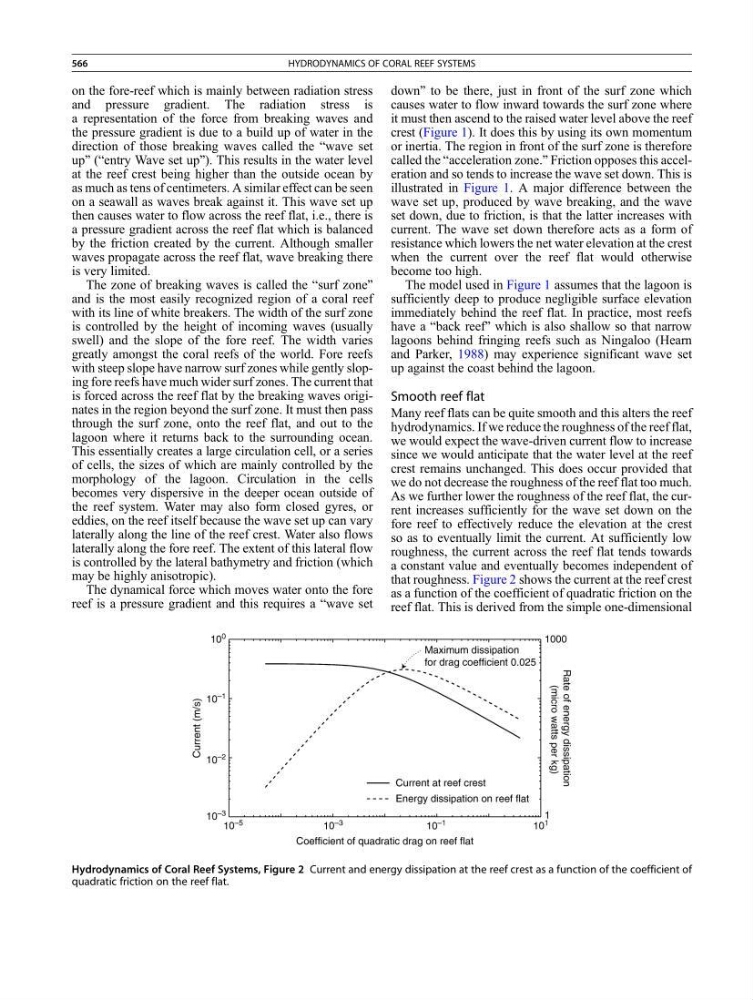
Many reef flats can be quite smooth and this alters the reef
hydrodynamics. If we reduce the roughness of the reef flat,
we would expect the wave-driven current flow to increase
since we would anticipate that the water level at the reef
crest remains unchanged. This does occur provided that
we do not decrease the roughness of the reef flat too much.
As we further lower the roughness of the reef flat, the current increases sufficiently for the wave set down on the
fore reef to effectively reduce the elevation at the crest
so as to eventually limit the current. At sufficiently low
roughness, the current across the reef flat tends towards
a constant value and eventually becomes independent of
that roughness. Figure 2 shows the current at the reef crest
as a function of the coefficient of quadratic friction on the
reef flat. This is derived from the simple one-dimensional
Hydrodynamics of Coral Reef Systems, Figure 2 Current and energy dissipation at the reef crest as a function of the coefficient of
quadratic friction on the reef flat.
566
HYDRODYNAMICS OF CORAL REEF SYSTEMS