

the Reynolds stress. A review of some of this work, is
given by Monismith (2007). These methods give values
of quadratic friction coefficient of the order 0.01–0.1 compared with a typical value of 0.0025 for the skin friction
from sand particles in coastal waters.
The use of a drag coefficient is rather limited for several
reasons. Firstly, it follows from the theory of the logarithmic layer, that the coefficient will always increase as water
depth decreases and so a comparison between values in
the scientific literature necessarily requires a knowledge
of that depth. Secondly, as discussed later in this article,
the presence of waves causes the quadratic dependence
of frictional stress to fail at low currents. Finally, the height
of the “roughness elements” on reefs is necessarily an
appreciable fraction of the height of the water column so
that the simple models that lead to quadratic friction in
coastal models are not completely applicable.
The part of the bottom of the water column around the
roughness elements is called the “roughness layer” and
fluid flow in this region is complex and dominated by inertia forces. We are only now starting to understand how to
model water flow within the roughness layer and there are
some similarities here with flow through canopies formed
by submerged aquatic vegetation (Cornelisen and
Thomas, 2009). Experiments have been performed within
flumes although the experimental reef structures built in
the laboratory can lack important aspects of the real structural complexity found in nature.
Solid reef models, can accommodate some part of the
processes within the roughness layer by a phenomenological modification of the Prandtl formulation of a vertical
“mixing length.” For a roughness layer that is thin
(compared to water depth), this mixing length method
reproduces the familiar logarithmic layer profile of current
against height within the water column. In such cases, measurement of this profile is a valuable method of finding the
roughness lengths (Lacy et al., 2005). The value of the
mixing length concept is that for a thick roughness layer,
it can be modified so that, within the roughness layer, it
has a polynomial dependence on height (Hearn, 2008).
Spatial variability of roughness
Rough reef flat
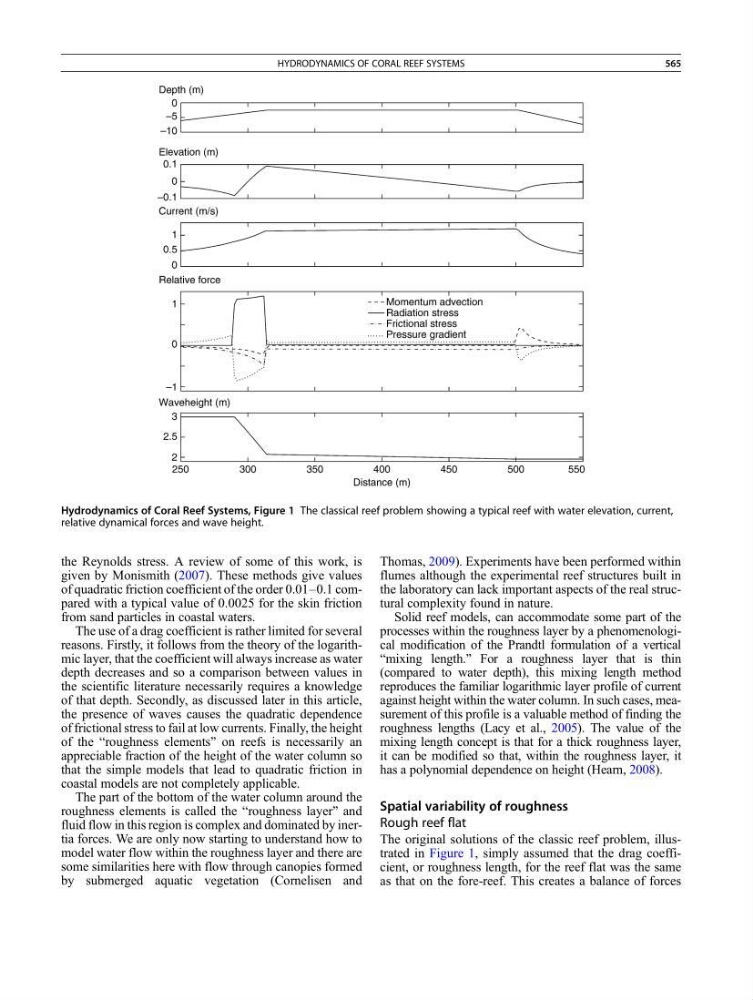
The original solutions of the classic reef problem, illustrated in Figure 1, simply assumed that the drag coefficient, or roughness length, for the reef flat was the same
as that on the fore-reef. This creates a balance of forces
Hydrodynamics of Coral Reef Systems, Figure 1 The classical reef problem showing a typical reef with water elevation, current,
relative dynamical forces and wave height.
HYDRODYNAMICS OF CORAL REEF SYSTEMS
565